Showing posts with label Greek Mythology. Show all posts
Rummanah Aasi

Description: More than three thousand years ago, two armies faced each other in an epic battle that rewrote history and came to be known as the Trojan War. The Iliad, Homer's legendary account of this nine-year ordeal, is considered the greatest war story of all time and one of the most important works of Western literature. In this stunning graphic novel adaptation -- a thoroughly researched and artfully rendered masterwork -- renowned illustrator Gareth Hinds captures all the grim glory of Homer's epic. Dynamic illustrations take readers directly to the plains of Troy, into the battle itself, and lay bare the complex emotions of the men, women, and gods whose struggles fueled the war and determined its outcome.

Review: Hinds' latest graphic novel is an ambitious and compelling adaptation of Homer's The Illiad, an epic poem that covers the tenth year of the Trojan War. Though the story of the whole Trojan War is complex and long, Hinds reminds faithful to the large plot points of the war in particular the internal conflict between two Greek leaders (Achilles and King Agamemnon) as they seek to conquer the city of Troy, the rage of Achilles, and the death of Trojan prince Hector. There is a lot to cover in this graphic novel adaptation, but Hinds does a great job in highlighting the main events without dragging down the pace of the graphic novel. I also really liked how he included the Zeus and the other gods and goddesses's involvement as fickle and meddlesome war agents, regularly resorting to acts of trickery, mischief, and deadly interference as they played with mortal lives.
  Of course the book is mainly focused on the battle scenes since it's covering a war, but it surprisingly does not rely on gore for their dramatic effect even though there is plenty of blood and violence. Instead, the artwork consisted of pencil, watercolor, and digital illustrations propel readers from scene to scene, shifting from neatly organized panels during moments of peace to angular layouts during times of physical and emotional strife.
  The graphic novel does capture the story's "war is glory" attitude and hypermasculinity but it also shows the emotions involved in the war. The themes of glory, pride, hubris, as well as the harrowing sorrow and desolation of women and children of the conquered. Even Hinds' Helen is aware of the destruction brought by her arrival (though Hinds notes that the reasons for the Trojan War is possibly many). I appreciated the purposeful color palette assigns each god his or her own vivid, monochrome hue, while a subtle red and blue color scheme helps differentiate between the Greeks and Trojans. Due to the sheer size of characters it was a bit confusing at times to identity who is who. Some panels have large text panels, but the text was necessary to understand the plot. There is extensive back matter which includes an author’s note, a map, extensive notes, and a selected bibliography for further reading. Hinds has succeeded in creating an accessible adaptation of a great epic poem for those who are encountering Homer for the first time as well as those who are already familiar with the original work. 

Rating: 4 stars

Words of Caution: There is strong violence in the graphic novel, but not gratuitously gory. Recommended for Grades 8 and up.

If you like this book try: The Age of Bronze series by Eric Shanower, The Song of Achilles by Madeline Miller (for a more personal insight to the character)
Rummanah Aasi

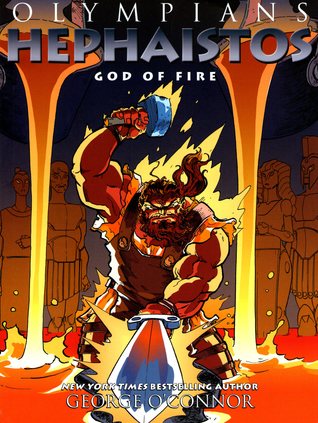
Description: Thrown from Mount Olympus as a newborn and caught by Thetis and Eurynome, who raised him on the island of Lemnos, Hephaistos had an aptitude for creating beautiful objects from a very young age. Despite his rejection from Olympus, he swallowed his anger and spent his days perfecting his craft. His exquisitely forged gifts and weapons earned him back his seat in the heavens, but he was not treated as an equal—his brothers and sisters looked down at him for his lame leg, and even his own wife, Aphrodite, was disloyal. In this installment of George O'Connor's bestselling Olympians graphic novel series, witness Hephaistos’ wrath in God of Fire as he creates a plan that’ll win him the respect he deserves.

Review: I have been a fan of the Olympians graphic novel series and have enjoyed watching the Greek gods and goddesses and their myths come alive. Unfortunately, Hephaistos is my least favorite volume so far. The dialogue which started as polished orators who recounted the rise of the Olympians and followed the stories of Prometheus soon derailed into modern colloquialism, which was really jarring and took me out of the story. While Hephaistos is the headliner of this graphic novel, the focus was much more on Prometheus' betrayal and the gift of fire to humanity. Unlike the narration, the illustrations of the panels remain consistently vibrant and full of action, humor, and subtlety especially where innuendos are involved with Aphrodite's affairs. Overall a disappointing volume in an otherwise great series.   

Rating: 3 stars

Words of Caution: There are several allusions to Aphrodite's infidelity with Ares including a scene where both gods are chained to the bed. Recommended for Grades 6 and up.

If you like this book try: Percy Jackson and the Olympians series by Rick Riordan, Heroes of Olympus series by Rick Riordan, Gods of Manhattan by Scott Mebus
Rummanah Aasi

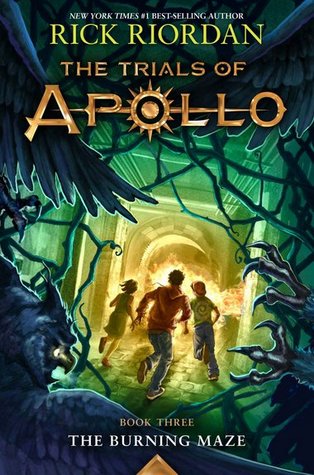
Description: With the help of some demigod friends, Lester managed to survive his first two trials, one at Camp Half-Blood, and one in Indianapolis, where Meg received the Dark Prophecy. The words she uttered while seated on the Throne of Memory revealed that an evil triumvirate of Roman emperors plans to attack Camp Jupiter. While Leo flies ahead on Festus to warn the Roman camp, Lester and Meg must go through the Labyrinth to find the third emperor—and an Oracle who speaks in word puzzles—somewhere in the American Southwest. There is one glimmer of hope in the gloom-filled prophecy: The cloven guide alone the way does know. They will have a satyr companion, and Meg knows just who to call upon.

Review: The Burning Maze is another enjoyable installment of the Trials of Apollo series.  Old favorite characters from both the Percy Jackson and the Olympian series and the Heroes of Olympians series make an appearance in the story. It is highly recommended to read those series first before reading the Trials of Apollo as they all connect. This time Apollo, Meg, and Grover find themselves in the smoldering ruins of Palm Springs. Fires and drought are putting the dryads in danger, and Apollo knows that the only way to restore the rightful order is to free the oracle hidden below ground in a dangerous labyrinth. The stakes are higher in this book and the villain is vicious, savoring any and all opportunity for cruelty. There are new developments in this new book. Apollo experiences loss and sacrifice firsthand as a mortal, the god loses some of his ego and begins to suspect his punishment is more than a consequence of Zeus’ short temper. We also learn more of Meg's secret past.
  While the tone is much darker in The Burning Maze, there is plenty of Riordan's trademark snarky banter and comedy mixed to balance the story. There is of course a cliffhanger ending which will make me eager for Apollo's next adventure.

Rating: 4 stars

Words of Caution: There is some strong violence and disturbing images in the story. Recommended for Grades 5 and up.

If you like this book try: The Tryant's Tomb by Rick Riordan (Trials of Apollo #4) coming Fall 2019, Percy Jackson and the Olympians series by Rick Riordan, Heroes of Olympus series by Rick Riordan, The Kane Chronicles by Rick Riordan, Magnus Chase and the Gods of Asgard series by Rick Riordan, and The Serpent's Secret by Sayantani DasGupta
Rummanah Aasi

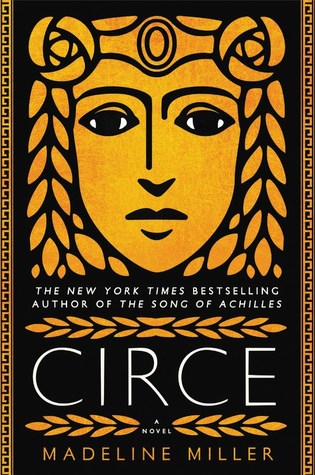
Description: In the house of Helios, god of the sun and mightiest of the Titans, a daughter is born. But Circe is a strange child—not powerful, like her father, nor viciously alluring like her mother. Turning to the world of mortals for companionship, she discovers that she does possess power—the power of witchcraft, which can transform rivals into monsters and menace the gods themselves.
Threatened, Zeus banishes her to a deserted island, where she hones her occult craft, tames wild beasts and crosses paths with many of the most famous figures in all of mythology, including the Minotaur, Daedalus and his doomed son Icarus, the murderous Medea, and, of course, wily Odysseus.
   But there is danger, too, for a woman who stands alone, and Circe unwittingly draws the wrath of both men and gods, ultimately finding herself pitted against one of the most terrifying and vengeful of the Olympians. To protect what she loves most, Circe must summon all her strength and choose, once and for all, whether she belongs with the gods she is born from, or the mortals she has come to love.

Review: I absolutely loved Miller's debut novel, The Song of Achilles, which is a retelling of Homer's Illiad. Miller had even a fresh voice and allowed me to change my perception of Achilles. Similarly in her next novel, Circe, she returns to Homer and takes a snippet of The Odyssey to give us an unique take on Circe, one of the famous witches in Greek Mythology.
  Unlike Achilles, whose fighting skills and passions are renown, there is not much known about Circe except her lineage and her witchcraft which is mentioned briefly in The Odyssey. This gives Miller a lot to play around and lends the book to be more than a retelling but also a coming of age story about a complex female figure who has to fight to make her own place. Circe is the daughter of the sun god Helios and his wife Perse. Though she doesn't have characteristics or abilities of a goddess, Circe's compassion and soft heart often make her the outcast in her family. She stumbles upon her power as a sorceress by accident when she longs to make a mortal companion immortal, but it goes horribly wrong and she is banished to the island of Aeaea. Watching Circe evolve from a quivering nymph to a formidable figure is fascinating. Her isolation at Aeaea allows her to focus on herself and build her own skills in learning about herbs and potions while surrounding herself with lions and wolves as companions. Before reading Circe, I was under the impression that Circe used her witchcraft as an evil person, but this book presents her in a different light. For Circe, witchcraft is a means for survival both for physical protection (where kindness and hospitality to lost mortal men result in rape) and an identity. In fact, Circe is not deceived by Odysseus as we are told by Homer, but she is well aware of his cunning. Circe’s fascination with mortals becomes the book’s central theme. She is well aware of how men work. She makes Hermes and Odysseus her lovers, but not expecting a fairy tale romance. The birth of her son Telegonus and the surprised ending makes me wonder how The Odyssey would be told differently if Homer was a woman. There are different mythologies also told in the book from the creation of Scylla, Daedulus and his tragic son Icarus, the creation of the maze, and the birth of the Minotaur, but the focus and spell of Circe holds the readers attention. A definite read if you are interested in reading Greek Mythology with a feminist bent to the well told epic poems.

Rating: 4 stars

Words of Caution: There is some strong language and violence. Sexual situations are alluded to in the book but not graphically depicted. There is also a rape scene that is mentioned but not graphically described. Recommended for older teens and adults with an interest in Greek Mythology.

If you like this book try: The Penelopiad by Margaret Atwood, Medea by Kerry Greenwood
Rummanah Aasi

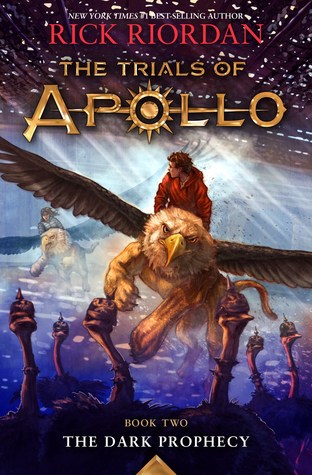
Description: After experiencing a series of dangerous—and frankly, humiliating—trials at Camp Half-Blood, Apollo must now leave the relative safety of the demigod training ground and embark on a hair-raising journey across North America. Fortunately, what he lacks in godly graces he's gaining in new friendships—with heroes who will be very familiar to fans of the Percy Jackson and the Olympians and Heroes of Olympus series.

Review: The Dark Prophecy is the second book in the Trials of Apollo series in which the Greek god Apollo has lost his powers and immortality and has been brought to Earth as an acne ridden American teenager. While the Dark Prophecy is a quick, fun read it is also a transitional book in the series. Apollo must work with other demigods, prominent in Riordan's Percy Jackson and Heroes of Olympus series, to help save Meg and other characters from a dark demise.
 I still find Apollo highly amusing from his self absorbed "woe is me" haiku poems that preface each chapter. I like that his human side is allowing him to see his own flaws and become a stronger person and character. While there are no particular myths that this series retells there are stories that are closely with Apollo that are interwoven in this series. I also appreciate Riordan's attention to diversity in his works as Apollo openly discusses his bisexuality plus meeting lesbian parents, and we meet demigods from various ethnicities and races throughout the series. It is not until the last few pages that a cryptic prophecy is revealed which clearly sets up the next book in a series. If you are interested in seeing why Riordan is super popular, I would highly recommend picking up the Percy Jackson and the Olympians series first as it sets up the foundation for his later series and gives you a sense of Riordan's trademark humor, action, and mythology retelling. I'm really looking forward to seeing where Riordan takes Apollo next.

Rating: 4 stars

Words of Caution: There are some disturbing scenes in the book and some of the stories mentioned in the book are quite violent. Recommended for Grade 6 and up.

If you like this book try: Olympians: Apollo by George O'Connor graphic novel, The Burning Maze by Rick Riordan (Trials of Apollo #3 coming in May 2018)
Rummanah Aasi
Description: Shunned even before she was born and destined to live a life of solitude, Artemis, Goddess of the Hunt, finds power through her skilled hunting ability and mighty bow. She slays those who wish to do harm to the innocent and takes care of the young and helpless. She protects women and young girls, helps in childbirth, soothes, and is unrivaled in her hunting abilities.


Review: O'Connor continues his Olympian graphic novel series with lots of action and the Greek deities are given superhero status. His latest entry focuses on Artemis, the goddess of the hunt. The narrative of this graphic novel is told through various perspectives ranging from Artemis's mother, brother, and her maidens and they all form a nuanced portrait of Artemis: formidable, quick-witted, occasionally cruel, yet always deeply devoted to the natural world and intensely protective of women and girls.At first I wasn't sure if I liked how the narration was formed but ultimately I was on board with it as it created drama and suspense in the story. Like the other graphic novels the images are eye appealing and dynamic. The images are dynamic, with the use of different perspectives creating drama and suspense. Artemis is drawn androgynously, highlighting her strength without sacrificing her feminity. The graphic novel explores popular myths such as Actaceon who was turned into a stag and eated by his own dogs as punished for leering at Artemis and her crew as they bathe in the water. There is also the inclusion of the haughty Orion who felt he could pressure Artemis to go against her vow of never being touched by a male and the trickery that befell of Atalanta (a story that never sit right with me). Blonde, blue-eyed Artemis is illustrated with cool tones, befitting her characterization.
 The graphic novel also contains source notes and O'Connor's own insightful and witty commentary. I like how O'Connor stays true to the original tales as much as people without dumbing it down for younger readers. In this installment there is particular attention to the strong female bonds throughout the graphic novel which I appreciated.

Rating: 4 stars

Words of Caution: There is some suggested nudity but it is kept PG, some crude humor, and some strong violence. Recommended for Grade 4 readers and up.

If you like this book try: Percy Jackson and the Olympians graphic novel series by Rick Riordan and Robert Venditti, Heroes of Olympus graphic novel series by Robert Venditti
Rummanah Aasi
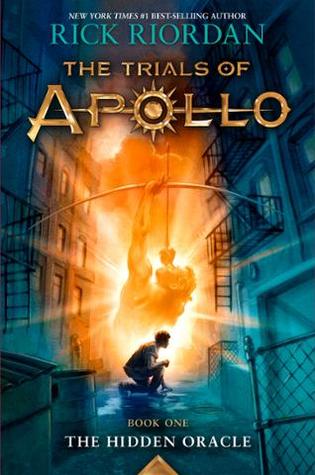
 Rick Riordan's latest series, The Trials of Apollo, delivers the same entertainment like the Percy Jackson and the Olympian series. The Hidden Oracle takes place a few months after the events of The Blood of Olympus, the final book in the Hero of Olympus series. While it isn't necessary to read the Percy Jackson and the Heroes of Olympus series to enjoy the Hidden Oracle, you will miss out on the world building and the events mentioned in this book. I would suggest reading the Percy Jackson and the Olympians first followed by the Heroes of Olympus before reading the Hidden Oracle.

Description: How do you punish an immortal? By making him human.

After angering his father Zeus, the god Apollo is cast down from Olympus. Weak and disorientated, he lands in New York City as a regular teenage boy. Now, without his godly powers, the four-thousand-year-old deity must learn to survive in the modern world until he can somehow find a way to regain Zeus's favor.

But Apollo has many enemies - gods, monsters and mortals who would love to see the former Olympian permanently destroyed. Apollo needs help, and he can think of only one place to go . . . an enclave of modern demigods known as Camp Half-Blood.

Review:Riordan takes a break from his well-known formula of a young man/woman discovering he/she is a demigod in his latest series. This time, he turns the tables and a demigod is stripped of his immortality and turned into a human. Apollo has done something to anger his father, Zeus, and he’s been cursed to walk the earth as gawky, mortal 16-year-old Lester Papadopolous. To add insult, he is required to obey the command of whichever demigod he encounters first, and in his case, that’s grouchy, volatile Meg, a 12-year-old with a powerful ability to wield garbage as a weapon. Together, the pair makes their way to Camp Halfblood, only to discover that demigods are going missing, and it has something to do with whispering trees, the blocked Oracle of Delphi, and a dangerous new threat.
  Apollo’s first-person narrative, awkwardly juggling his godly egotism and teenage insecurity, is hilarious. Other reviewers have commented that Apollo got on their nerves, but I loved his voice. Greek gods and goddess are known for their childish behaviors and Riordan displays this brilliantly with Apollo's voice, especially his haiku's the preface each chapter. His mortality not only provides him to comment and lament how lame mortals are, but it also provides him multiple opportunities for him to grow as a character such as appreciating his many children and being (gasp!) humble.
  In true Riordan fashion, there is the interweaving of Greek myths throughout the story and I really like the absence of an oracle, which undoubtedly influences and shapes the overall arching plot of the series. I enjoyed having the same amount of information and clues as his characters do. The pace moves quickly and the story is filled with lots of action, adventure, and humor makes the Hidden Oracle a very enjoyable read. For fans of Riordan's Percy Jackson and the Olympian and Heroes of the Olympus series, you will definitely see a lot of familiar faces. I'm really looking forward to the next book in this series.
Rating: 4 stars

Words of Caution: Apollo mentions having both male and female lovers, which is not unusual in Greek mythology or in Ancient Greece. There is also some strong violence in the book. Recommended for Grades 6 and up.

If you like this book try: Apollo by George O'Connor, Dark Prophecy (Trials of Apollo #2) Rick Riordan coming in May 2017, Pegasus and the Flame of Olympus by Kat O'Hearn, Night Tourist by Katherine Marsh, Gods of Manhattan by Scott Mebus
Rummanah Aasi
Today I am happy to introduce historical fiction and fantasy young adult author, Coreena McBurnie, who will talk to us about her new series Prophecy which retells the story of Antigone. Prophecy is the first book in the series and is now available. See below for more details about Prophecy and Coreena down below. 

Hi, Coreena. Thank you for stopping by the blog today for an author interview! Can you tell us about the journey that led you to write your book?

I had always wanted to write about Antigone, but wasn't sure where to start, especially because I envisioned a young adult novel and some of the subject matter is delicate -- like Antigone being the child of incest (her mother is her grandmother and her father is also her brother). I also really love Sophocles' plays involving Antigone -- she has always been one of my favourite characters from Greek myth -- and I wanted to do her justice. About four years ago, I was signed up to do National Novel Writing Month (a challenge to write 50,000 words in November) and didn't know what to write. I finally decided to tackle Antigone. I sat down and decided not to worry about what was in the Greek myth, that was all set and done, and instead decided to write without trying to tiptoe around the sticky issues. Once I did that, Antigone found her voice, one that was surprising even to me.

Why did you decide to retell the Oedipus myth from the point of view of Antigone when Antigone has a story of her own?

I decided to do this because I wanted to start the story at the beginning. Oedipus' and Antigone's stories are most famously told by Sophocles in his Oedipus plays, the last of which is called Antigone. My book, Prophecy, is the first of a planned trilogy mirroring these three plays. I wanted to get to the roots of Antigone's amazing sense of duty that we know her for and thought the place to start would be with the profound impact her family story must have had on her life.

Who is your favorite Greek god or goddess and why?

I love Athena, the goddess of wisdom. She is strong, independent, and smart, which has always appealed to me. She even has an owl as her animal symbol. And, her temple is the Parthenon in Athens -- an amazingly fantastic building!

What is your favorite Greek myth?

That's a tough one, but I'd probably have to say Theseus and the Minotaur because it is the first myth that I remember learning about way back in elementary school. I wrote a report on it and I was fascinated -- I think my love for Greek myth began there.

What are you reading at the moment and what do you think of it?

I have just started reading The Readers of Broken Wheel Recommend by Katarina Bivald, a Swedish author. So far it is very good, and promises to be a funny, quirky read. It's about a young Swedish woman who has never travelled before and is now visiting her elderly pen pal in a small town in Iowa called Broken Wheel. However, when she arrives, her pen pal friend has died, but the young woman ends up staying for her visit anyway. I am really enjoying Swedish writing in general right now because the sense of humour appeals to me.

What are the top 5 reasons readers should pick up Prophecy?


  • It has a powerful, strong, yet fallible heroine.
  • It takes place in ancient Greece and has gods and goddesses in it.
  • It is a fresh take on an old story that most people know.
  • Even though Antigone is an ancient Theban princess, her struggles to find herself and do what she thinks is best, despite what everyone else says, is pretty universal and applicable, even today.
  • I have studied Classical myth and culture for years, I even have degrees in Classical Studies, and I have put my love for Greek myth into this book.

About the Book

 A hidden prophecy.
 A chosen princess who speaks with snakes.
 A family duty.

Sixteen year old Princess Antigone, daughter of the infamous ancient Greek King Oedipus, wants to lead a normal life and fulfill her duty to the gods, her city, and her family, but fate has other plans. The Olympian gods bless her, the snakes talk to her, her parents want her to marry a foreign prince, her embroidery looks like burial shrouds for dogs, and she has fallen in love with the wrong boy. When the mysterious and devastating prophecies surrounding her family are revealed, Antigone must choose where her allegiance lies: With the gods who have betrayed her family but who she is obliged to serve? With her plague ridden city? With her family which lay in ruins? Or even with herself?


Find the Book at: Amazon | Smashwords | Kobo | iBooks | Barnes and Noble


About the Author

My name is Coreena McBurnie and, ever since grade 5 when I had to do a report on Theseus and the Minotaur, I have had a soft spot for Greek mythology. When I hit university, I was drawn to the Classical Studies department (earning both a BA & MA), where I explored the archaeology and culture of the ancient Greek and Roman worlds — and also where I managed to read Homer’s Odyssey, one of my absolute favourite books, in the original Greek, something which was thrilling for me (I know, sounds crazy, but the poetry and scope of the original text is amazing). After a lifetime of “what is that?”, “why did you study that?”, and “what can you do with a degree in Classical Studies?” I have decided to write novels based in ancient myth and to bring so many of the stories I love to life for a modern audience, with my own spin, of course.

Prophecy, Book 1 in the Antigone Series, is my first published novel. Currently I am working on Book 2 in the Antigone Series, called Fate. I am also in the middle of another novel about Clytemnestra who is notorious in Greek myth for killing her husband, Agamemnon, when he returned home from the Trojan War. I love exploring the motives of strong women in ancient myth.

I live in BC, Canada with my husband, our three kids, and our cat, in a beautiful part of the country, on two rivers, surrounded by ranches, near ski hills, and only a couple of hours drive to the ocean.

Rummanah Aasi
  A number of my trusted blogger friends are huge fans of Sarah Fine's books in particular her young adult series. Since I have been meaning to read a book by this author, I thought I would try Marked, the first book in her adult series. While I enjoyed Marked for the most part, it left me unsatisfied.

Description: In a broken landscape carved by environmental collapse, Boston paramedic Cacia Ferry risks life and limb on the front lines of a fragile and dangerous city. What most don’t know—including her sexy new partner, Eli Margolis—is that while Cacy works to save lives, she has another job ferrying the dead to the Afterlife. Once humans are “Marked” by Fate, the powerful Ferrys are called to escort the vulnerable souls to either eternal bliss or unending fire and pain.
  Unaware of Cacy’s other life, Eli finds himself as mesmerized by his fierce and beautiful partner as he is mistrustful of the influential Ferry clan led by the Charon—who happens to be Cacy’s father. Cacy, in turn, can no longer deny her intense attraction to the mysterious ex-Ranger with a haunted past. But just as their relationship heats up, an apparent hit takes the Charon before his time. Shaken to the core, Cacy pursues the rogue element who has seized the reins of Fate, only to discover that Eli has a devastating secret of his own. Not knowing whom to trust, what will Cacy have to sacrifice to protect Eli—and to make sure humanity’s future is secure?

Review: Marked has a really intriguing premise that uses elements of Greek mythology with a post-apocalyptic Boston setting. There are two factions who are seen to be fighting for human souls. On the one hand you have the ferrys who deliver the human souls to the afterlife. On the other hand there are the Kere who work with the Sisters of Fate and mark people to die. Both the Ferry and the Kere are rewarded by a gold coin after they perform their duties. Unfortunately due to the very weak world building, I had a very difficult time trying to figure out how everything came together. How were the Ferrys and Keres created? Why and how long have they been battling for human souls? What do they do with the rewards they received? What exactly happened to Boston that made it a city submersed in disease infested waters? There came a point in my reading where I had to stop myself from asking questions just so that I could roll with the story, but I was very disappointed as I had heard from the author's fans that her world building skills were very good.
  In addition to the weak world building, I also thought the book had a hard time deciding if it belong to the paranormal romance genre or to urban fantasy. The plot see-sawed between a murder mystery featuring Cacy's family and her romantic relationship with Eli. Neither of these plot points were well developed. The murder mystery is very much in the background, characters involved in the case are briefly mentioned and there is no suspense in finding out the perpetrators contrary to the victim's significance in the story. I was surprised to find that the murder mystery was very much in the background and then brought to light in the last three chapters. Similarly, while it was fun watching Cacy and Eli dance around their desires for each other, I didn't feel that there was any emotional connection between them besides their sizzling physical one. Their romance was insta-love which is a bit jarring since they were together for a very short period of time and towards the end of the book began a bit repetitive as they separated and came back together.
  Overall I liked the different cast of characters that Fine introduced in this series. I just wished they were a bit more complex. There were several opportunities to elaborate on Cacy and Eli's back stories, but it was summarized in a few quick sentences. If the characters were much stronger, I could have enjoyed this book much more and would be more forgiving of its flaws. I am not sure if I will continue this series, but I would try a young adult book by this author as those seem to have better reviews.

Rating: 3 stars

Words of Caution: There is strong language and explicit sex scenes in the book. Recommended for adults only.

If you like this book try: Claimed (Servants of Fate #2), Dark Hunter series by Sherrilyn Kenyon
Rummanah Aasi


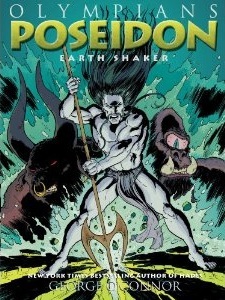
Description: In volume 5 of Olympians, author/artist George O'Connor turns the spotlight on that most mysterious and misunderstood of the Greek gods, Poseidon: Earth Shaker. Thrill to such famous stories as Theseus and the Minotaur, Odysseus and Polyphemos, and the founding of Athens—and learn how the tempestuous Poseidon became the King of the Seas.

Review: Poseidon is one of the few Greek gods who doesn't have a physical presence in mythology. We usually hear of him by the raging waters or his monstrous children, but never the actual god himself. The narrative style of his graphic novel follows this same train of thought.
 Instead of an overarching theme which was featured in the previous Olympian graphic novels that I read, Poseidon reads more episodic. He begins his story of how he came to rule the sea after the war of the Titans. There is palpable resentment and tension as Poseidon keeps a tally of the wrongs done by his siblings, particularly Athena who favored Odysseus rather than her brother (uncle?). He tells the gory stories of how the clever Odysseus injured Polyphemus and Theseus managing to survive the Minatour. While he may appear to receive the shorter end of the stick, Poseidon knows he can cause significant amount of damage and does so in several tales.
  Unlike the other Greek deities that O'Connor drew, I didn't like how Poseidon was drawn. He looks like a mash up between Kung Fu master with his long, wispy mustache and Conan the Barbarian on steroids. I didn't picture him to be like that in my mind.
  While the plot jumps from story to story, it is easy to follow in the crisply drawn sequential panels. I do like how O'Connor makes his subject relatable by today's standard's of action heroes. While this may not be my favorite book in the Olympians series, I did find it enjoyable.
 
Rating: 3.5 stars

Words of Caution: There is strong, bloody violence on the PG-13 scale. Recommended for Grades 7 and up.

If you like this book try: The Odyssey by Gareth Hinds, Theseus Battles the Minator by Gary Jeffrey


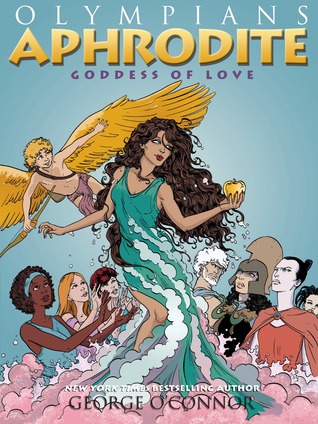
Description: In volume six of Olympians, graphic novel author/artist George O'Connor turns the spotlight on Aphrodite, the goddess of love. Look for the same thoroughly researched and wonderfully accessible comics storytelling as O'Connor tackles the story of the Aphrodite from her dramatic birth (emerging from sea-foam) to her role in the Trojan War.

Review: I was really curious to see how O'Connor would spotlights the goddess of beauty and love in a kid friendly graphic novel. I thought he made a clever decision in emphasizing on power instead of sexuality in this solid addition to his Olympians series. Aphrodite's three attendants, the Charites, narrate a recap of the origin of the Titans and Olympians, leading up to the goddess's birth and highlighting that Aphrodite is essentially Eros embodied. After a series of shorter myths, various affairs and the introduction of Aphrodite's capricious son (Eros aka Cupid), the graphic novel concentrates on the beauty contest of the goddesses Aphrodite, Hera and Athena, judged by the mortal Paris. It was really cool to see how he problematic female stereotypes be pointed out by the goddesses themselves. They find the contest "beneath" them and "debasing" even while participating and re-frame the contest as one of power instead of beauty- each offering Paris either wealth, being a hero, or a chance to have one of the most beautiful women in the world. While there might not be a lot of action in this volume of the Olympians, there is a lot more tongue in cheek humor and great one-liners sprinkled in the story. This graphic novel shows Aphrodite's power in femininity and sexuality without being overt and crude.

Rating: 4 stars


Words of Caution: There are sexual situations alluded to in the book that happen off the page which older children make understand. There is also some crude humor in the graphic novel as well. Recommended for Grades 7 and up.

If you like this book try: Aphrodite: Goddess of Love and Beauty by Teri Temple
Rummanah Aasi
 I stumbled upon George O'Connor's Olympians graphic novel series as I was browsing the graphic novel section at work. As readers of this blog know, I'm a big fan of Greek Mythology and I couldn't resist picking up this series. O'Connor's attention to details, meticulous research, incredible artwork, and great storytelling makes the Olympians an enthralling read and a must have series in libraries. Please note that this review is based on the advanced reader's copy that I received from First Second via Netgalley. Olympians: Apollo the Brilliant one will be published and available on January 26th at libraries and bookstores.

Description: Mighty Apollo is known by all as the god of the sun, but there's more to this Olympian than a bright smile and a shining chariot. In the latest volume of Olympians, New York Times bestselling author George O'Connor continues to turn his extensive knowledge of the original Greek myths into rip-roaring graphic novel storytelling.

Review: Unlike the previous installments of the Olympian series, Apollo's graphic novel is narrated by the nine Muses who were also worshiped along with the Greek deity. Each muse tells a different story featuring Apollo and they all paint him as a tragic hero "who has had many loves, but whose loves seldom prosper."
  O'Connor successfully shows different aspects of Apollo's personality through a variety of myths, some of which I was familiar with before and a few others that I did not know. We witness Apollo the hero when he goes off to avenge his mother, Leto, by defeating Python, the humongous serpent who had harried Leto at Hera's instigation, with fiery arrows. We also watch Apollo's ill luck with finding love as he lusts and chases after the nymph Daphne who would much rather be transformed into a laurel instead of being with him, kill his lover Hyacinth, the Prince of Sparta, who was killed by a misguided discus he threw and was led by the winds of a jealous Zephyr, and have his sister shoot the unfaithful mother of his own not-yet born son, Aklepios.  
  In addition to theses heartaches, we also see the majestic Apollo as he reminds everyone that he is indeed the greatest musician ever created after he gruesomely skins the hubris satyr Marsyas and wears it as his cape. Perhaps out of all of these different sides to Apollo, what struck me the most was the parental side of Apollo as he watched helplessly as his gifted son who healed many mortals be killed for upsetting Hades. As we wrap up the graphic novel, we can't help but think that the Muses maybe right in stating that Apollo is the most human out of all of the Greek gods and goddesses.


Rating: 4 stars

Words of Caution: Though not graphically depicted, there are strong violent allusions in the myths and mature themes. Recommended for Grades 4 and up.

If you like this book try: Greek Gods and Monsters by Bernard Evslin, Mythology by Edith Hamilton, or any of the Olympians series by George O'Connor
Rummanah Aasi
 I've been a fan of Greek Mythology since I was a child and it is very cool to see them now star in their very own graphic novel series. The Olympians graphic novel series are such a delight to read in revisiting the famous Greek myths from a fresh format and point of view. I always learn something new in each volume of the Olympians series. I would highly recommend reading them and the best part is that each volume can be read as a standalone.

Description: Hades: Lord of the Dead tells the story of the great God of the Underworld and one of the most famous of all Greek myths: Hades' abduction of Persephone and her mother's revenge. Be prepared to see a new side of Persephone in this dynamic adaptation of the story of the creation of the seasons.

Review: O'Connor gives a panoramic viewpoint of the Underworld as we see souls tormented for their sins while others wander aimlessly or reside in the Elysian fields. We are also given shades of the gloomy, quiet, and brooding Hades too, however, the graphic novel centers on the retelling of the famous Hades and Persephone myth. I know many readers who love this myth and find it romantic, but this myth has always made me feel uncomfortable.
  In O'Connor's retelling, the tempestuous mother-daughter relationship between Demeter and Kore (translated as "The Maiden") gives us a fresh and funny viewpoint of the famous myth. Demeter is an overbearing mother who smothers her teenage daughter Kore. We watch a screaming fight between these two women that many young readers can relate to with familiar dialogue such as "Butt out of my life!!" and "You ungrateful brat". When Kore does not heed the advice of her mother to be careful, she is captured by Hades, who too pressurizes Kore to become his wife. Kore initially gives her quiet, gloomy captor Hades a hard time too. She also takes advantage of her time alone to give herself a thorough makeover and changing her name to Persephone ("Bringer of Destruction"). We are now seeing Persephone not as a victim but a woman who has taken charge of her life. We daresay that she actually likes being with Hades- when offered the opportunity to return to her remorseful mom, she lies about having eaten those pomegranate seeds so she can spend half of each year as Queen of the Dead.
  I loved how O'Connor has taken note that many of the myth retellings have shown us what happened to Persephone, but many writers and storytellers have never given her a voice. He has also expertly captures both the dramatic action and each character's distinct personality for instance Demeter's wild hair matches to her flammable temper as well as the physical transformation of a waif Kore into a woman with a backbone of steel in Persephone. While the Greek gods hold infinite power, O'Connor never forgets to show their humanity.

Rating: 4 stars

Words of Caution: There are disturbing images and discussion of the center figures who are tormented in the Underworld. Recommended for Grades 6 and up.

If you like this book try: Percy Jackson the Olympians graphic novel adaptations by Robert Venditti, Hades Speaks! by Vicky Shecter
Rummanah Aasi
 After reading three volumes of the Olympians series by George O'Connor, I've definitely become a fan of this series. The great thing about reading this series is that you can read them in any order.

Description: Greek Gods as you've never seen them before!

The strong, larger-than-life heroes of the Olympians can summon lightning, control the sea, turn invisible, or transform themselves into any animal they choose. Superheroes? No! Greek gods. The ancient pantheon comes to explosive life in this new series where myth meets comic books. Epic battles, daring quests, and terrible monsters await readers within the pages of these books.

Volume 2, Athena: Grey-Eyed Goddess, is the tale of the goddess of wisdom and war, recounting her many adventures.

Review: O'Connor does a good job in summarizing Zeus's story for new readers. He also introduces the Fates who are the narrator's of this volume. Unlike Zeus's graphic novel, there is not a linear story told but rather a collection of vignettes of Athena's creation and birth story along with the story of Arachne and Perseus. Each story, in the end, tells how Athena added to her Aegis, which became her most powerful weapon. Plus there are two versions of why she took the name Pallas Athena.
  The storytelling and artwork sucked in me in quickly. The myths are brilliantly told, highlighting the prism of emotion that the Greek gods inhibited. The physical characterizations and facial expressions bring the characters to life. There were also some new tales told that I did not know much about, which was great. There is also a lot of violence in this issue, which makes sense since Athena is the Goddess of War, however, there are no graphic details of blood and gore. My only hesitation of adding this graphic novel to a elementary or middle school collection would be the actual birth story of Athena. There is real no way around the fact that her father eat Athena's mother in hopes of avoiding a prophecy only to have her born inside his body and popping out of his skill.


Rating: 4 stars

Words of Caution: There is strong violence throughout the graphic novel, however, there is no graphic bloodshed depicted. Given the context of Athena's birthing story I would feel comfortable in recommending this graphic novel to strong Grade 6 readers and up.

If you like this book try: Olympians: Hera by George O'Connor, Heroes, Gods, and Monsters of the Greek Myths by Bernard Evslin, Mythology by Edith Hamilton
Rummanah Aasi
  Introducing Greek mythology to young adults can be a bit tricky due to the strong sexual and violent content of the myths, however, George O'Connor's Olympians graphic novel series manages to teach the Greek myths in exciting ways and not sacrificing the action nor nuisances of the Greek gods and goddesses. He reminds us that before all of the superheroes that were created, the Greek gods and goddesses had the much deserved spotlight with their own drama and back stories.

Description: Volume 3 of Olympians, Hera: The Goddess and Her Glory, introduces readers to the Queen of the Gods and Goddesses in the Pantheon. This volume tells the tales of the many heroes who sought and won Hera's patronage, most notably Hercules.


Review:  Hera is not my favorite goddess from Greek mythology. She is always depicted as a shrew, jealous, and petty wife of Zeus. In the third volume of the Olympian series, however, Hera is a given a chance to appear more nuanced and multi-layered character rather than just being Zeus’ long-suffering, acid-tongued queen. Interestingly O'Connor chooses to retell the 10 labors of Heracles myth to give Hera a personality makeover since it is widely thought Hera hated Heracles, the illegitimate son of her philandering husband. I did like how O'Connor spins this tale of hate into a source of motivation for Heracles. I took me a while to even grasp that Heracles's name actually means the "Glory of Hera." 
  It was fun watching all the Olympians watch in rapt attention and amazement as Heracles makes his way through the series of impossible tasks with his strength and smarts. O'Connor's Olympian series continues to be well researched and executed. I was a bit worried as to how see how far O'Connor would take Zeus's philandering, but he does it tastefully with giving us hints but nothing too explicit or graphic. The fantastic artwork brings the gods and goddess to life in all of their glory. This series would be a great addition to supplement the Greek myths in the English curriculum as well as a terrific addition to the library's collection development. I can't wait to continue this series. 

Rating: 4 stars

Words of Caution: There is some disturbing images and violence featuring the monsters of the Greek Myths such as the Hydra and Cerebus. There is also some suggestions of nudity. Recommended for Grades 6 and up.

If you like this book try: Hercules : the Twelve Labors by Paul Storrie
Rummanah Aasi
The Olympians graphic novel series combines Greek mythology retelling along with superhero action and pacing in a graphic novel format will appeal to many readers. Knowledge of the myths are not required to enjoy the graphic novel and it would serve as a really good introduction to those who are curious about Greek myths.

Description: A fictionalized retelling, in graphic novel format, of the Greek myth that details the story of Zeus, describing his boyhood through the beginning of his reign as the ruler of the Olympian Pantheon.

Review: The Greek Myths get the superhero makeover in this new series by George O'Connor. The first volume of this series focuses on Zeus from his miraculous birth to his journey of destroying his father and freeing his siblings. What I really liked about his volume was how O'Connor took his time to visualize the creation myth that establishes Gaea, the Titans, and other important Olympian entities that are often neglected or quickly glossed over. O'Connor introduces Zeus once his stage is set. His godly powers slowly develop along with his flirtatious manner.  The extended, earth-shattering battle he wages with his father, Kronos, takes up the bulk of the story, delivering page after page of action packed panels that keep the pages turning much like those found in a superhero comic. The artwork and coloring are stunning and the panels leap off the page. Before you know it, the graphic novel ends, but the good news is that there many volumes of this series are already out and ready to be read. I would definitely read this graphic novel to fans of Greek mythology.

Rating: 4 stars

Words of Caution: There is some violence though not too graphic. Recommended for Grades 5 and up.


If you like this book try: Percy Jackson and the Olympians: Lightning Thief Graphic Novel Adaptation by Robert Venditti, Olympians Vol 2: Athena by George O'Connor
Rummanah Aasi
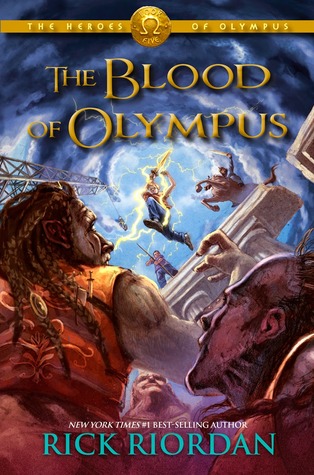
 The Blood of Olympus by Rick Riordan was one of the highly anticipated book release for this year. While it was a satisfying ending to a great series filled with mythology and demigods, I was expecting a bit more from it. Below is a spoiler free review of the book.


Description: Though the Greek and Roman crew members of the Argo II have made progress in their many quests, they still seem no closer to defeating the earth mother, Gaea. Her giants have risen-all of them-and they're stronger than ever. They must be stopped before the Feast of Spes, when Gaea plans to have two demigods sacrificed in Athens. She needs their blood-the blood of Olympus-in order to wake.
  The demigods are having more frequent visions of a terrible battle at Camp Half-Blood. The Roman legion from Camp Jupiter, led by Octavian, is almost within striking distance. Though it is tempting to take the Athena Parthenos to Athens to use as a secret weapon, the friends know that the huge statue belongs back on Long Island, where it might be able to stop a war between the two camps.
   The Athena Parthenos will go west; the Argo II will go east. The gods, still suffering from multiple personality disorder, are useless. How can a handful of young demigods hope to persevere against Gaea's army of powerful giants? As dangerous as it is to head to Athens, they have no other option. They have sacrificed too much already. And if Gaea wakes, it is game over.


Review: With over 500 pages in length and an ominous title, I was a bit hesitant in reading The Blood of Olympus in fears that my favorite characters would meet their end. With so much plot that involves many characters, I highly suggest reading the Heroes of Olympus series from the beginning as Riordan doesn't fill the reader in with much background information. The story picks up right where it left us in The House of Hades. Time is not on the side for our demigods. With just 12 days to go until Gaea awakens fully on Aug. 1 and brings an end to the world as we know it, the Greek and Roman demigods must put their differences aside and work together to stop her.Aboard the Argo II, Percy, Annabeth, Jason, Piper, Frank, Hazel and Leo race to Athens for the final showdown. Meanwhile, Nico, Reyna, and Coach Hedge. 
  Each chapter is told from a different demigod's point of view, which keeps the pace, plot, and suspense moving. The book is filled with what Riordan is known for: comedic, action-packed encounters with deities most readers--and sometimes characters--have never heard of such as Nike, the Goddess of victory Nike. With each previous book in this series, we are given herculean obstacles that the characters face and in this book the real highlight are the characters growths of both Nico's and Reyna's arduous and emotional journeys from outcast loners to self-acceptance.
  What disappointed me the most in The Blood of Olympus is how anticlimactic it seemed. The blood chilling prophecy was resolved too easily in my opinion with convenient plot points. I also would have liked to have chapters from Percy and Annabeth, the stars of the series and well known to readers. The story's occasional ventures into romance are also a bit stilted and awkward, but fortunately they are brief. While the book ended on a good note, which might bring some peace and quiet to its characters, I was hoping it deliver a greater punch than it did. Overall, I enjoyed this installment but I didn't love it like the other books in the series.

Rating: 4 stars

Words of Caution: There are a lot more battle scenes in this book. Recommended for Grades 5 and up.

If you like this book try: Kane Chronicles by Rick Riordan, Blackwell Pages series by K.L. Armstrong, The Night Tourist by Katherine Marsh, Gods of Manhattan by Scot Mebus,
Rummanah Aasi


Description: Icarus flies once more. Aztec jaguar gods again stalk the earth. An American soldier designs a new kind of Trojan horse—his cremains in a bullet. Here, in beguiling guise, are your favorite mythological figures alongside characters from Indian, Punjabi, Inuit, and other traditions.

Review: When I got XO Orpheus from the library, I was so excited to read it and discover the new ways the Greek myths would be retold but unfortunately this anthology was a mixed bag for me. I enjoyed the stories that gave the  mythological figures a 21st century makeover. Two of the stories that stood out for me was the re-imaging Demeter as a divorced mom who is struggling with the half-year custody of her daughter and a Vietnam veteran, in the spirit of Daedalus, builds an emotional labyrinth for his son. Where this anthology lost me is when it took the myths in a really bizarre direction that played with the content as well as loosely adapting the myths.
Editor Bernheimer describes her anthology as a necessary farewell to the old world of myth and acknowledgment of a modern age in which humans are regarded as the new gods. Though many of the stories maintain the timeless and quite often frightening themes of the myths, I'm not sure if this anthology is for every reader.

Rating: 2 stars

Words of Caution: There is strong language, sexual situations, and adult themes. Recommended for adults only.

If  you like this book try: My Mother She Killed Me, My Father He Ate Me: Forty New Fairy Tales edited by Kate Bernheimer, 
Rummanah Aasi
 Frequent readers of my blog know that I've been interested and a huge fan of Greek Mythology. When I came across Kerry Greenwood's Delphic Women which retold the myths of Jason and the Gold Fleece, the Trojan War and its aftermath from the point of view of the important female characters, I knew I had to read them. Greenwood makes the myths come alive and provides a different spin on characters who were once thought to be weak and one dimensional.

Description: In the third and final volume of the Delphic Women series, Hector is dead, Troy has fallen in ruins; and unknown to the Argives, refugees from the sack are rebuilding their civilization in New Troy. Agamemnon King of Men returns in triumph to Mycenae, bringing Princess Cassandra among his captives. Diomenes called Chryse and a Trojan sailor pursue her by sea, hoping against hope to rescue her. Their resourcefulness will be strained to its limits by war, pillage and social breakdown. For all is not well in the House of the Axe. In the king’s absence, Clytemnestra the Queen has taken a lover Aegisthus and has mixed feelings about her husband’s return. And the King’s golden-eyed daughter Electra hides a secret of her own which will bring a terrible vengeance. Meanwhile Odysseus, Sacker of Cities, has troubles of his own. He wishes only to return home to Ithaca, but the gods have other ideas.

Review: Greenwood's Electra is a very ambitious novel that mostly succeeds in retelling the myths of Electra/Orestes meanwhile continuing Cassandra's story along with a side note of Odysseus plight to go back home to Ithaca. Out of the three books in the Delphic Women series, I found Electra to be the weakest. The pacing of the book was uneven for me as we quickly go through the action and suspense right away with the Electra/Orestes myth but then really drags as the characters go on separate journeys. I would have liked to get to know Electra before all the action started and I didn't really get a sense of what kind of person she is other than cunning and observant. I didn't find Electra likable, but I can hardly fault her for her actions given the history of her family and the actions of her parents. 
  Like her other novels, Greenwood takes liberty with the Greek myths. For example, contrary to the common story of Cassandra who is tragically killed in her well known myth, Greenwood keeps her alive and she still remains a strong character. I really liked the juxtaposition between her point of view and that of Electra on the society's culture and role of women. The Greek gods still play an important role though they are mostly passive observers who play with the lives of all of mortal characters, although Zeus periodically asks them to stop. Periodically, the gods look into the Pool of Mortal Lives and comment on the action, argue, and decide the next step in these peoples' fates. We do find out the outcome of the gods' wager: the stronger of the two--love or death. I wasn't too thrilled with how everything tied up too neatly in a tight bow at the end of the book. Overall, I would recommend picking this book up if you are really interested in reading about Greek Mythology, particularly from the viewpoint of women. 

Rating: 3 stars

Words of Caution: There is strong violence including rape and sexual situations throughout the book as well as language. Recommended for mature teens and adults who enjoy and are serious about Greek Mythology.

If you like this book try: Age of Bronze graphic novel series by Eric Shanower, Women of Troy by Euripides, Antigone by Sophocles
Rummanah Aasi
 I've been interested in Greek Mythology for as long as I could remember. When I came across Kerry Greenwood's Delphic Women which retold the myths of Jason and the Gold Fleece, the Trojan War and its aftermath from the point of view of the important female characters, I knew I had to read them. Greenwood makes the myths come alive and provides a different spin on characters who were once thought to be weak and one dimensional.

Description: From Mount Olympus, Aphrodite, the goddess of love, yawned. Even perfection can be tedious. "My Lord," she called to Apollo, "Sun God and brother. Let us play a game with mortals—my power against yours."
And so Cassandra, the golden haired princess cursed with the gift of prophecy, and Diomenes, the Achaean with the healing hands, become puppets of the gods. Their passions are thwarted, their loves betrayed, their gifts rendered useless for the sake of a wager between the immortals.
Doomed, magnificent Troy is the stage, and Cassandra and Diomenes the leading players in this compelling story of the city's fall. Both have found love before, and lost it.
Will they find each other in the light of the burning city? And, if they do, can their love survive the machinations of malicious gods and men?

Review: What is stronger: love or death? Cassandra is the second book in the Delphic Women series featuring a new reimaging of popular female figures in Greek Mythology. As the title suggests, Cassandra is the focus of this novel as we watch the horrifying fall of Troy. Like Medea, Greenwood uses popular myths and new additions to the story along with well researched time period to recreate the Cassandra myth. Cassandra and her twin brother, Eleni, the children of King Priam and Queen Hecube of Troy, are a priestess and priest of Apollo the sun god. When a bored Aphrodite makes a wager with Apollo for a golden apple, the lives of Cassandra and Achaean healer Diomenes, called Chryse, are forever changed as they become pawns of the gods.
 Cassandra, as some of you know, is cursed with the gift of prophecy after rejecting to sleep with Apollo. While she can clearly see what will happen to her beloved city Troy, she cannot tell others what she knows. While Cassandra is growing and learning in Troy, we see Chryse becoming a gifted healer whose life is forever changed when he is called upon to treat his first love, Elene (aka Helen) of Sparta, the most beautiful woman in the world. Though she's married to Menelaus, Elene is nevertheless sought by many powerful men, and a war will soon be fought over her. When Elene runs off to Egypt with Cassandra's arrogant brother Pariki (Paris), the Achaeans have the perfect excuse to declare war on Troy even though they know that the Trojans would gladly have given her up had she not remained in Egypt. The story then follows the major events of the Trojan War.
  I was completely sucked in to this new story of Cassandra. Normally, Cassandra is depicted as the frail girl who harbors a horrible curse and eventually gets kidnapped, raped, and killed, however, she is a completely different person in Greenwood's version. In this book, Cassandra is a strong female character even in the worst circumstances. She never backs down and continues to fight against the gods. Chryse is an equally fascinating character who meets famous mythical figures and is passionate about medicine. Though their story lines are told in alternating chapters they eventually intersect in an interesting fashion. The ending of Cassandra's story was a nice surprise and I'm very curious to see how it pans out in the next Delphic Women book, Electra.
  The destruction of Troy is vividly illustrated and the settings come to life as their own characters in this book. I thought it was very interesting how Greenwood approaches romantic love as their are several relationships throughout the book. It was not uncommon for the people of this time to have more than one romantic partners. If you are a serious fan of Greek Mythology I would definitely recommend picking up the Delphic Women series by Kerry Greenwood. 

Rating: 4 stars

Words of Caution: There is strong violence including rape and sexual situations throughout the book as well as language. Recommended for mature teens and adults who enjoy and are serious about Greek Mythology.

If you like this book try: The Firebrand by Marion Zimmer Bradley, Antigoddess by Kendare Blake
Rummanah Aasi
 If you like Greek mythology, New Adult romance and a touch of the paranormal, check out The Chrysomelia Stories by Molly Ringle. The story centers around Sophie Darrow - a normal college freshman - who is abducted by a man she’s never met before and tricked into eating some pomegranate. What follows is her realization that she is no other than Persephone and her kidnapper – Hades himself.

As the official release date (June 27) of Underworld’s Daughter approaches, the second book in the series after the very successful and well received Persephone’s Orchard, we are very happy to point you towards an awesome giveaway!

The lucky winner will be receiving:

• Signed copies of both books
• 1 oz Persephone’s Pomegranate Blend looseleaf tea by Dryad Tea (black tea with pomegranate and vanilla)
• 25 plantable paper mini-flowers with wildflower seeds, by PaperSprouts (on Etsy)
• $5 Starbucks card
• Pegasus Greek coin pendant necklace from PartsForYou (on Etsy)

To enter, just fill out the Rafflecopter below. If not, never fear, the publisher will be offering more awesome giveaways like this one in the coming weeks.

And if you haven’t read Persephone’s Orchard yet, there’s good news there too since the ebook will be only $0.99 on all major bookstores for a limited time starting on June 27!

About the books:


The Greek gods never actually existed. Did they? Sophie Darrow finds she was wrong about that assumption when she's pulled into the spirit realm, complete with an Underworld, on her first day at college. Adrian, the mysterious young man who brought her there, simply wants her to taste a pomegranate.

Soon, though she returns to her regular life, her mind begins exploding with dreams and memories of ancient times; of a love between two Greeks named Persephone and Hades. But lethal danger has always surrounded the immortals, and now that she's tainted with the Underworld's magic, that danger is drawing closer to Sophie.


New immortals are being created for the first time in thousands of years thanks to the tree of immortality discovered by Persephone and Hades. But Sophie Darrow is not one of them. Nikolaos, the trickster, has given the last ripe immortality fruit to two others, the reincarnations of the gods Dionysos and Hekate: Tabitha and Zoe, currently Sophie's and Adrian's best friends.

While the disappointed Sophie struggles to remember Hekate and Dionysos from ancient Greece, she must still face her daily life as a mortal university freshman. Tabitha and Zoe have their own struggles as they come to terms with being newly immortal and their own haunting dreams of past lives and loves. The evil committed by Thanatos invades all of them in heartbreaking memories, and worse still, Sophie and her friends know their enemies are determined to kill again. And even the gods can't save everyone.

Related Posts with Thumbnails