While I didn't get a chance to completely finish my Banned/Challenged reading challenge from last year, I did manage to squeeze in a few more reads before the challenge's deadline. I've read many stories about the following books but haven't actually read them until now.
 Description: Fearing that her legal guardian
plans to abandon her to return to France, ten-year-old aspiring
scientist Lucky Trimble determines to run away while also continuing to
seek the Higher Power that will bring stability to her life.
Description: Fearing that her legal guardian
plans to abandon her to return to France, ten-year-old aspiring
scientist Lucky Trimble determines to run away while also continuing to
seek the Higher Power that will bring stability to her life.
Review: It's a shame that one word overshadowed a great book. The Higher Power of Lucky is story of a young girl named Lucky who lives in tiny, poor town Hard Pan, California with her dog and the young French woman who is her guardian. Her mother died in a thunderstorm and her father handed her over to his first exwife, a French woman named Brigitte. With a personality that reminded Ramona Quimby, a character that I absolutely adored, Lucky is contemporary and relate-able. She teeters between being a grown-up that can easily gather insects and scares away snakes without any hesitation yet she is vulnerable and fears that her guardian will leave her to return to France at any moment. Looking for solace, Lucky eavesdrops on the various 12-step meetings held in Hard Pan, hoping to discover her own higher power that will see her when she hits 'rock bottom'. Peppered with memorable secondary characters such as her best friend and crush, Lincoln, who has a fixation for tying knots, and a little, adorable yet pesky toddler named, Miles, who can relate to Lucky's fears. Patron's plotting is as tight as her characters are endearing. Lucky is a true heroine, especially because she's not perfect: she does some cowardly things, but she takes pains to put them to rights.
Rating: 4 stars
Reason why it was banned/challenged: There was a big controversy when the book was published, specifically because the word scrotum appears a handful of times throughout the book. Lucky first hears of the word while eavesdropping on a conversation when a character says he saw a rattlesnake bite his dog, Roy, on the scrotum. Many educators including elementary school librarians felt the inclusion of the "s-word" was highly inappropriate and unnecessary. They even called for the book to be removed from library shelves and some even thought the book should be stripped of its Newbery award. I, personally, feel that the inclusion of the word is a nod to Lucky's curiosity which natural for her age. Though she wonders what the word means as she thinks it's important, she isn't fixated on it and nor does it drive the story. Unfortunately, this controversy has overshadowed the book's importance. Most people including me had to really think of the book's real title instead of referring it as the book with the "S-word". To read more about the controversy, read the New York Times article and then the author's response as well as her interview.
Words of Caution: None. Recommended for Grades 3 and up.
If you like this book try: Lucky Breaks by Susan Patron, Walk Two Moons by Sharon Creech, Waiting for Normal by Leslie Connor
 Description: At New York City's Central Park
Zoo, two male penguins fall in love and start a family by taking turns
sitting on an abandoned egg until it hatches.
Description: At New York City's Central Park
Zoo, two male penguins fall in love and start a family by taking turns
sitting on an abandoned egg until it hatches.
Review: And Tango Makes Three is based on a true story about a charming penguin family living in New York City's Central Park Zoo. In this heartwarming story, readers will meet Roy and Silo, two male penguins, who are "a little bit different" than the other penguins. They cuddle and share a nest like the other penguin couples, and when all the others start hatching eggs, they too want to be parents. Determined and hopeful, they bring an egg-shaped rock back to their nest and proceed to start caring for it. They have little luck, until a watchful zookeeper decides they deserve a chance at having their own family and gives them an egg in need of nurturing. The dedicated and enthusiastic fathers do a great job of hatching their funny and adorable daughter. Done in soft watercolors, the illustrations set the tone for this uplifting story. The words are matched well with the illustrations and the message of tolerance and a broader definition of family is well received.
Rating: 4 stars
Reason why it was banned/challenged: And Tango Makes Three is frequently challenged since its publication of 2006. It has appeared on the list several times between 2006 and 2010 for the following reasons: homosexuality, religious viewpoint, and unsuited to age group.
Words of Caution: None. Recommended for Pre-school to Grades 3. Though the book is about two male penguins, I don't see any agenda of imposing homosexuality to kids, but rather showing that a family no matter how family is designed all have the same concepts at its core: love, warmth, and tolerance. What are we telling kids who are raised by GLBT adults? That they aren't loved and they aren't normal? It amazes me that a simple book like Tango can generate so volatile opinions while TV shows like Modern Family that also features two male partners raising a child can garner so many accolades and be accepted by so many people.
If you like this book try: The Family Book by Todd Parr, The Very Best Daddy of All by Marion Dane Bauer
 Description: A retelling of a mother's account of what happened to her family during the Flash that destroyed Hiroshima in 1945.
Review: Hiroshima No Pika is a striking picture book that details one of the horrific events of history: the dropping of atomic bomb in Hiroshima, Japan. The book is filled with watercolor paintings which reinforce the colors of flames and debris, vividly heightening this low-key text recounting the fictionalized experiences of a 7-year-old Hiroshima child and her mother after the 1945 "Hiroshima flash." The story told in precise and easy sentences send chills down your back with its easiness. Like most people, you only hear about the event but when you read Hiroshima No Pika, you are given a tiny glimpse of what true horror is really like.
Rating: 4 stars. Recommended for Grades 4 and up.
Curriculum Connection: Social Studies
Reason why it was banned/challenged: According to the MVCC Libraries, the book was challenged because it "does not depict war as glorious (graphic depiction of victims of bombing of Hiroshima).
Words of Caution: There is nudity and strong images of violence. The book does not shy away from the dark side of war: causalities, destruction, and an abrupt change to life. The pictures, though hard to take in because of how much is inflicted by the people of the story, show just enough detail of horror without going overboard. Though not a book that would used as a read-aloud, it would serve a great purpose in discussing World War II with mature students such as older elementary students and above who can understand the book and its context.
If you like this book try: Baseball Saved Us by Ken Mochizuki, So Far From the Sea by Eve Bunting
 Description: Fearing that her legal guardian
plans to abandon her to return to France, ten-year-old aspiring
scientist Lucky Trimble determines to run away while also continuing to
seek the Higher Power that will bring stability to her life.
Description: Fearing that her legal guardian
plans to abandon her to return to France, ten-year-old aspiring
scientist Lucky Trimble determines to run away while also continuing to
seek the Higher Power that will bring stability to her life.Review: It's a shame that one word overshadowed a great book. The Higher Power of Lucky is story of a young girl named Lucky who lives in tiny, poor town Hard Pan, California with her dog and the young French woman who is her guardian. Her mother died in a thunderstorm and her father handed her over to his first exwife, a French woman named Brigitte. With a personality that reminded Ramona Quimby, a character that I absolutely adored, Lucky is contemporary and relate-able. She teeters between being a grown-up that can easily gather insects and scares away snakes without any hesitation yet she is vulnerable and fears that her guardian will leave her to return to France at any moment. Looking for solace, Lucky eavesdrops on the various 12-step meetings held in Hard Pan, hoping to discover her own higher power that will see her when she hits 'rock bottom'. Peppered with memorable secondary characters such as her best friend and crush, Lincoln, who has a fixation for tying knots, and a little, adorable yet pesky toddler named, Miles, who can relate to Lucky's fears. Patron's plotting is as tight as her characters are endearing. Lucky is a true heroine, especially because she's not perfect: she does some cowardly things, but she takes pains to put them to rights.
Rating: 4 stars
Reason why it was banned/challenged: There was a big controversy when the book was published, specifically because the word scrotum appears a handful of times throughout the book. Lucky first hears of the word while eavesdropping on a conversation when a character says he saw a rattlesnake bite his dog, Roy, on the scrotum. Many educators including elementary school librarians felt the inclusion of the "s-word" was highly inappropriate and unnecessary. They even called for the book to be removed from library shelves and some even thought the book should be stripped of its Newbery award. I, personally, feel that the inclusion of the word is a nod to Lucky's curiosity which natural for her age. Though she wonders what the word means as she thinks it's important, she isn't fixated on it and nor does it drive the story. Unfortunately, this controversy has overshadowed the book's importance. Most people including me had to really think of the book's real title instead of referring it as the book with the "S-word". To read more about the controversy, read the New York Times article and then the author's response as well as her interview.
Words of Caution: None. Recommended for Grades 3 and up.
If you like this book try: Lucky Breaks by Susan Patron, Walk Two Moons by Sharon Creech, Waiting for Normal by Leslie Connor
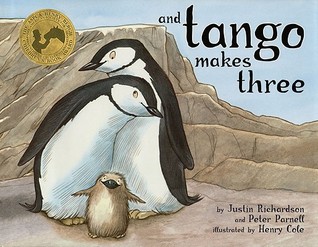
Review: And Tango Makes Three is based on a true story about a charming penguin family living in New York City's Central Park Zoo. In this heartwarming story, readers will meet Roy and Silo, two male penguins, who are "a little bit different" than the other penguins. They cuddle and share a nest like the other penguin couples, and when all the others start hatching eggs, they too want to be parents. Determined and hopeful, they bring an egg-shaped rock back to their nest and proceed to start caring for it. They have little luck, until a watchful zookeeper decides they deserve a chance at having their own family and gives them an egg in need of nurturing. The dedicated and enthusiastic fathers do a great job of hatching their funny and adorable daughter. Done in soft watercolors, the illustrations set the tone for this uplifting story. The words are matched well with the illustrations and the message of tolerance and a broader definition of family is well received.
Rating: 4 stars
Reason why it was banned/challenged: And Tango Makes Three is frequently challenged since its publication of 2006. It has appeared on the list several times between 2006 and 2010 for the following reasons: homosexuality, religious viewpoint, and unsuited to age group.
Words of Caution: None. Recommended for Pre-school to Grades 3. Though the book is about two male penguins, I don't see any agenda of imposing homosexuality to kids, but rather showing that a family no matter how family is designed all have the same concepts at its core: love, warmth, and tolerance. What are we telling kids who are raised by GLBT adults? That they aren't loved and they aren't normal? It amazes me that a simple book like Tango can generate so volatile opinions while TV shows like Modern Family that also features two male partners raising a child can garner so many accolades and be accepted by so many people.
If you like this book try: The Family Book by Todd Parr, The Very Best Daddy of All by Marion Dane Bauer
 Description: A retelling of a mother's account of what happened to her family during the Flash that destroyed Hiroshima in 1945.
Review: Hiroshima No Pika is a striking picture book that details one of the horrific events of history: the dropping of atomic bomb in Hiroshima, Japan. The book is filled with watercolor paintings which reinforce the colors of flames and debris, vividly heightening this low-key text recounting the fictionalized experiences of a 7-year-old Hiroshima child and her mother after the 1945 "Hiroshima flash." The story told in precise and easy sentences send chills down your back with its easiness. Like most people, you only hear about the event but when you read Hiroshima No Pika, you are given a tiny glimpse of what true horror is really like.
Rating: 4 stars. Recommended for Grades 4 and up.
Curriculum Connection: Social Studies
Reason why it was banned/challenged: According to the MVCC Libraries, the book was challenged because it "does not depict war as glorious (graphic depiction of victims of bombing of Hiroshima).
Words of Caution: There is nudity and strong images of violence. The book does not shy away from the dark side of war: causalities, destruction, and an abrupt change to life. The pictures, though hard to take in because of how much is inflicted by the people of the story, show just enough detail of horror without going overboard. Though not a book that would used as a read-aloud, it would serve a great purpose in discussing World War II with mature students such as older elementary students and above who can understand the book and its context.
If you like this book try: Baseball Saved Us by Ken Mochizuki, So Far From the Sea by Eve Bunting


 Posts
Posts