Showing posts with label Book Ban. Show all posts
Rummanah Aasi

Welcome to my new feature called Forbidden Reads! Join me in celebrating your freedom to read. My goal for this soon-to be- regular monthly feature is to highlight challenged and/or banned books from each literary audience: children, YA, and adult. Not only will I be doing a review of the book, I will also include information as to where and why the book was challenged/banned. Today I'll be reviewing Chris Crutcher's controversial, hard hitting YA novel, Staying Fat for Sarah Byrnes, which was published in 1993.

Description: Sarah Byrnes and Eric have been friends for years. When they were children, his fat and her terrible scars made them both outcasts. Later, although swimming slimmed Eric, she stayed his closest friend. Now Sarah Byrnes -- the smartest, toughest person Eric has ever known -- sits silent in a hospital. Eric must uncover the terrible secret she's hiding, before its dark currents pull them both under.

Review: Staying Fat for Sarah Byrnes is a heart-wrenching story of loyalty, friendship, and courage. A social outcast in junior high due to his excessive weight, narrator Eric Calhoune found a kindred spirit in Sarah Byrnes, whose face and hands were hideously disfigured in a childhood accident. Now a slim senior thanks to competitive swimming, Eric remains fiercely devoted to Sarah by standing up for her. Unlike Eric who uses physical exercise who fight his bullies, Sarah uses her sharp tongue and whit.
  For Sarah to remain silent and committed to a mental ward, is alarming to Eric. Eric is compelled to take action to help her, but quickly finds that he is in over his head. He risks their friendship by breaking his vow of secrecy and enlisting others' aid--help that comes from such unlikely quarters as a former bully, Eric's swim coach and, most surprisingly, his mother's seemingly wimpy boyfriend. Crutcher emphasizes throughout his story that none of the characters are what they appear to be on the surface.
    I really enjoyed Eric's voice. Self deprecating and humorous, Eric's voice is memorable. We applaud him for taking on a huge task of helping his friend and standing up for what he believed in. Sarah was a tough character to connect to at first. Her abrasive nature is a defense mechanism she uses to prevent anyone to see her weakness. Her emotional strength is admirable.
  Like many of Crutcher books, there are lots of other serious topics addressed from religion to abortion in Eric's philosophy elective. While the discussions are interesting, they do came across a bit heavy handed especially with very conservative characters. Though I appreciated Crutcher allowing teens to talk about important subject matter, I did feel that it slowed down an otherwise tightly paced novel. I would definitely recommend this book to readers who enjoy gritty realistic fiction with a hopeful ending.

Rating: 3.5 stars

Why it was challenged: In 2011 the Belleville (WI) School Board decided to keep a book that's required reading for high school freshmen in the curriculum despite a parent's complaint that the book was "pornography" and its language was "pervasively vulgar." Published in 1993, the novel has been read by ninth-grade students at Belleville Hish School for eight years. Source: Marshall University

Words of Caution: After reading Staying Fat for Sarah Byrnes, I can see why some people would want to challenge it. Topics such as emotional and physical abuse, abortion, suicide, and religion are hard topics to discuss. It's important to remember that Crutcher offers a discussion on these topics, a chance for the characters to exchange their opinions and not attacking on another nor preaching his own ideas. I really don't see how different these topics are from a class doing a debate/speech unit.
  As for the "pornography" comment, there is a small scene of Eric flipping to HBO late night and seeing, briefly describing what's going on in an Adult program, but he doesn't indulge in it. He is trying to test and make his mother's boyfriend uncomfortable. There is not much strong language in the book. In fact if you had to rate it like a movie, I think it very much lies on the PG scale. Due to the mature topics discussed in the book, I would recommend this book for Grades 9 and up.

If you like this book try: It's Kind of a Funny Story by Ned Vizzini, Rules of the Road by Joan Bauer, Fat Kid Rules the World by K.L. Going
Rummanah Aasi


Welcome to my new feature called Forbidden Reads! Join me in celebrating your freedom to read. My goal for this soon-to be- regular monthly feature is to highlight challenged and/or banned books from each literary audience: children, YA, and adult. Not only will I be doing a review of the book, I will also include information as to where and why the book was challenged/banned. Today I'll be reviewing Robert Cormier's controversial YA suspense novel, Tenderness, which was published in 1997.


Description (from Goodreads): Eighteen-year-old Eric has just been released from juvenile detention for murdering his parents. Now he's looking for tenderness--tenderness he finds in killing girls. Fifteen-year-old Lori has run away from home again. Emotionally naive and sexually precocious, she is also looking for tenderness--tenderness that she finds in Eric. Will Lori and Eric be each other's salvation or destruction?

Review: Cormier is known for his gritty novels. His most widely known book, The Chocolate War, is a staple in YA literature and unapologetic explores the important issue of bullying which we are still struggling today. Tenderness is a mesmerizing albeit extremely disturbing plunge into the mind of a psychopathic teen killer. The book is compelling, short, and quick to the point. The story is simple as it follows two teens who are desperately searching for something called tenderness. 
  Eric Poole is handsome, clean cut, and with a vulnerability that plays well before the cameras. He is about to be released from the juvenile facility where he has spent three years for killing his mother and stepfather, who were believed to have abused him. Eric himself only knows that he murdered his parents without provocation; killed and sexual assaulted the girls involved in the serial killer case. Veteran cop Jake Proctor is almost positive that Eric is the serial killer, but he has no hard evidence to prove his suspicions. When Proctor's covert endeavors to obstruct Eric's release fail, the teen walks out of the facility, glorying in his cleverness and in great anticipation of renewing his obsessive search for "tenderness." 
  The really suspense begins with Eric carefully avoiding controversy until he can escape to another town while Proctor anxiously watches and waits for the young man to make a mistake. Neither villain nor cop suspects that Eric's undoing will come in the form of 15-year-old runaway Lori, who sees her own desire for affection mirrored in Eric's haunted eyes. 
  Lori is a complicated character. My reactions toward her varied from a selfish, vulnerable, obsessive child to a sexually precocious and an intuitive young woman. A victim of sexual harassment and abuse, Lori blatantly and aggressively uses her sexuality to get what she wants. Like Eric, she is obsessed with a search for genuine affection, and she's every bit as committed to pursuing it.
  While I was engrossed in the story, I didn't think this book was textured enough to satisfy today's YA readers. The chapters that switch from Eric and Lori's point of views aren't labeled though their voices are clearly distinct. There are, however, a number of intriguing psychological underpinnings that made me pause and think. There are strong hints of incest as we get a clear focus of Eric's fixation for his young victims: girls who have long, dark hair, medium height, just like his mother's.  Sex, though never explicit, plays a big role in both Lori's and Eric's behaviors. 
  Even though we don't get a whole lot of background to the story, particularly with Eric's parents, both main characters are fully developed. Though the characters are introduced separately, their perspectives smoothly transition once they finally meet. As readers, we know that Lori's time might be quickly shorten when she meets and spends time with Eric, but I never expected the book's final twist. The irony of Eric and Lori's ends is searing. The idea that humanity is a switch that can be turned off and on by will is the most disquieting aspect of the novel. It is also what ultimately makes the book so dark, seductive, and well.. forbidding. 

Rating: 3.5 stars

Why it was challenged: According to Marhall University Library, the book was challenged in 2003 at the Fairfax (VA) school libraries by a group called Parents Against Bad Books in Schools for "profanity and descriptions of drug abuse, sexually explicit conduct and torture".

Words of Caution: There is some profanity in the book, but nothing that isn't spoken in a PG-13 movie. Lori mentions that her mother has an alcohol and drug problem, which highlights her isolation and the way she behaves. She is harassed by her mother's boyfriends who don't disguise their lecherous desire for her. There are scenes of sexual suggestiveness: In the beginning we see Lori's mother's current boyfriend brushes against her. Later a hitchhiker who Lori allows him to kiss and fondle her, but these incidents aren't graphically depicted but give enough of a set-up for readers to fill in the details. While difficult to read, I thought these scenes were necessary to show how sex Lori has become a big part of her life and she is provocative without really thinking about what she is doing which is the point that Cormier is trying to make. Her opinions of adults never go beyond their sexual desires because that is all that she has known. As mentioned in the review, Eric is a serial killer and there is obviously going to be violence associated with him. We are briefly told that he strangles his victims and there are clear suggestions that he sexually assaults his victims. In almost all popular adult books, the author spends time detailing the act of crime.  Cormier, however,  spends more time focusing on Eric's psychological state. Due to the book's mature themes, I would feel comfortable in recommending this book to older teens (i.e. Grades 10 and up).

If you like this book try: Right Behind You by Gail Giles, The Killer's Cousin by Nancy Werlin
Rummanah Aasi


 Welcome to Forbidden Reads! Join me in celebrating your freedom to read. My goal for this regular feature is to highlight challenged and/or banned books from each literary audience: children's, YA, and adult. Not only will I be doing a review of the book, I will also include information as to where and why the book was challenged/banned.

Join me in the fight against censorship. If you would like to join me and do a review or a guest post for this feature, I would be thrilled! Just email me at: rummanaha(at)hotmail(dotcom) and we'll set up a schedule. I would also love to have an author's input on censorship and their first hand experience. If you are an author who would like to participate in this feature, please email me at  rummanaha(at)hotmail(dotcom).
I'm currently working on a list of books to get me started. I will post all the books I've read for this feature on this page:

                                                            Books I Read for Forbidden Reads


  1. Tenderness by Robert Cormier
  2. Staying Fat for Sarah Byrnes by Chris Crutcher

Rummanah Aasi
  I've gotten a great response from reviewing challenged books and though I'm not participating in any banned/challenged books this year, I do plan on continuing reviewing these books as I think it's important information to know. I am even considering making it my own meme/feature for my blog. What do you think?

Description: While running away from home and an unwanted marriage, a thirteen-year-old Eskimo girl becomes lost on the North Slope of Alaska and is befriended by a wolf pack.

Review: During my younger reluctant reading days, I was handed a copy of Julie of the Wolves to read since I absolutely loved and adored Scott O'Dell's Island of the Blue Dolphins and was hoping to read a similar story. I did not finish Julie of the Wolves because the plot moved too slowly for me and I couldn't connect with Julie at all.
  Now after several years I tried Julie of Wolves again since it is one of the most frequently and prominent children's book that has challenged. Looking at the reasons listed for the challenges, I quickly realized that this book is one that I ought to know about.
  Though I still find the plot pacing to be very slow and found the protagonist to be a bit aloof, I immediately drawn into her desperate situation. In the first half of the book, she is alone and struggles to befriend a pack of wolves in the snowy backdrop of Alaska in the hopes that the wolves would give her food and their protection. She spends a lot of trying to understand the wolves' behavior in efforts to communicate with them. Slowly, the wolves become somewhat comfortable around her. Soon the wolves become an allegory of her troubling family situations.
  Julie of the Wolves is a many layered adventure story that also brushes upon colonialism and self discovery just to name a few. For example Julie's real name is Miyax but she is called Julie when she goes to school where she learns how to read and write English. Miyax is torn between abandoning her "old" Eskimo customs and culture in order to become more "civilized" in the modern world of the white-man “gussak". Though she enjoys and is successful at learning English, she is taken out of school because she has become a marriageable age. Troubling home situation after another, Miyax runs away into the Alaskan wilderness and must decide for herself what life she wants to lead. Although the climax and the ultimate ending of the story seem troubling, bleak, and unsatisfying, it speaks of  Miyax's maturity and her newly gained independence.

Rating: 3.5 stars

Why it was challenged: Julie of the Wolves is listed at #32 on the ALA's most frequently challenged books 1990-1999 and #91 on the 2000-2009  list. The reasons for the book challenged are: references to alcoholism, divorce, abuse  (therefore, anti-family), for sexual content, offensive language, violence and being unsuited to age group. Source: Marshall Library and MVCC library guide.

Words of Caution: There are allusions to adult alcoholism and a glimpse of domestic abuse. Recommended for Grades 7 and up. The most notable scene which the challenges are referring to is that of Miyax's marriage to Daniel, a boy who is described as "mentally slow" and that of her in-laws. Daniel's father is an alcoholic and we learn that Eskimos have a low tolerance to alcohol. Daniel's father becomes an angry drunk and hits his wife. The readers don't see this happening but we hear it from one of Miyax's friends. Meanwhile Daniel storms home and is angry that people from his village are making fun of him that he can't please his wife. In a fit, Daniel pushes Miyax down and rips her shirt. Many readers have construed this small scene as rape, but when I read this scene I didn't find any contextual clues to suggest this. Not to condone his behavior, Daniel jumps up and says "he can" and soon leaves. The author has said that she needed a very urgent and important event happen to Julie in order to motivate her to leave her situation and find her own life as family is extremely important to the Eskimo culture.

If you like this book try: Julie (Julie of the Wolves #2) by Jean Craighead George, Island of Blue Dolphins by Scott O'Dell, Hatchet by Gary Paulsen
Rummanah Aasi
  While I didn't get a chance to completely finish my Banned/Challenged reading challenge from last year, I did manage to squeeze in a few more reads before the challenge's deadline. I've read many stories about the following books but haven't actually read them until now.

Description: Fearing that her legal guardian plans to abandon her to return to France, ten-year-old aspiring scientist Lucky Trimble determines to run away while also continuing to seek the Higher Power that will bring stability to her life.

Review: It's a shame that one word overshadowed a great book. The Higher Power of Lucky is story of a young girl named Lucky who lives in tiny, poor town Hard Pan, California with her dog and the young French woman who is her guardian. Her mother died in a thunderstorm and her father handed her over to his first exwife, a French woman named Brigitte. With a personality that reminded Ramona Quimby, a character that I absolutely adored,  Lucky is contemporary and relate-able. She teeters between being a grown-up that can easily gather insects and scares away snakes without any hesitation yet she is vulnerable and fears that her guardian will leave her to return to France at any moment. Looking for solace, Lucky eavesdrops on the various 12-step meetings held in Hard Pan, hoping to discover her own higher power that will see her when she hits 'rock bottom'. Peppered with memorable secondary characters such as her best friend and crush, Lincoln, who has a fixation for tying knots, and a little, adorable yet pesky toddler named, Miles, who can relate to Lucky's fears. Patron's plotting is as tight as her characters are endearing. Lucky is a true heroine, especially because she's not perfect: she does some cowardly things, but she takes pains to put them to rights.

Rating: 4 stars

Reason why it was banned/challenged: There was a big controversy when the book was published, specifically because the word scrotum appears a handful of times throughout the book. Lucky first hears of the word while eavesdropping on a conversation when a character says he saw a rattlesnake bite his dog, Roy, on the scrotum. Many educators including elementary school librarians felt the inclusion of the "s-word" was highly inappropriate and unnecessary. They even called for the book to be removed from library shelves and some even thought the book should be stripped of its Newbery award. I, personally, feel that the inclusion of the word is a nod to Lucky's curiosity which natural for her age. Though she wonders what the word means as she thinks it's important, she isn't fixated on it and nor does it drive the story. Unfortunately, this controversy has overshadowed the book's importance. Most people including me had to really think of the book's real title instead of referring it as the book with the "S-word". To read more about the controversy, read the New York Times article and then the author's response as well as her interview.

Words of Caution: None. Recommended for Grades 3 and up.

If you like this book try: Lucky Breaks by Susan Patron, Walk Two Moons by Sharon Creech, Waiting for Normal by Leslie Connor


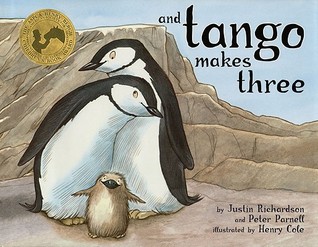
Description: At New York City's Central Park Zoo, two male penguins fall in love and start a family by taking turns sitting on an abandoned egg until it hatches.

Review: And Tango Makes Three is based on a true story about a charming penguin family living in New York City's Central Park Zoo. In this heartwarming story, readers will meet Roy and Silo, two male penguins, who are "a little bit different" than the other penguins. They cuddle and share a nest like the other penguin couples, and when all the others start hatching eggs, they too want to be parents. Determined and hopeful, they bring an egg-shaped rock back to their nest and proceed to start caring for it. They have little luck, until a watchful zookeeper decides they deserve a chance at having their own family and gives them an egg in need of nurturing. The dedicated and enthusiastic fathers do a great job of hatching their funny and adorable daughter. Done in soft watercolors, the illustrations set the tone for this uplifting story. The words are matched well with the illustrations and the message of tolerance and a broader definition of family is well received.

Rating: 4 stars


Reason why it was banned/challenged: And Tango Makes Three is frequently challenged since its publication of 2006. It has appeared on the list several times between 2006 and 2010 for the following reasons: homosexuality, religious viewpoint, and unsuited to age group. 

Words of Caution: None. Recommended for Pre-school to Grades 3. Though the book is about two male penguins, I don't see any agenda of imposing homosexuality to kids, but rather showing that a family no matter how family is designed all have the same concepts at its core: love, warmth, and tolerance. What are we telling kids who are raised by GLBT adults? That they aren't loved and they aren't normal? It amazes me that a simple book like Tango can generate so volatile opinions while TV shows like Modern Family that also features two male partners raising a child can garner so many accolades and be accepted by so many people.

If you like this book try: The Family Book by Todd Parr, The Very Best Daddy of All by Marion Dane Bauer

Description: A retelling of a mother's account of what happened to her family during the Flash that destroyed Hiroshima in 1945.

Review: Hiroshima No Pika is a striking picture book that details one of the horrific events of history: the dropping of atomic bomb in Hiroshima, Japan. The book is filled with watercolor paintings which reinforce the colors of flames and debris, vividly heightening this low-key text recounting the fictionalized experiences of a 7-year-old Hiroshima child and her mother after the 1945 "Hiroshima flash." The story told in precise and easy sentences send chills down your back with its easiness. Like most people, you only hear about the event but when you read Hiroshima No Pika, you are given a tiny glimpse of what true horror is really like.

Rating: 4 stars. Recommended for Grades 4 and up.

Curriculum Connection: Social Studies


Reason why it was banned/challenged:  According to the MVCC Libraries, the book was challenged because it "does not depict war as glorious (graphic depiction of   victims of bombing of Hiroshima).

Words of Caution: There is nudity and strong images of violence. The book does not shy away from the dark side of war: causalities, destruction, and an abrupt change to life. The pictures, though hard to take in because of how much is inflicted by the people of the story, show just enough detail of horror without going overboard. Though not a book that would used as a read-aloud, it would serve a great purpose in discussing World War II with mature students such as older elementary students and above who can understand the book and its context. 

If you like this book try: Baseball Saved Us by
Rummanah Aasi
   Manga Mondays is a meme hosted by Alison at Alison Can Read where bloggers can share their passion for reading mangas. It's a great place to get new manga titles to try and to meet new bloggers. Now that I'm at a stand-still for the Nana manga series, I'm trying to catch up on some of my other ongoing manga series. Today I'll be reviewing the seventh volume of the Library Wars.

Description (from Goodreads):  Hikaru's big brother is working for the enemy, and he wants to reunite with Hikaru. Meanwhile, someone is posting negative reviews on the library's website, and Kasahara intends to find out who. Later, personal issues are set aside when the Library Forces find out about a book burning on their home turf!

Review: The Library Wars is a hit or miss manga series for me. I honestly don't care much for the comedy, romance or fighting, but I am interested on the different political scenarios that are involved with libraries, particularly that of censorship and library patron's rights. Volume 7 has a much serious and direct, giving us an ample amount of suspense and intrigue to hold our attention more so than the previous lighthearted volumes.
  The plot this time around focuses on the ethics of censorship and partisan politics within the library system. Freedom of speech, whether or not libraries should become a government agency rather than a public good, and book burning are all dealt with and for the most part quite well in the book. Each issue is tackled separately though they all come together in the end.
  Though there isn't much growth in the romantic, relationship department, we do get to know more about the  sibling bond between Hikaru and his old older brother. Hikaru has always been seen as a serious, distant competitor, but we get to see a more human and three dimensional aspect to him when he expresses his concerns about the library rights which are completely against his brother's pro-censorship faction. The tension and suspense picks up nicely in a cliffhanger where poor Iku is unknowingly found in the middle of a book burning scandal which may or may not have been organized by Hikaru's brother. Iku must use her wits and her instructor Dojo's advice to prove her innocence.

Rating: 4 stars

Words of Caution: There is some language and adult themes. Recommended for teens and adults only.

If you like this book try: Library Wars Vol. 8 by Kiiro Yumi,
Rummanah Aasi
 I find reading banned or challenged books to be like a treasure hunt of some sort. You are given a person's (or persons') reasons for objecting the book and then you can read it with their lens. Sometimes you can kind of see where the objection is coming from while other times you can't seem to make a logical connection. Three Wishes by Deborah Ellis hasn't stirred much controversey in the U.S. but it is one of top challenged books in Canada.

Description: Deborah Ellis's enormously popular Breadwinner trilogy recounted the experiences of children living in Afghanistan; now Ellis turns her attention to the young people of the Israeli-Palestinian conflict. After visiting the region to conduct interviews, she presents their stories here in their own words. Twelve-year-old Nora, eleven-year-old Mohammad, and many others speak directly about their lives - which prove to be both ordinary and extraordinary: They argue with their siblings. They hate spinach. They have wishes for the future. Yet they have also seen their homes destroyed and families killed, and live amidst constant upheaval and violence.This simple, telling book allows young readers everywhere to see that the children caught in this conflict are just like them - but living far more difficult and dangerous lives. Without taking sides, it presents an unblinking portrait of children victimized by the endless struggle around them.

Review: Three Wishes is a hard and uncomfortable read not due to the book's writing style, but of the unflinching, honest, and often times bleak accounts of how war takes a toll on the lives of young people between the ages of 8 and 18. Instead of looking toward their futures with optimistic eyes, these kids really don't know whether they are going to be alive tomorrow. Instead of doing what we would call normal kids activities such as playing in the streets, they're lobbing rocks at soldier's and dodging tear gas and bullets.
  Presenting both sides of the conflict, Israeli and Palestinians kids talk openly about the conflict. Each narrative is prefaced with a short historical or personal background description providing a point of reference for the sentiments expressed. Anger, despair, and fear ripple through the story where you can see the constant cycle of violence takes their tow. Ellis effectively remains absent, serving as chronicler for these ordinary kids in traumatic circumstances. The three wishes range from being a doctor to wishing the war to end to simply wanting to grow old (something which I never considered as a wish). Along with the text, there are black-and-white photos of the narrators and of scenes in Ramallah and elsewhere where the children are from are included. Three Wishes is a heavy read, but it's a really good presentation of a confusing, complicated historic struggle told within a palpable and perceptive format.

Rating: 4 stars

Curriculum Connection: Social Studies, Current Events

Reasons why it was banned/challenged: In 2006 in Ontario, Canada, the Canadian Jewish Congress (CJC) urged public school boards to deny access to this children’s non-fiction book about the Israeli-Palestinian conflict to students in the elementary grades. The CJC said that Ellis had provided a flawed historical introduction to the Israeli-Palestinian conflict and that some of the children in the book portrayed Israeli soldiers as brutal, expressed ethnic hatred and glorified suicide bombing. The effect on young student readers, the CJC said, was "toxic."
 
Update: Although the Ontario Library Association (OLA) had recommended Three Wishes to schools as part of its acclaimed Silver Birch reading program, and although schoolchildren were not required to read the book, at least five school boards in Ontario set restrictions on the text:

a) The District School Board of Niagara encouraged librarians to steer students in Grades 4–6 away from Three Wishes and to tell parents that their children had asked for the book.

b) The Greater Essex County District School Board restricted access to the book to students in Grade 7 or higher.

c) The Toronto District School Board restricted access to the book to students in Grade 7 or higher and withdrew the book from school library shelves.

d) The Ottawa-Carleton District School Board refused to stock the book and refused to provide copies to students who asked for it.

e) In 2005, before the CJC made its views about Three Wishes public, the York Regional District School Board also withdrew the book from the Silver Birch program.

Protests by the OLA, The Writers’ Union of Canada, PEN Canada and the Association of Canadian Publishers failed to persuade the school boards to repeal their restrictions. Source: Freedom to Read

Words of Caution: The objection to Three Wishes is clearly politically motivated. It's interesting that only one group presented in the book raised objection to the book. Yes, Israeli soldiers where depicted at times to be brutal, but how would you describe someone who demolished your house and kicked you out on the streets? The Palestinians people were also depicted as suicide bombers and terrorists, but there is no objection to this particular part of the book. Yes, attacks were discussed more passionately in some of the childrens' lives because they experienced the attack first hand-either they knew the person directly responsible or had loved ones who died. Without giving the situation context or understanding the other's thought process, it's easy to misconstrue their feelings. I'm not saying what the childrens are advocating is right, but that's what they think and perhaps this is the place where we can start to change hatred into peace and understanding.
  As a librarian and educator, I find it offensive to imply that anyone would blindly give this book to a child without providing them enough information about the topic. The book presents an opportunity for discussion, which what I personally think is the objective of writing this controversial book. There are not that many good books written on this topic for children and young adults. Furthermore, I'm not entirely sure what the CJC means by Elli's book not being accurate. You can't write a nonfiction book without real sources and authority. The book does have bibliographical references. I would definitely recommed this book for Grades 5 and up who've learned about this region in their classrooms.

If you like this book try: Samir and Yonatan by
Rummanah Aasi
   I'm privileged to have Alex Flinn here on the blog today. Though she's mostly known for her sweet, romantic, and popular fairy tale retellings such as Beastly, A Kiss in Time, and Bewitching, Alex is first book is the gritty, realistic fiction novel, Breathing Underwater, which was challenged but ultimately retained in the Richland School in Washington this year. I actually read about the challenge off of Alex's facebook page and asked if she'd be willing to chat about her experiences of having her book challenged and the writing process of Breathing Underwater. She graciously agreed. Before I get to the interview, I wanted to give you a brief bio on Alex.

   Brief Bio: Alex was born in Glen Cove, New York. Before going to law school, she received a degree in vocal performance (opera) from the University of Miami. She practiced law for ten years before becoming a full-time author. She based her first book, Breathing Underwater, on her experiences interning with the State Attorney's Office and volunteering with battered women. Breathing Underwater won the Maryland Black-Eyed Susan Award in 2004.


  Thank you so much for doing this interview, Alex. How did you find out that Breathing Underwater was challenged? What were your first thoughts upon hearing the news? 

  I found out from a Google alert. I've actually been surprised Breathing Underwater hasn't been challenged more, since it has a few swear words, and I know some people think that's important. I think I've had an easy time because, since Breathing Underwater is a problem novel, maybe its value is more obvious (i.e., schools can say that it teaches about dating violence) than with another type of novel. That said, I was sorry it was being challenged because I do think it has great value and the kids might not get to read it. I was also surprised there wasn't more of an uproar about it. The same district challenged Sherman Alexie's book [Rummanah's note: The book Alex is referring to is The Absolutely True Diary of a Part-Time Indian which is awesome and a must read] last year, and everyone was up in arms. I don't know if my book is viewed as having less value so the censorship doesn't matter or if people are just bored, but it didn't seem like anyone really said anything in its defense.

 What does censorship mean to you as an author and as a reader? 

I think it's a shame because it keeps kids from being able to read a book they would enjoy and that might benefit them. In the case of Breathing Underwater, the challenges I have had have either been based on someone not reading the whole book (I've heard comments about not liking Nick's attitude toward women which, of course, is the whole POINT of the book, which someone would understand if they read the whole thing) or a few swear words that everyone has heard anyway. I'm a parent too, and I do pick and choose what my own kids would be exposed to, but I think it should be an individual decision. Also, it sort of amazes me that parents will let their kids see all sorts of violent PG-13 movies in grade school but will recoil at a mild swear word in a book. I guess that attests to the power people give books.


 In your opinion, what is the purpose of realistic fiction? Why is this genre so easily targeted by censors?

Realistic fiction portrays the world in a realistic way. Some readers don't care for it, but a lot of kids (including kids who don't read much at all) will read nothing but realistic fiction. I think it is easily targeted by censors because they either don't want to face that their kids are aware of certain issues or language or because they wish they weren't and want to blame a book. Also, I've seen reviews indicating that a parent was upset that a character in one of my books didn't share their values. Unfortunately, books can't all be about good kids doing wonderful things or they wouldn't have much of a story. A character needs to have flaws in order to have personal growth. For example, Kyle in Beastly is a jerk. He swears. He treats women as objects. I'm not advocating those things and I think readers know that. But that is why he needs to have a book written about him, because it is about him learning that those things are wrong. If he was a great guy, there would be no story. I think the kids get that but, again, if you skim, it's not as obvious.


  Most of the challenges arise from parents. As a parent yourself, have you previewed books for your kids? What advice would you give parents who are completely new to the YA realm? 

Frankly, I'm pickier about movies, but I do notice what my kids are reading. For the most part, my daughters haven't been all that interested in reading books above their age group (The one exception was the Twilight books, and I allowed my daughter to read the first three but not the fourth at age eleven). If I have a real question about a book, I have checked the School Library Journal reviews, which any parent can see on Amazon. Common Sense Media, though sometimes maligned by authors, is not a bad site either. I think they usually place a book as being about a year older than I would. Language, for the most part doesn't bother me, but I recommended that my daughter hold off on reading The Hunger Games until she was twelve just because it was scary. If she'd really wanted to read it, I would have let her, but I suspected she wouldn't like it. She did wait but eventually read the books.


 What is your favorite challenged/censored book you've read and why?

To Kill a Mockingbird because it's a great book.


Why did you want to write about dating violence? 

I volunteered with battered women and I thought it was an important and interesting issue.


Most of the books, at least the ones that I'm familiar with, on dating violence are told from the female point of view. What made you decide to write it from Nick's point of view? 

He was the only character that knew that side of the story. I've always liked to consider why people do what they do. When I was a young teen, I became familiar with Sondheim's musical Sweeney Todd, which was the first time I'd ever seen someone give voice to a character who was doing something really bad, yet sought to see his point-of-view. I also had the bizarre experience of being in three different English classes (in 10th, 11th, and 12th grades -- I switched schools) that read The Crucible and then being in a production of the opera in college, as one of the crying out girls. This is another play that really explores the roots of evil, what makes people do what they do, if they know it is wrong or not. I researched that era a lot and found that one of the girls (in real life) portrayed in that play (Actually, the girl I played) actually did apologize to the families of the women who were hanged on her evidence. So, did she know at the time? Did she not understand what it meant to accuse people who would then be killed? Was she too young and just following her parents? Or was she just so caught up in what was happening, as Mary says in the courtroom scene, that she didn't realize what was real and what wasn't? I am very fascinated by people's motivations. In my mind, and from the research I did, Nick (abusers in general) really did not realize he'd done anything wrong and was able to justify his actions to himself. The story, of course, is about him realizing that he can't continue to do so.


What character surprised you the most while writing Breathing Underwater

Nick. I started writing the book in the girl's viewpoint with just a scene or two in Nick's viewpoint, but I became completely obsessed with him.


I was surprised to read Nick's clarity in his journals, which made the book that much more powerful to me. Why did you decide to use the journal motif instead of the group therapy? 

I like split narrative books like this, such as The Prince of Tides or Rob Thomas's Rats Saw God. That was what I wanted to do, two stories that dovetailed. The journals seemed like the best way to do that.

It's been 11 yrs since Nick's story was written. Where do you imagine him to be today?

I always tell teens he's going to go to college and lead a blameless life, which is why I can't write a sequel to his story.

  Thank you so much for taking the time to chat with us, Alex. I would like to think the quietness surrounding the book to mean that the book's purpose is quite obvious. 4 out of 5 board members agreed to leave the book on the 12th grade curriculum list and I've read teachers views on the book's importance and power.
   As a librarian I feel obligated to let parents know of any red flags that are found in the books that I feature on my blog just as if they had asked me about the book on my library shelves, which is how I came up with the "Words of Caution" part on my blog. I want to give the parent enough information so they can make the ultimate decision. Only a parent and child can know what is right for them.
Rummanah Aasi
  It's Monday! I'm joining my blogging friend, Alison from Alison Can Read, on her manga meme Manga Mondays where bloggers can discuss manga we've read. I'm very much a newbie when it comes to manga and I like experimenting with different genres and series. Today I'll be reviewing the volume 6 of Library Wars.

Description: It's Valentines Day in Japan. Iku finds her hopes for this special day ruined when her crush, Dojo, receives a box of chocolates from an admirer. Meanwhile the beautiful and flirtatious Shibazaki meets a suitor and Hikaru thinks he is being followed.

Review: This volume did really do much for me. It definitely felt like a filler/transition book. Nothing exciting happens and the characters are just riding along. 
The plot seems to split into three story lines. The first story line is a censorship issue wasn't well developed in my opinion. The Weekly World News magazine has printed an article about the teen serial killer and it has been banned by the new head librarian, which shocks everyone in the Library Task Force. I was confused about exactly why the library would consider censoring the article at all. It sounds counter intuitive if the purpose of the library is to ensure access to information for all. Maybe the article's writer use illegal sources and thus what is printed isn't allowed to be shown to the public because of the prisoner's rights? If so, then how the author get access to person in question's library history? As far as I know, libraries are not allowed to hand out patron history records to anyone even the government. The government would have to have a warrant or other documents in order to get anywhere near the history. I simply can't understand how this issue came to this decision.
 The second story line is about Shibazaki, Iku's roommate and friend. We gain a little insight into her past and her personality. Basically, she's just putting on a show on how others feel like she should behave in order to be well liked and popular. I do like Shibazaki in general and it's nice to know that she isn't all that confident and all knowing as she appears. She is more human and fragile in this volume. She meets a suitor who I think might become a recurring character and I hope that relationship is something to root for. 

  The third story line focuses on Tezuka, who believes someone is following him. Since this story line occurs in the last few pages, it doesn't have much time to develop. We do meet his mysterious brother, who may or may not work for the enemy. 
 In addition to these story lines, there are bonus chapters that focus on the Library Task Force team going out to a spa resort together and they happen to stop robbers who robbed a near-by bank from running away. The same nauseating Iku and Dojo 'banter' occurs and there are some slapstick humor and violence that occurs. Overall, this volume was okay and I probably wouldn't have missed much if I skipped it altogether. 

Rating: 3 stars

Words of Caution: There were several bath scenes with the two girls completely covered by the water, but then there was a scene where only strategic placement kept Dojo decent. No real language and much less violence in this one with the biggest injury being Iku's run-in with a door jam. Rated T for teens.

If you like this book try:  Library Wars Volume 7 by Kiiro Yumi, Saturn Apartments by Hisae Iwaoka, Kingyo Used Books by Seimu Yoshizaki
Rummanah Aasi
I'm joining my blogging friend, Alison from Alison Can Read, on her manga meme Manga Mondays where bloggers can discuss manga we've read. I'm very much a newbie when it comes to manga and I like experimenting with different genres and series. Since I get so many responses from readers who are interested in manga but don't know where to start, I will be making a few informational posts on this topic soon. Today I'll be reviewing the volumes 5 of Library Wars.

Description (from Goodreads): Iku is about to face her most difficult challenge--her parents are coming to visit the library where she works When she joined the Library Forces, she told her parents that she was just going to be a librarian. Now she has to come clean that she's on the ultra-dangerous Task Force. Can her parents ever accept that she's a library warrior?


Review: Volume 5 picks up immediately where volume 4 ends. Iku is still very stressed out because her parents are visiting her and she is desperately trying to cover her real position as a soldier with an ordinary, less dangerous library clerk job. Iku's parent's are on the last day of their visit and despite Iku's attempts they discover her real job. At first they are a bit concerned of having their daughter on the front lines, but Iku's colleagues ensure that Iku is very passionate about her job and tries her best. 
  To my surprise and very much delight the plot of this volume changes pace and concentrates on a side story about Instructor Komaki and a love interest. I really like Komaki as a character. He is laid back and cool headed unlike the Dojo who is a complete jerk. While a whole chapter is dedicated to him, I wanted to spend more time with him and wished he was the main character instead of a side one. Anyway, we learn about Tomaki's past and his developing relationship with a neighbor and friend's daughter. The relationship is very cute, sweet, and exactly what I thought was missing from this series until now. Tomaki treats his love interest with respect and though there is a big age difference between them (about 10 yrs or so) I didn't find anything 'sick' about it. This chapter was paced just right as we witness Tomaki being arrested due to idle untrue gossip, by the MBC (Media Betterment Committee) and held for several days while being tortured. The story mainly involves the team figuring out a way to rescue him. I must mention that Iku takes the initiative in rescuing Komaki. I must also mentioned that she is slapped another time by Dojo for disobeying him, which is totally uncalled for and made me chuck the volume across the room. Of course, Iku's plan worked and Dojo was proved wrong, unapologetic.
The "I love you/I hate you" see-saw of Iku and Dojo makes me squirm. I don't find it entertaining at all. There is suppose to be a funny, tender moment between the two towards the end of this volume where Iku has to get all dressed-up-hair, makeup, and all-for a party and is hit on by all the men. Dojo who rescues when an overly ardent admirer has her trapped against a wall. Too bad there is no one to rescue Iku from Dojo when he is being equally offensive. Another decent read with a great sideline departure with the focus on another character for a change.


Rating: 3.5 stars


Words of Caution: There is some language, crude humor, and some violence. Recommended for teens and up.

If you like this book try: Library Wars Volume 6 by Kiiro Yumi
Rummanah Aasi
I'm joining my blogging friend, Alison from Alison Can Read, on her manga meme Manga Mondays where bloggers can discuss manga we've read. I'm very much a newbie when it comes to manga and I like experimenting with different genres and series. Today I'll be reviewing the volumes 4 through 6 of Library Wars.

Description (from Goodreads): Iku and Commander Inamine are abducted by Bakushu-kai terrorists, who demand sensitive material from the library's protected collection in return for the hostages! Dojo is worried about Iku, his problem student with limited field experience. But what Iku lacks in training she more than makes up for in gumption, and she is not going to let library material go without a fight!

Review: The fourth volume of Library Wars is a mixed bag for me. I liked some parts and didn't like others. I think my mixed reaction mainly stems from the central relationship in the manga, that of Dojo and Iku, which I, personally, find troublesome. I know I mentioned this in my other reviews for this series thus far; I'll try to explain my issues in this review since the romantic angle is emphasized much more in this installment.
  Iku is a likable female character who is fiery, passionate yet somewhat impulsive. She entered the library task force as a guard after a personal run in with the censors herself while browsing at a local bookstore as a teen. When a male guard protected her rights to read, she dubbed him her prince and fell in love with him and in his profession. She vowed she would do the same when she became an adult. When Iku enters the library task force, she is practically bullied by Dojo, her boss. He berates her constantly and calls her an idiot more than I can count. In fact in one vivid moment in the first volume, Dojo slaps her very hard as a punishment. After that moment, Dojo never apologized and Iku believes he was justified in treating her so because it was her fault. Since that moment, I've been very uncomfortable reading about Iku and Dojo.
 In this volume we get a rare moment where we read from Dojo's perspective. He actually thinks about Iku and more specifically her good qualities. We dare say that he actually has developed feelings toward her. Some may think Dojo is a great love interest, but I really don't see it at all. One minute he can be caring and nice, offering his support and encouragement and the next he can be a down right brute. We are told he behaves this way because he knows the identity of Iku's prince but doesn't want Iku to know that he knows. His "cruel to be kind" ways frustrate me and I secretly hope for Iku to have another love interest so I don't have think about him.
  Despite my issues with the romance, there are parts that I did like in this volume. Iku gets a chance to shine. As the manga opens, Iku finds herself in a hostage situation with a library Commander and tries to find a way to escape. Instead of cowering into a corner, Iku uses her smarts and quick thinking to alert her colleagues of her location so they can help get her and the Commander out. She also struggles to not be a disappointment to her parents and tries very hard to make them proud. I also like that this volume also gives the reader a chance to learn a bit more about the secondary characters, especially Tomaki whom I've come to really like.  Though a backseat to the last stronger two volumes, this one was readable and just okay. 


Rating: 3 stars

Words of Caution: There is some violence, language, and a scene of drinking at a bar where Iku gets drunk. Recommended for teens and adults interested in libraries and reading about censorship.

If you like this book try:  Library Wars Vol 5 by Kiiro Yumi
Rummanah Aasi
I'm joining my blogging friend, Alison from Alison Can Read, on her manga meme Manga Mondays where bloggers can discuss manga we've read. I'm very much a newbie when it comes to manga and I like experimenting with different genres and series. Today I'll be reviewing the third volume of Library Wars.

Description (from Goodreads): Iku is witness to a disturbance during a Board of Education speech on protecting children from the danger of books. The perpetrators are two young boys protesting the banning of their favorite books. But while Iku wants to reach out to the next generation of book lovers, Dojo insists that they can't play favorites. Will Dojo's prickly insistence on sticking to the rules ruin their budding friendship?

Review: The stakes are raised higher in this installment of Library Wars. The concept of library workers fighting on the side of the Library Freedom Act is what makes me come back to this series. I'm interested in the many ways the freedom to read is challenged in this manga. In this volume, we have two story lines. In the first, there are two teens who protest about the Board of Education banning their favorite books. Although they go about the protest in the wrong way with igniting fireworks during a meeting and causing chaos and commotion, it is obvious that the two teens are serious about their rights being taken away. After being questioned about their motive by the Library Defense, the two teens work on the presentation to display their concern. Unfortunately, they aren't taken seriously at first because of their age.  In the second storyline, an FBI-like government agency wants to retrieve the library records of a criminal and various employees react to how the Library Defense goes about protecting civilian rights. I found the different perspectives on the library rights really interesting and it had me thinking about what I would have done if I were in their position. 
   The only problem, which is a big one, I have with this manga series is how Iku is treated badly by her male coworkers particularly with those she works closely with on various projects. She is constantly underestimated, belittled for her small mistakes by Dojo who serves as the love interest, and how she is obsessed by getting in Dojo's good graces. Normally, I read shojo in order to see how the romance and relationship progresses but not for Library Wars. The third volume ends in a sort of cliffhanger and I've already checked out the next three books in the series to see what happens next.

Rating: 4 stars

Words of Caution: There is some language and violence, which I would rate as PG-13.

If you like this book try: Library Wars Volume 4 by Kiiro Yumi
Rummanah Aasi
 I'm joining my blogging friend, Alison from Alison Can Read, on her manga meme Manga Mondays where bloggers can discuss manga we've read. I'm relatively new to manga and take more risk into finding out which genres or series to follow. I generally check around to see what is popular and/or recommended by other reviewers. Today I'll be reviewing the second volume of Library Wars.

Description (from Goodreads): In the near future, the federal government creates a committee to rid society of books it deems unsuitable. The libraries vow to protect their collections, and with the help of local governments, form a military group to defend themselves---the Library Forces! When the director of the Kanto Library Base gets sick, a temporary replacement is assigned, according to regulations. But Iku and her roommate Asako discover a trail of missing books that lead back to the temporary Director. Has he betrayed everything the Library Forces stands for and handed books over to the enemy?!

Review: I didn't really care for the first volume of Library Wars, which emphasized the romantic, in my opinion troubling, angle rather than the really interesting premise of fighting for the freedom to read and battling censorship. Though I liked the premise of the manga enough, I decided to read the next volume. Though some of my issues regarding the relationship angle are still there, I did enjoy this volume much more.
  Volume 2 is much more eventful. We dig a little deeper into the characters and the potential relationship between Kasahara and Dojo. Kasahara is a sweet,likable girl who is reckless, impulsive, and emotional though she does have a good head on her shoulders and have good intentions at heart. I have issues with Dojo who continually berates her in one heartbeat and then in another can be caring. Dojo gives me whiplash with his mood swings. I guess you could call their relationship a love/hate one. Unlike many other shojo manga that I've read, which concentrates on romance, I really don't care for their relationship right now. I'm much more interested in what the Library Forces do and the different cases they tackle.
 It was nice to see Kasahara get her first taste of action when the library has its first raid since she joined the staff. The team all knows an insider has been working with the government, though they can't prove it yet, and he's helped set up the book grab for the raiders. This time censorship is occurring within the system that was protected against it. I'm not sure if many people know, but this does happen in real life with many libraries. I worked with a woman in the past who would cut out pictures from Rolling Stone that she felt was inappropriate. You can image what was left of the magazine when she was done. I hope the series gets more interesting and digs a little deeper in its premise.


Rating: 4 stars

Words of Caution: There is some language and violence, which I would rate as PG-13.

If you like this book try: Library Wars Volume 3 by Kiiro Yumi
Rummanah Aasi
  Out of the seven books I've read for Banned Books Week, I'm more shocked and confused as to the reasons why Barbara Ehrenreich's best selling book Nickel and Dimed was challenged. The book is listed as the 8th most challenged book in 2010. With our economy in shambles and unemployment increasing, I would think more people would want to read Nickel and Dimed.


Description: Millions of Americans work full time, year round, for poverty-level wages. In 1998, Barbara Ehrenreich decided to join them. She was inspired in part by the idea that having a job can be the ticket to a better life, but how does anyone survive, let alone prosper, on $6 an hour? To find out, Ehrenreich went undercover and discovered the dark side of U.S. employment.


Review: I've heard great things about Nickel and Dimed for quite sometime, but never got around to actually reading it until now. I admit my expectations for the book were pretty high and I was a bit disappointed when the book didn't meet them. I was expecting a bit more of an analysis about the minimum wage jobs and more of a self-reflection from Ehrenreich herself, however, the book presents itself as a sociological experiment noting down only the results and very little explanation. 
   Ehrenreich is a well known social critic. After having lunch with a magazine editor at a pricey restaurant, Ehrenreich wonders aloud what it is like to be on the bottom of the working class. How can anyone survive just by working at a job that pays below the minimum wage? Ehrenreich curiosity led her to a social experiment where she subsequently spent about three months in three cities throughout the nation, attempting to "get by" on the salary available to low-paid and unskilled workers. Unlike many others who are employed at extremely low paid jobs, she is white, English-speaking, educated, healthy, has transportation and burdened by a family to take care of. During her stint at three cities, Ehrenreich tried to support herself by working as a waitress, a cleaning woman, a nursing-home aide, and a Wal-Mart employee. While employed she discovered that her average salary of $7 per hour couldn't even provide the necessities of life such as rent, transportation, and food, let alone the luxury of health coverage. 
  Enrereich's personal account is eye opening, enraging, and sobering. She holds nothing back as she describes how labor-intensive, demeaning, and controlling such jobs can be. I found the sections about her various jobs interesting. I had a hard time trying not to read the book as a novel but as an essay instead, but that is just because I'm so use to reading fiction with fast paced novels. In a concluding chapter, Ehrenreich takes on these issues and poses questions before and during the experiment such as why these wages are so low, why workers are so accepting of them, and what Washington's refusal to increase the minimum wage to a realistic "living wage" says about both our economy and our culture. There are a lot of questions asked but not many possible solutions given.


Rating: 3.5 stars


Curriculum Connection: Social Studies, Business Education


Why the book was challenged/banned: In 2010 at the Easton, Penn. School District (2010) the book challenged due to a parent's claim the book promotes “economic fallacies” and socialist ideas, as well as advocating the use of illegal drugs and belittling Christians. Despite these claims, the book was retained, however; the book was removed from the Bedford, N.H. School District’s required Personal Finance course in 2010 after two parents complained about the “book’s profanity, offensive references to Christianity, and biased portrayal of capitalism. Source: ALA


Words of Caution: I'm not sure how the book promotes "economic fallacies". It's hard to deny jobs that there are jobs available that pay less than the minimum wage and often times these jobs are the less desirable ones. Though Ehrenreich does lean towards a socialistic viewpoint and uses words such as proletariat and bourgeoisie in her description, I don't necessarily find these terms to express socialist ideas but just ways to show the large difference between the high earning and low earning classes. The author doesn't mention about income distributing equally but rather wanting workers to protest to get a better wage for themselves and stand up for their rights. There is language in the book, which in my opinion, shows how frustrating the circumstances the author finds herself in. As for the use of the illegal drugs, the author points out how often the question of drug use appears on job applications and is a concern of employers. In regards to the belittling Christians, there are a few references where Enhrenreich compares being a maid to a prostitute as stating Mary Magdalene's job which I agree is in bad taste. Due to the book's content, I would recommend to adults and high school students interested in economics and social issues. 


If you like this book try: Kara, Lost by Susan Niz or Fear of Falling: The Inner Life of the Middle Class by Barbara Ehrenreich


   According to Random.org, the winner for the The Predicteds giveaway is Sablelex! Congrats, Sablelex . I sent you an email. Please respond within 72 hours or I will have to pick a new winner.
Rummanah Aasi
  I've meant to pick up Kevin Henke's Olive's Ocean for quite some time. The book has received many starred reviews as well as nominated for the Newbery Award in 2004. Olive's Ocean goes to show that even award and critically acclaimed books aren't safe from challenges either.

Description (from the book's inside panel): Martha Boyle and Olive Barstow could have been friends. But they weren't-and now all that is left are eerie connections between two girls who were in the same grade at school and who both kept the same secret without knowing it.
  Now Martha can't stop thinking about Olive. A family summer on Cape Cod should help banish those thoughts; instead, they seep in everywhere. And this year Martha's routine at her beloved grandmother's beachshide house is complicated by the Manning boys. Jimmy, Tate, Todd, Luke, and Leo. But especially Jimmy. What if, what if, what if, what if? The world can change in a minute.

Review: Olive's Ocean opens with a very simple yet powerful opening scene that stirs our emotions. Our main character, Martha, opens the door and is greeted by a strange woman holding an envelope announces who announces: "Olive Barstow was my daughter." Olive, a schoolmate that Martha had barely noticed, has recently been killed in a car accident. The envelope contains an extract from Olive's diary in which she shares her dreams, including the hope that Martha, who she states is "the nicest person in my whole entire class," would become her friend. With this original and compelling opening scene Henkes draws us into one summer in the life of a familiar, convincing, likeable twelve-year-old girl. A girl who is slowly losing her childhood innocence as she realized that we are all mortal.
  I liked Martha right away. She is a quiet, introvert who keeps her dreams of becoming a famous writer a secret in fears that her aspiring-writer father will think she is just copying him. She slowly comes out of her shell as her eyes are open to the world around her. Martha experiences at her grandmother's house has all the elements of a traditional summer novel: a house by the sea, playing at the beach and board games, and a summer crush. The book's setting offers the idea of summer as the time between, the hinge time of growth and change.
  What sets Olive's Ocean apart from all the other summer novels is that at its core the book is about the web of relationships with Martha. Like many younger siblings have witness and experienced, Martha's older and beloved brother begins to pull away, the first indication that times are changing. Martha sees her grandmother with new eyes, one who has a world of experience yet still retains vulnerability and insecurities in her old age. Martha and her mother can't seem to stop irritating each other. Her summer crush turns out differently from what Martha expected. All of these relationships are created and feel natural. The heavy issues of realizing death's sudden appearance are handled with care, grace, and humor. You can tell that the author has respect for his characters and they all come alive on the page. Although we don't know who the real Olive is, we do get a chance to see what her life could have been as we vicariously live through Martha's experiences. Olive's Ocean is a deceptively clever and complex look at how the life of another can add dimension to our own existence.

Rating: 4 stars


Why it was challenged/banned: Olive's Ocean was number 59 on the list for the most challenged book from 2000-2009 due to the book's "sexually explicit content and offensive language". I'm a bit surprised at the sexually explicit content charge since nothing even remotely sexual happens besides a kiss, which was even detailed. I'm guessing this claim was raised when Martha's 13 year old brother makes an offhand comment that his parents are exhibiting "morning sex behavior". The comment is something that I would expect a boy undergoing puberty to say. I'm sure many reasons would gloss this over and realize that the parents are happy because they have resolved their problems. There is mild language in the book, but nothing that you wouldn't find on a middle school playground or even a PG movie. 

Words of Caution: Mild language. I would recommend this book to strong Grade 5 readers and up.

If you like this book try: Shug by Jenny Han or The Austin Family Chronicles (particularly A Ring of Endless Light) by Madeline L'Engle
Rummanah Aasi
  Like Lush, I never heard of Adam Selzer's debut middle grade novel How to Get Suspended and Influence People before. I'm not sure if I would have gone out of my way to check it out, but I saw it listed on a challenged list by ALA and that in it of itself made me curious. The book tackles the ever controversial sex education curriculum in schools. 

Description: Gifted eighth-grader Leon Harris becomes an instant celebrity when the film he makes for a class project sends him to in-school suspension.

Review: Leon Harris is our sarcastic, smart aleck, and extremely witty narrator. He is a gifted eighth grader who participates in an advanced studies activity along with several of his equally intelligent, socially outcast friends. For their first assignment, each advanced student must film an educational health or safety advisory video to be shown to the younger middle-school students. Leon immediately thinks of the boring videos that he and his classmates have seen throughout the year particularly the out dated and uncomfortable sex education videos that never really address that plagues the ordinary tween. Leon decides he wants to do a sex-ed video that will address his peer's issues and anxiety with honesty so he signs up for the sex-ed topic. He decides to deviate from boring anatomical line drawings and cheesy cartoons in favor of a surreal, avant-garde video inspired by Fellini and Salvador Dal!. In fact he goes even further and names his movie La Dolce Pubert. He knows he can't use real nudity in his movie but cleverly goes around this issue by using a montage of classical nudes with close-ups on the 'good parts' and frank rhyming narration that comes off as quite comical and tongue in cheek. 
  While his advanced studies teacher applauds Leon's creativity, the moralistic and conservative teacher, Mrs. Smollett, who heads the gifted program finds Leon's video inappropriate for the student body. Her interference with Leon's video results in Leon's suspension. Leon's peers' interest in the video skyrockets and Leon becomes an instant celebrity. Whether or not Leon achieves victory is what the second half of the book is about. 
  I liked Leon. He is definitely a lot wiser than his years. His intention of making a sex-ed video never deviates from making an educating video that states "it's okay. it's normal". I don't think he even thought he could reach celebrity or fame with his video nor does his head swell up when he does. The book is definitely more slanted to the unconventional bent that clearly empathizes with Leon's attitude toward school, his budding relationships and the adults who seemingly don't understand him. Unfortunately, the book falls a bit flat in the last half of the book as we are told how the video is made and what Mrs. Smollet's reaction is instead of showing it. I felt the lack of describing the process lessened the impact of the book's purpose and it showcases the one dimensional opposing viewpoint. Selzer doesn't take into consideration that there are parents that oppose to sexual education being taught in schools and that opinion is also valid too. Despite these flaws, I thought the book was enjoyable. 

Rating: 3 stars

Why it was challenged/banned: In 2009 the book was challenged at the Nampa, Idaho Public Library by a parent appalled that the cover included an abstract drawing of a nude woman and the back cover contains some profanity. Source: ALA

Words of Caution: While there is an abstract drawing of a nude woman on the front cover, that depiction is most graphic as the book gets. There are no detailed graphic descriptions of which pictures Leon uses for his project. There is some mild profanity in the book, however, it is mild and not unlike what is heard in the school hallways. I would recommend this book to Grades 6 and up.


If you like this book try: The Gospel According to Larry by Janet Tashijan
Rummanah Aasi
  Author Chris Crutcher is not immune to challenges. In fact he is one of the authors listed that have been frequently challenged according to ALA. I only read a few books by the author including Deadline which was on the Abraham Lincoln list in Illinois. I just finished one of his well known book called Whale Talk.

Description: T.J. Jones is a multiracial, adopted teen, who shuns organized sports and the fervent athletes at his high school until he agrees to form a swimming team and recruits some of the school's less popular students when he is asked for assistance by his English teacher.

Review: All of Chris Crutcher books, at least the ones I have read so far, have a sports foundation that also incorporates important issues. Whale Talk has all of the author's trademarks. Adopted, biracial high-school senior The Tao Jones (his birth mother named him after a philosophy and prefers to be just called T.J.) is well-adjusted on the surface. T.J. is a smart, likable kid with a great sense of humor and athletic ability. He is your model student who effortlessly glides through school with decent grades and for the most part active in the social scene. Unlike many males in his high school, T. J. doesn't need competitive sports to create his identity. Though Cutter High School jocks and coaches see he is wasting his athletic potential and go far as calling him a traitor and other insults for not having enough school spirit.  T. J. backtracks his promise of not joining a sport when English teacher-coach Mr. Simet makes an unconventional offer: Be the anchor of the swim team and pick your teammates.  The offer is perfect, especially since racist football bully Mike Barbour has taken up letter jackets as a cause. It seems developmentally disabled Chris Coughlin has been wearing his dead brother's jacket, and Mike is annoyed. If Chris, naturally comfortable in the water, is on the swim team, T. J. reasons, Chris will earn a jacket of his own, and Mike will be put in his place.
  Whale Talk is more than your average sports book as the author also includes several side plots in his story such as T.J.'s father atoning for a past tragedy, T.J.'s therapist treating the biracial and severely abused daughter of Cutter's biggest athletic booster, and the misfit team members T.J. has assembled have their own personal problems. While this may be over the top, Crutcher handles these several topics well with honesty, humor, and wonderful insight. The characters are well-constructed characters and quick pacing add tension to how the sometimes cruel and abusive circumstances of life affect every link in the human chain. There is a heartwrenching series of plot twists leads to an end that I wasn't ready to deal with but shows that goodness at least partially prevails.
 While most people may be alarmed at the language used in this book, they are overlooking the great themes presented in the story: overcoming obstacles and adversity, everyday acts of racism, and most importantly forgiveness. If there is anything that bothers me about this book, it is the book cover which features a white male on the cover running. The cover does not reflect anything about the book or the characters at all.  Firstly, T.J. is mixed race and that is a huge part of his identity and main focus for the story. Secondly, the sport is not running but swimming. I'm alarmed at how this blatantly wrong cover could be placed on this book. It is another example of whitewashing covers of books that feature a character of color. I actually had to do a double-take when I retrieved Whale Talk from the library's bookshelf. I had thought I had made a mistake and picked up a different book. I even had to reread the inside panel to make sure it was the story. 

Rating: 4 stars

Why it was challenged/banned: Whale Talk has been challenged several time and even has been banned. Here is a look at the book's controversy: In 2005 and 2006, Whale Talk was removed from all five Limestone County (AL) high school libraries because of the book's use of profanity. It was also removed from suggested reading list for a pilot English-literature curriculum by the superintendent of the SC Board of Education. At this time, the book was also challenged at the Grand Ledge (MI) High School. In 2007 and 2008, Whale Talk was challenged at the Missouri Valley (IA) High School because the book uses racial slurs and profanity as well as challenged as an optional reading in a bullying unit at the Lake Oswego (OR) Junior High School because the novel is "peppered with profanities, ranging from derogatory slang terms to sexual encounters and violence." Source: Marshall Library

Words of Caution: Whale Talk does contain strong language, primarily with the use of the "n" word. The offensive language is not just thrown into the novel just for the sake of controversy, but rather it serves as a reason to make us uncomfortable. It is alarming how easily the word is used by the characters, but it also serves us as a reminder of how prominent it is used in our culture. Why don't we talk about racism and prejudice in a though provoking novel such as this instead of taking the easy and well stupid way out of removing it out of the discussion because it makes us comfortable? Chris Crutcher responded by to his banners and challengers. If you're curious, you can read his response here. In regards to sexual situations, there is allusion to some of the characters who have experience sexual abuse in their childhood. There is nothing explicit or graphic in the book. I think this book is suitable for Grades 8 and up.

Curriculum Connection: Teachers interested in using Whale Talk in their classrooms should take a look at this great lesson plan starter by CCHS. The ALA and AASL (American Association of School Libraries) have also created a discussion guide for teachers to use.

If you like his book try: Black and White by Paul Volponi or Response by Paul Volponi
Related Posts with Thumbnails