Showing posts with label Middle East. Show all posts
Rummanah Aasi
Description: 
Five years after a suspicious fire killed his mother, a closeted Syrian American trans boy sheds his birth name and searches for a new one. He has been unable to paint since his mother's ghost has begun to visit him each evening. The only time he feels truly free is when he slips out at night to paint murals on buildings in the once-thriving Manhattan neighborhood known as Little Syria. One night, he finds the tattered journal of a Syrian American artist named Laila Z; whose past is intimately tied to his mother's--and his grandmother's--in ways he never could have expected. Following his mother's ghost, he uncovers the silences kept in the name of survival by his own community, his own family, and within himself, and discovers the family that was there all along. Please note: The author has clearly said that his main character is trans non-binary whose preferred pronouns are he/his.

Review: The Thirty Names of Night is a complex story with multiple layers. It is a story of visibility, being, and belonging. It is a story of artists who connected by unspoken personal histories. It is a story of immigrants trying to find themselves. It is a ghost story. It is a story about birds. It is a mystery. It is also possibly the most beautiful book that I have read thus far in 2021.
     In this exquisitely, lush, and lyrical book we follow two main story-lines that will ultimately converge. In one story line we follow an unnamed narrator (for majority of the book) in contemporary New York City who is struggling with gender dysphoria, coming to terms to his own gender identity, and grieving the loss of his mother who died tragically in an Islamophobic hate crime. The narrator is unnamed because the name he was given at birth no longer fits him. Our narrator is an artist who has a creativity block, because he is constant restricted to the limitations of art just like his gender. He longs to be limitless, label-less in a world that constantly wants to place people in neat boxes. During the day our narrator cares for his ailing grandmother and during the night he paints murals of birds across New York City as an homage to his ornithologist mother as well as to Laila Z, an artist his mother admired and whose journals he discovers. 
  Our second story line follows Laila Z, a Syrian artist whose story begins in 1920 in French occupied Syria. After her family immigrates to America, she becomes an acclaimed illustrator of birds. Through Laila Z's diary we see the construction of Little Syria and its people in New York City. There is a profound sense that there has always been people who identify as LGBTQ+ in Syria in which our narrator finds comforting. It is also through Laila Z that our narrator also finds the key to unlocking himself.
  It did not take me long to get absorbed by Thirty Names of Night. I found both narratives equally compelling. Though both story lines are written in the second person and addressed to another character, it did not deter me from connecting to the characters. I read these two story lines as confessionals that are much easier told to another person than to yourself. Having our main character be unnamed is powerful and highlights the importance of agency:

“I think to myself, It is terrifying to be visible, and then I think, I have been waiting all my life to be seen."

    Little Syria, an area that I was not familiar with at all until reading this book, also becomes a character in the novel. We follow the plights of the Syrian American community and watch how it evolves from a bustling cultural community that is slowly being destroyed by gentrification. The author does not shy away from Islamophobia, struggles with faith, nor the discourse surrounding the uncertainty of the Muslim community's inclusion of the LGBTQ+ individuals, which I appreciated. 

 I will confess that I did not follow all of the details surrounding ornithology, but I liked how birds was used metaphorically throughout the book. I also really liked the secondary characters, particularly our narrator's group of friends and I wanted to know more of them. Despite these minor issues, Thirty Names of Night is a beautiful book that you should definitely add to your reading piles.  


Rating: 4.5 stars

Words of Caution: There is some strong language, implied sex scene, and Islamophobic hate crimes. Recommended for older teens and adults. 

If you like this book try: On Earth We're Briefly Gorgeous by Ocean Vuong, How Much of These Hills are Gold by C. Pam Zhang
Rummanah Aasi
Description: Jude never thought she’d be leaving her beloved older brother and father behind, all the way across the ocean in Syria. But when things in her hometown start becoming volatile, Jude and her mother are sent to live in Cincinnati with relatives.
  At first, everything in America seems too fast and too loud. The American movies that Jude has always loved haven’t quite prepared her for starting school in the US—and her new label of “Middle Eastern,” an identity she’s never known before. But this life also brings unexpected surprises—there are new friends, a whole new family, and a school musical that Jude might just try out for. Maybe America, too, is a place where Jude can be seen as she really is.

Review: Other Words for Home is a beautifully written novel in verse that covers war and displacement, resilience and adjustment to a new culture and country.  Growing up in a coastal town in Syria, Jude’s days revolve around her family and best friend, watching American romantic movies, and going to school. There is war looming in Syria and Jude’s brother, Issa, gets involved in the resistance movement. Jude and her mother leave Syria before the civil war peaks and move in with Uncle Mazin and his family in Cincinnati. The novel’s blank verse form works beautifully to capture Jude’s wide range of emotions as she leaves the only life she's known behind, dread with worry about her father and brother who are still in Syria and she adjusts to her new life in America. Friendships, complicated family relationships, microaggressions, Islamophobia, and a new language are just a few of the layers Warga weaves into Jude’s consciousness. Jude is keenly aware of the roles she embodies and the complexities associated with them. She is also becoming aware of the labels that are placed upon her in America such as "Arab American". Her voice is both wise and hopeful despite the obstacles that she faces. Her bravery is admirable and accessible. After a few emotional crescendos, the story is resolved with satisfying closure and believable new possibilities. I would not be surprised if this book pops up as a Newbery nominee.

Rating: 4 stars

Words of Caution: There is a hate crime in the book in which a Middle Eastern restaurant is vandalized and destroyed. There is also talk about menstruation and female puberty in the book. Recommended for Grades 4 and up.

If you like this book try: Refugee by Alan Gratz, Inside Out and Back Again by Thanhha Lai
Rummanah Aasi

Description: Nahri’s life changed forever the moment she accidentally summoned Dara, a formidable, mysterious djinn, during one of her schemes. Whisked from her home in Cairo, she was thrust into the dazzling royal court of Daevabad—and quickly discovered she would need all her grifter instincts to survive there.

Now, with Daevabad entrenched in the dark aftermath of a devastating battle, Nahri must forge a new path for herself. But even as she embraces her heritage and the power it holds, she knows she’s been trapped in a gilded cage, watched by a king who rules from the throne that once belonged to her family—and one misstep will doom her tribe..

Meanwhile, Ali has been exiled for daring to defy his father. Hunted by assassins, adrift on the unforgiving copper sands of his ancestral land, he is forced to rely on the frightening abilities the marid—the unpredictable water spirits—have gifted him. But in doing so, he threatens to unearth a terrible secret his family has long kept buried.

And as a new century approaches and the djinn gather within Daevabad's towering brass walls for celebrations, a threat brews unseen in the desolate north. It’s a force that would bring a storm of fire straight to the city’s gates . . . and one that seeks the aid of a warrior trapped between worlds, torn between a violent duty he can never escape and a peace he fears he will never deserve.


Review: Chakraborty’s debut novel The City of Brass was one of my favorite books from 2018 and its stunning sequel, The Kingdom of Copper, does not disappoint. While you can read Kingdom of Copper independently of the first book, I would not recommend doing so because you would lose out on the various alliances and the character growth of our main characters. The setting of this amazing Middle Eastern inspired fantasy is Daevabad, a legendary Eastern city protected by impervious magical brass walls and ruled by King Ghassan, whose Geziri ancestors overthrew the Daevas and captured Suleiman’s seal, which tempers magic. To this bubbling pot of tensions, the powerful djinn warrior Dara conveyed young Daeva healer Nahri; in the process they developed feelings for one another.
  Kingdom of Copper takes place five years later. King Ghassan’s younger son, Prince Ali is exiled, Dara is gone, and King Ghassan has forced Nahri to marry Muntadhir or witness the slaughter of the city’s Daevas unless she cooperates. Chakraborty deftly works three subplots concerning our three main characters masterfully until the crescendo of the climax. For most of the book, I had no idea how all of these subplots would add up until the puzzle pieces came together slowly as the book unfolds. There are many twists and turns that I did not expect to happen. Alliances shifts constantly throughout the novel and characters are hardly what they appear to be. The contentious clashes between racial, familial, magical, and religious alliances and divides is what keeps me glued to the pages. This book ends in a cliffhanger and I have absolutely no theories of what will happen in the conclusion, which is very rare for me. I will counting down the months until the conclusion is released. If you are looking for a non Eurocentric or American centric fantasy read, I highly recommend this series. It has plenty of action, adventure, slow burning romance, and political intrigue.

Rating: 4.5 stars

Words of Caution: There is some strong violence, language, and sexual innuendo in the book. Recommended for teens and adults.

If you like this book try: Empire of Gold by S.A. Chakraborty (April 2020),
Bloodprint by Ausma Zehanat Khan, The Dark Carvan Cycle series by Heather Demetrios, Daughter of Smoke and Bone series by Laini Taylor, Ember in the Ashes series by Sabaa Tahir
Rummanah Aasi
Description: Doaa and her family leave war-torn Syria for Egypt where the climate is becoming politically unstable and increasingly dangerous. She meets and falls in love with Bassem, a former Free Syrian Army fighter and together they decide to leave behind the hardship and harassment they face in Egypt to flee for Europe, joining the ranks of the thousands of refugees who make the dangerous journey across the Mediterranean on overcrowded and run-down ships to seek asylum overseas and begin a new life.
  After four days at sea, their boat is sunk by another boat filled with angry men shouting threats and insults. With no land in sight and surrounded by bloated, floating corpses, Doaa is adrift with a child’s inflatable water ring around her waist, while two little girls cling to her neck. Doaa must stay alive for them. She must not lose strength. She must not lose hope.

Review: A Hope More Powerful Than the Sea is a story of heartbreak, hope, and a human crisis. This memoir follows a teen Syrian refugee, Doaa Al Zamel’s perilous and personal journey to Europe in hopes of pursuing a future of peace and opportunities. Initially a subject of a TED talk by Melissa Fleming, the head of communications and chief spokesperson for the United High Commissioner for Refugees, the book expounds upon the topic. Doaa Al Zamel was only nineteen years old when she and her family flee from their homeland of Syria due to a civil war and a brutal government who crushed any opposition. The book gives a general yet clear understanding of the complexities of the ongoing Syrian civil war. The numbers of Syrian civilians who are either displaced or have been killed during the civil war is daunting and eye opening.
  We follow Doaa as she is awaken to the disparities of what has become of her homeland. She joined demonstrations and joined the rebellion which was sparked by the Arab Spring, but soon she realizes that revolution and the desire for change comes at a very high cost as her neighborhood is continuously shelled, held under martial law, and the lives of her family are at stake. The family seeks temporary shelter in Egypt, but soon the change of the Egyptian government had looked down upon refugees. The book has plenty of dark moments but there are also lighter ones such as Doaa finding love in the very unlikely place and hope once again bloomed in her heart for a new chance at life in Europe.
  Doaa left with the vaguely formed idea of making her way to asylum in Europe. The trip nearly cost her life. In the hands of smugglers, beset by rough seas and pirates, she survived a horrific shipwreck, so far among the deadliest in the annals of illegal migration from Africa to Europe. With the exception of a handful of survivors, all the other refugees including her fiance, died from either drowning, hypothermia, and/or dehydration. Set adrift at sea for four days, she barely survived while also saving the life of a toddler, earning awards from humanitarian agencies and calling renewed attention to the plight of refugees from Syria. Finally resettled in Sweden, Doaa’s story is one of the few refugee tales that seem to have a happy ending yet her struggles are far from over.
  I like how this book is very upfront and puts a personal face to a humanitarian crisis. There is no sentimentality attached to the story. Doaa is not propped as a role model from the get go. She is human who has flaws such as a being incredibly stubborn and having a bad temper. She is an ordinary woman who has gone through extraordinary and tragic events in her life. Her ordinariness is extremely important and a reminder for everyone to see that a refugee is a human being and no different from you and I. She is not a terrorist nor is she out to snatch away anyone's benefits, jobs, or rights away from them, but a symbol of hope. Doaa's story reminds us that a refugee is a human being not any other label that people attach to it, but an individual that wants freedom and the pursuit of happiness.

Rating: 4 stars

Words of Caution: There are scenes of sexual harassment, attempted sexual assault, strong violence of war, and disturbing images. Recommended for teens and adults only.

If you like this book try: The Unwanted by Don Brown, Escape from Syria by Samya Kullab
Rummanah Aasi

Description: It is the summer of 2011, and Nour has just lost her father to cancer. Her mother, a cartographer who creates unusual, hand-painted maps, decides to move Nour and her sisters from New York City back to Syria to be closer to their family. But the country Nour’s mother once knew is changing, and it isn’t long before protests and shelling threaten their quiet Homs neighborhood. When a shell destroys Nour’s house and almost takes her life, she and her family are forced to choose: stay and risk more violence or flee as refugees across seven countries of the Middle East and North Africa in search of safety. As their journey becomes more and more challenging, Nour’s idea of home becomes a dream she struggles to remember and a hope she cannot live without.
  More than eight hundred years earlier, Rawiya, sixteen and a widow’s daughter, knows she must do something to help her impoverished mother. Restless and longing to see the world, she leaves home to seek her fortune. Disguising herself as a boy named Rami, she becomes an apprentice to al-Idrisi, who has been commissioned by King Roger II of Sicily to create a map of the world. In his employ, Rawiya embarks on an epic journey across the Middle East and the north of Africa where she encounters ferocious mythical beasts, epic battles, and real historical figures.


Review: I really wanted to love The Map of Salt and Stars, but unfortunately I had a few issues with the book. There are two parallel stories running throughout the book. The contemporary story line is told by Nour, a twelve year old girl who has synthesia, and recalls her family's flight into exile from the Syrian civil war. The historical story line is narrated by Rawiya a girl of a similiar age in the twelfth century who is hoping to help her mother by disguising herself as a boy and working as an apprentice to al-Idrisi, a famous mapmaker, as he traveled around trade routes.
  Nour was born and raised in Manhattan by immigrant parents, her mother a cartographer and her father a bridge designer. Shortly after her father’s death from cancer in 2011, her mother moves Nour and her two older sisters, Huda and Zahra, to Homs, Syria, where they have relatives to help out. Soon civil war is underway and the family is not safe.  As the family takes flight, Nour comforts herself with a fairy tale–like story her father used to tell about Rawiya.
 While I enjoyed both stories and can definitely make the connections of symbolism and metaphors that run throughout the book, I did not get a firm grasp on the characters. Though I can empathize with the struggles and pain Nour's family goes through, I could not tell the characters apart and the plot dragged for me. The transition from Nour's and Rawiya's story was not smooth either and would abruptly weave in and out. Personally, I think the book would have been stronger if it just focused on story and fleshed out the characters instead of two. At times I would find Nour's story compelling at other times I found Rawiya's. It is fascinating to see both girls travel though Nour's purpose is to find refuge and Rawiya's a romantic adventure full of wonder and magic. The themes of finding a home both in the physical and spiritual sense will make this book a good candidate for book clubs.  I appreciated the lush imagery, but wanted something more concrete to grasp in this story.

Rating: 3.5 stars

Words of Caution: There is some language and a scene of attempted sexual assault. Recommended for older teens and adults.

If you like this book try: Dark at the Crossing by Elliott Ackerman, In the Shadow of the Banyan by Vaddey Ratner, Snow Hunters by Paul Yoon
Rummanah Aasi

Description: Darius Kellner speaks better Klingon than Farsi, and he knows more about Hobbit social cues than Persian ones. He's about to take his first-ever trip to Iran, and it's pretty overwhelming--especially when he's also dealing with clinical depression, a disapproving dad, and a chronically anemic social life. In Iran, he gets to know his ailing but still formidable grandfather, his loving grandmother, and the rest of his mom's family for the first time. And he meets Sohrab, the boy next door who changes everything.

Sohrab makes sure people speak English so Darius can understand what's going on. He gets Darius an Iranian National Football Team jersey that makes him feel like a True Persian for the first time. And he understands that sometimes, best friends don't have to talk. Darius has never had a true friend before, but now he's spending his days with Sohrab playing soccer, eating rosewater ice cream, and sitting together for hours in their special place, a rooftop overlooking the Yazdi skyline.

Sohrab calls him Darioush--the original Persian version of his name--and Darius has never felt more like himself than he does now that he's Darioush to Sohrab. When it's time to go home to America, he'll have to find a way to be Darioush on his own.


Review: When Darius’ grandfather becomes terminally ill, Darius, along with his parents and younger sister, travels to Iran for the first time in his life. Iranian on his mother’s side and white American on his father’s side, Darius never quite fits in. Darius Kellner does not belong anywhere. He always seems to disappoint his father, the “Übermensch” who is perfect. He is overweight, has clinical depression, and is bullied by jocks at his school. He doesn’t speak enough Farsi to communicate with his Iranian relatives either. Feeling overwhelmed by his new culture and relatives who are practically strangers, Darius is completely lost and is in search of himself, but all that changes when Darius befriends Sohrab, a Baha’i boy, in Yazd who becomes his first real friend who   teaches Darius what friendship is really about.
  There is much to enjoy in Khorram's debut, character driven novel. I found myself easily to relate to Darius on a personal level, especially as he is trying to navigate two worlds and still feeling he is not enough for both. There is a nice infusion of Persian culture which I found to be fascinating. I would have loved to learn more especially with the different religions such as Baha'i and Zoroastrian. The topic of mental health is also handled really well. Darius's interior monologue of never living up to his father's expectations is very strong and potent, especially when the reader realizes its completely internal and not external. I wanted a bit more of fleshed out tension between father and son, and though they have a nice moment where they both come together it didn't hit the emotional mark like it wanted. I would have also loved Sohrab's character to be fleshed out. We don't know a whole lot about him or his family situation. Overall, this is an uplifting story where Darius learns to love himself and gain self confidence despite the obstacles he faces on a daily basis.

Rating: 4 stars

Words of Caution: There is brief nudity scene, mentions of police brutality, and racist and Islamophobic slurs.

If you like this book try: Aristotle and Dante Discover the Secrets of the Universe by Benjamin Alire Saenz, Tell Me Again How a Crush Should Feel​ by Sara Farizan
Rummanah Aasi

Description: It’s 2002, a year after 9/11. It’s an extremely turbulent time politically, but especially so for someone like Shirin, a sixteen-year-old Muslim girl who’s tired of being stereotyped.
  Shirin is never surprised by how horrible people can be. She’s tired of the rude stares, the degrading comments—even the physical violence—she endures as a result of her race, her religion, and the hijab she wears every day. So she’s built up protective walls and refuses to let anyone close enough to hurt her. Instead, she drowns her frustrations in music and spends her afternoons break-dancing with her brother. 
   But then she meets Ocean James. He’s the first person in forever who really seems to want to get to know Shirin. It terrifies her—they seem to come from two irreconcilable worlds—and Shirin has had her guard up for so long that she’s not sure she’ll ever be able to let it down.


Review: I have been eagerly anticipating Tahereh Mafi's latest contemporary novel centering on Islamophobia called A Very Large Expanse of Sea. A Very Large Expanse of Sea is a deeply personal read for me as a Muslim American and it mostly succeeds.
  Shirin has never settled at any school. She has been constantly moving due to her father's job being relocated. Being an Iranian Muslim who wears hijab and taking the brunt of repeated cruelty because of her hijab, has further alienated Shirin and made her extremely jaded and cynical. She has learned to protect herself from xenophobic threats and insults by being distant and guarded. She only plans to get through high school as quickly and fade into the background until she meets Ocean James, who sees more than just her headscarf and is charmingly persistent about learning who she is, from her love of music to her burgeoning skills on the break dancing team her brother starts. While Shirin is drawn to Ocean’s honesty, she is terrified of a possible future: Would a "tentative relationship" even succeed? What happens to him when he is confronted by the hate she receives? Would he stand by her at her utmost vulnerable state?
   I really liked Shirin’s sharp, crisp, and honest voice as she narrates her story. Constantly dealing with racist and Islamophobic threats has made her abrasive and standoffish. Mafi clearly demonstrates the common comments Muslims teens deal with daily. Mafi holds nothing back when she openly addresses many common misconceptions about Islam and what it means to be a woman of color in the face of racism. I admired how Shirin takes a stand on practicing her faith and makes the reader understand that it is her choice to wear the hijab. I would have loved if she discussed why she  wears the hijab as everyone has a different reason. I also enjoyed the warm and supportive relationship Shirin has with her older brother.
  My biggest issue with A Very Large Expanse of Sea is that there is a lot of telling and less of showing. For example, there is a small but important scene in which Shirin meets another Muslim girl who does not wear hijab at her school, who mentions that she is also dealing with Islamophobic comments. This would have been a wonderful opportunity to show this moment in the narrative and focus on a friendship between these two characters. I also was disappointed that we are told about Ocean instead of fleshing out his character. I did not have a good grasp on him as a character, which lead me to not really feel invested in his and Shirin's relationship.  
 A Very Large Expanse of Sea is a compelling and compulsive read. It is one of the strongest Muslim #ownvoices contemporary books that are out right now. While not every Muslim reader who picks up this book will agree with Shirin's decisions and/or actions, it will serve a mirror for many of them. While readers may be disappointed in the romance, it will certainly enlighten them. 

Rating: 4 stars

Words of Caution: There is some strong language in the book. Recommended for Grades 8 and up.

If you like this book try: The Lines We Cross by Randa Abdel-Fattah, Love, Hate, and Other Filters by Samira Ahmed
Rummanah Aasi

Description: Laia is a slave. Elias is a soldier. Neither is free.
Under the Martial Empire, defiance is met with death. Those who do not vow their blood and bodies to the Emperor risk the execution of their loved ones and the destruction of all they hold dear.

It is in this brutal world, inspired by ancient Rome, that Laia lives with her grandparents and older brother. The family ekes out an existence in the Empire’s impoverished backstreets. They do not challenge the Empire. They’ve seen what happens to those who do.

But when Laia’s brother is arrested for treason, Laia is forced to make a decision. In exchange for help from rebels who promise to rescue her brother, she will risk her life to spy for them from within the Empire’s greatest military academy.

There, Laia meets Elias, the school’s finest soldier—and secretly, its most unwilling. Elias wants only to be free of the tyranny he’s being trained to enforce. He and Laia will soon realize that their destinies are intertwined—and that their choices will change the fate of the Empire itself.

Review: I often heard the word brutal when describing the Ember in the Ashes series. I use to think this was a hyperbole until I actually picked it up as part of my Ramadan Reading Challenge this summer. Brutal is the perfect adjective for this series. Tahir's strong debut fantasy series opener is set in the Martial Empire, an ancient Rome-like setting. Elias Veturius is the scion of a proud Martial military family and an outstanding soldier, but he dreams of escaping Blackcliff Academy, the elite military academy where he has nearly completed his training as a Mask, and his inevitable future as a ruthless killer. Elias and three fellow students will be facing the Trials, dangerous and rigorous challenges that will determine the next emperor. Laia is a Scholar, one of many oppressed groups living under the rule of the Martials. When nearly all of Laia's family is killed and her brother is arrested for having a sketchbook depicting Martial weapons, she goes to the Resistance in desperation. The rebel leaders plant her as a spy at Blackcliff Academy, where she must pose as the personal slave of the Commandant, promising that in return they will rescue her brother. Though their story lines are told separately in alternate in dual point of views, Elias and Laia interact with one another and converge as they each face treachery and political schemes.
  Tahir's world-building is wonderfully detailed and is set apart from the derivative of lost heirs reclaiming the throne trope in the recent fantasy trends. Though inspired by ancient Rome, Tahir also manages to weave in Middle Eastern/Southeast Asian mythology and culture with the inclusion of jinns and other ghouls as well as the physical descriptions of the characters and the names of places within the Empire. I loved finding these little nods throughout the story. The ebb and flow of the jinns and ghouls are truly creepy and have peeked my interest. We are only just learning about them and I can't wait to see how this aspect of the story develops as the series continues. 
  All of the characters, even minor ones, are fully realized with flaws and strengths. I immediately liked Elias for his strong moral compass and felt horribly when I learned of his harsh childhood. I also appreciated the inclusion of Laia's quiet strength and resilience as she grew from a whimpering, insecure girl into an established woman and Helene's physical strength as being the sole female at Blackcliff. The Commandant is a genuinely evil and frightening villain. She reminded me so much of Darth Vader. There are hints of various romantic relationships, but I am waiting to read more of this series before I start allying myself with teams.
 The author doesn't pull any punches; her descriptions of torture, punishment, and battle are graphic and brutal, and her realistic depictions of the treatment of slaves include rape and physical abuse. I could only read a few chapters at a time because of its dark tones, but each chapter felt like it ended on a cliffhanger so I had to read more to find out what happens next. Luckily, I can catch up with this series and will not have to wait too long for the series finale. I am so glad that I waited for the hype of this series to die down before judging it on its own merits.

Rating: 4 stars

Words of Caution: There is strong violence, often graphic, in the book. There are also alluded scenes of rape and physical abuse. Recommended for Grades 9 and up.

If you like this book try: A Torch Against the Night by Sabaa Tahir (Ember in the Ashes #2), The Winner's Trilogy by Marie Rutkoski, Lumatere Chronicles by Melina Marchetta, Throne of Glass series by Sarah J. Maas,
Rummanah Aasi

Description: Zarin Wadia is many things: a bright and vivacious student, an orphan, a risk taker. She’s also the kind of girl that parents warn their kids to stay away from: a troublemaker whose many romances are the subject of endless gossip at school. You don't want to get involved with a girl like that, they say. So how is it that eighteen-year-old Porus Dumasia has only ever had eyes for her? And how did Zarin and Porus end up dead in a car together, crashed on the side of a highway in Jeddah, Saudi Arabia? When the religious police arrive on the scene, everything everyone thought they knew about Zarin is questioned. And as her story is pieced together, told through multiple perspectives, it becomes clear that she was far more than just a girl like that.

Review: When Zarin and her friend Porus die in a car accident in Jeddah, Saudi Arabia, everyone, from the religious police to Zarin's classmates and neighbors, is suspicious. What were Porus and Zarin doing? Was Porus one of Zarin's many romantic liaisons? Only the deceased teens know the truth, and as their spirits hover above the wreckage, they look back on what led up to this point.
  Zarin has been doomed since her illegitimate birth. She is the daughter of an Indian gangster and a bar dancing "loose" Parsi mother. Her origins are a shameful secret to her family and follows her like a black cloud over her head. Raised by aunt and uncle, Zarin moves to Mumbai, India to Jeddah, Saudi Arabia for work and hopes of escaping rumors of Zarin's mother's death. In Jeddah Zarin's domineering, abusive, and paranoid aunt fears Zarin will follow the same path as her mother, keeps a tight grip on Zarin, removing all signs of physical femininity from her haircut to her clothes and shielding her from boys and men, to no avail. Zarin defies convention, dating boys and smoking, developing a bad reputation at school. It was only after reconnecting with Porus, a Parsi friend from Mumbai, whomoved to Jeddah for work, that Zarin began to reconsider her behavior—and her capacity for love.
  Bhathena's debut tackles rape culture in Saudi Arabia and for the most part does it quite well. The book addresses double standards and the gender expectations among men and women. Men are expected to demonstrate their masculinity by taking what they want and being aggressive. Women are expected to be "pure" and submissive. The narrative is split between five points of view: Zarin, Porus, Zarin's ex-boyfriend Abdullah; his righteous sister, Mishal, and Farhan, Abdullah's best friend and the popular student on whom Zarin nurses a crush. All of these points of views attempt to give the reader a multi-layered view of Zarin's reputation. Due to the numerous voices, it was hard to distinguish between the many voices and witness character development especially from Mishal and Farhan when they want to repent for their actions. The timeline between past and present jumps around and was confusing to follow.
      What I found troubling with A Girl Like That is the treatment of its Muslim characters. With the exception of the angelic Porus, the Muslim males are stereotyped and one dimensional. Abdullah follows his father's behavior of tossing one girl aside and moves on to the next when he is unable to have sex with her. Farhan takes this behavior to the extreme and uses the date rape drug to make scores on his "man card" even though he seems to be desired by virtually every female he sees. The drug dealer who supplies Farhan is also Muslim. While rape culture is unfortunately not limited to one country, due to the lack of wide range of male characters the book dangerously implies that it is limited to one group of men.
   Similarly, Muslim women are not complex characters either. Mishal is Abdullah's sister who bullies and harasses Zarin by spreading rumors about Zarin around social media and in school. The other female classmates are also bullied for their wayward actions and some are survivors of sexual assault though their stories are not talked about nor are they believed. It is also hinted at several times that Zarin's aunt suffers from mental illness but it is also not addressed in the story. Overall A Girl Like That tackles an important subject and gives the reader a lot to think about. I just wished it was more nuanced, fleshed out, and balanced. 

Rating: 3 stars

Words of Caution: The novel contains graphic descriptions of abuse and sexual assault. Recommended for Grade 10 and up.

If you like this book try: What Girls Are Made Of by Elana K. Arnold, Story of a Girl by Sara Zarr
Rummanah Aasi
Description: Nadia stands at the center of attention in her parents’ elegant dining room. This is the best day of my life, she thinks. Everyone is about to sing “Happy Birthday,” when her uncle calls from the living room, “Baba, brothers, you need to see this.” Reluctantly, she follows her family into the other room. On TV, a reporter stands near an overturned vegetable cart on a dusty street. Beside it is a mound of smoldering ashes. The reporter explains that a vegetable vendor in the city of Tunis burned himself alive, protesting corrupt government officials who have been harassing his business. Nadia frowns.
    It is December 17, 2010: Nadia’s twelfth birthday and the beginning of the Arab Spring. Soon anti-government protests erupt across the Middle East and, one by one, countries are thrown into turmoil. As civil war flares in Syria and bombs fall across Nadia’s home city of Aleppo, her family decides to flee to safety. Inspired by current events, this novel sheds light on the complicated situation in Syria that has led to an international refugee crisis, and tells the story of one girl’s journey to safety.

Review: Nadia is enjoying her birthday with her family and friends when news arrives of Mohamed Bouazizi, a young man who set himself on fire to protest harassment and corruption of government officials in Tunisia. Nadia is not aware of the new's significance, but the elders in her family watch as protests spread from Tunisia throughout parts of the Middle East in what is called the Arab Spring. Soon the Arab Spring comes to Syria as citizens begin to demand their rights and desires for improved living conditions. Instead of optimism the movement promised, civil war breaks out in Syria as multiple factions face off one another. As her family attempts to flee to Turkey and reunite with her father, their home is bombed and Nadia is left behind. With her cat, Mishmish, and the help of an old, mysterious man—Ammo Mazen—Nadia begins the journey.
  After reading a little about the Syrian Civil War, Escape from Aleppo does a better job in explaining the origins and complexity of the civil war. The author is not afraid to touch upon the politics and uses simple terms for young readers without dumbing it down for them. Flashbacks of Nadia’s life before the war are interspersed with those detailing her struggles to find her father. Nadia gains courage and trust throughout her journey, thanks to her companions, all while struggling to understand why there is such sadness and unfairness in this world. There are dark moments in the book such as kids playing in a cemetery that formed a lump in my throat, but there is also a nice balance of kindness and hope too. Though there are moments of unrealistic events in the book that hinder the story, Escape from Aleppo is a necessary reminder and primer of what is happening in Syria and what many people in war town areas of the country live through every day.

Rating: 4 stars

Words of Caution: There is war violence in the book such as planes dropping bombs and guns firing in the book. Recommended for strong Grade 4 readers and up.

If you like this book try: Escape from Syria by Samya Kullab, Refugee by Alan Gratz
Rummanah Aasi

Description: Nahri has never believed in magic. Certainly, she has power; on the streets of 18th century Cairo, she’s a con woman of unsurpassed talent. But she knows better than anyone that the trade she uses to get by—palm readings, zars, healings—are all tricks, sleights of hand, learned skills; a means to the delightful end of swindling Ottoman nobles.
  But when Nahri accidentally summons an equally sly, darkly mysterious djinn warrior to her side during one of her cons, she’s forced to accept that the magical world she thought only existed in childhood stories is real. For the warrior tells her a new tale: across hot, windswept sands teeming with creatures of fire, and rivers where the mythical marid sleep; past ruins of once-magnificent human metropolises, and mountains where the circling hawks are not what they seem, lies Daevabad, the legendary city of brass, a city to which Nahri is irrevocably bound.
  In that city, behind gilded brass walls laced with enchantments, behind the six gates of the six djinn tribes, old resentments are simmering. And when Nahri decides to enter this world, she learns that true power is fierce and brutal. That magic cannot shield her from the dangerous web of court politics. That even the cleverest of schemes can have deadly consequences. After all, there is a reason they say be careful what you wish for...

Review: The City of Brass is a rich Middle Eastern fantasy series opener. The story is told from two points of view. Nahri is a young con woman who lives on the streets of 18th-century Cairo. She has the unique ability to diagnose and heal diseases without any proper training and uses this talent to swindle Ottoman nobles by pretending to wield supernatural powers she doesn’t believe in. During a exorcism con gone wrong, she accidentally summons a mysterious djinn warrior named Dara, whose magic is both real and incomprehensibly powerful. Dara insists that Nahri is no longer safe and they  must travel to Daevabad, a legendary eastern city protected by impervious magical brass walls. At Daevabad Nahri is astonished to learn that she is the daughter of a legendary healer of the Nahid family, a once powerful family who ruled Daevabad until it was overthrown by the Ghassan clan who stole Suleiman’s seal, which nullifies magic. It is very surprising and suspicious when the current Ghassan king welcomes her. The second point of view belongs to Prince Ali, the king's younger son, Prince Ali, who is caught in between fealty to his father and the throne and his moral duty to help the Shafit, the lower and oppressed class of djinn who are of mixed blood of djinn and humans.
  The City of Brass is a complex, multilayered story that centers on the kingdom's deeply divisive religious, political, and racial tensions. The world building is excellent as clues are sprinkled evenly throughout the story will leaving mysteries that need to be solved. I loved the inclusion and infusion of Middle Eastern culture throughout the novel. Though Daevabad is fictional, I can see how different Middle Eastern countries and cultures have influenced it, which is credited to the author's attention to detail and her research of this geographical region. The magic and terrifying creatures used in this book feel new. I am thrilled that this story is fresh and original and not a derivative of Game of Thrones with a dash of djinns instead of dragons. My only complaint is that I wish the glossary was a bit more fleshed out particularly with the various djinn tribes whose names can be confusing at times.
 The characters are flawed, three dimensional, and enigmatic. There are many times where the characters surprised me with their actions and unveiling a part of their backstories made my opinions of them change constantly. These characters are not kept in clean boxes of good and evil. Nahri is a cunning and fiercely independent woman. Though she can hold her own in Cairo, she is very much a novice in Daevabad and has to learn how to play the court's political game in order to outwit the king who would very much want her to be his pawn. Similarly, Prince Ali is constantly questioning how Daevabad should be ruled much to the chagrin of his father who rules with an iron fist. Dara’s emerging history and personality grow more and more bewildering and ambiguous.
  The story's pace is a bit slow going as we learn along with Nahri as she journeys to Daevabad, but once she is at court the story takes off. There are a few character inconsistencies (mostly new information about the characters that appear out of nowhere without any hints or allusions) and subplots that are not flushed out as I had hoped, especially with Prince Ali's older carefree brother, but they didn't take my enjoyment away from this story. I just wanted to know more and I hope we do because there were huge reveals in the end along with a shocking cliffhanger that has me on the edge of my seat. I can not wait for book two.

Rating: 4.5 stars

Words of Caution: There is strong violence and language in the book. Recommended for teens and adults.

If you like this book try: The Kingdom of Copper (The Daevabad Trilogy #2) coming out 2019, Bloodprint by Ausma Zehanat Khan, The Dark Carvan Cycle series by Heather Demetrios, Daughter of Smoke and Bone series by Laini Taylor
Rummanah Aasi

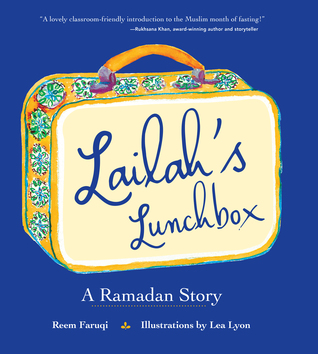
Description: Now that she is ten, Lailah is delighted that she can fast during the month of Ramadan like her family and her friends in Abu Dhabi, but finding a way to explain to her teacher and classmates in Atlanta is a challenge until she gets some good advice from the librarian, Mrs. Carman.

Review: Lailah recently moved from Abu Dhabi to Peachtree City, Georgia, and while she misses her friends back in the Middle East, she is very excited to be old enough to fast during Ramadan. Lailah is in a difficult situation. She is the new kid in school and also different from her classmates. How can she participate in Ramadan when no one in class knows what it is and what if she is the only one fasting? When her mother gives Lailah a note excusing her from lunch, Lailah hides the note when it is time to give it to her teacher Mrs. Penworth, and she has to endure the tempting smells of food and kind offers of her classmates to share lunch. After escaping to the library, the school librarian encourages Lailah to write down her feelings and share them with her teacher. After all, who knows what could come of sharing her culture?
 Lailah's Lunchbox is a story that will hit home to a lot of younger Muslims and it also reminded me of my own childhood explaining why I would not eat and drink for an entire month to my classmates and teachers in school. Lailah's is proud of her religion and culture, but is unable to express herself until a librarian advises her to explain her feelings. This picture book is a great introduction to Ramadan for both young Muslims and non-Muslims.The large, often full-page watercolor illustrations provide gentle details that add depth to the text. A note and glossary round out the story, giving context from the author's life and information about Islamic culture. A great addition to a growing number of books that educate about Islam without being preachy or heavy handed.

Rating: 4 stars

Words of Caution: None. Recommended for Grades 1-3.

If you like this book try: Moon Watchers: Shirin's Ramadan Miracle by Reza Jalali,


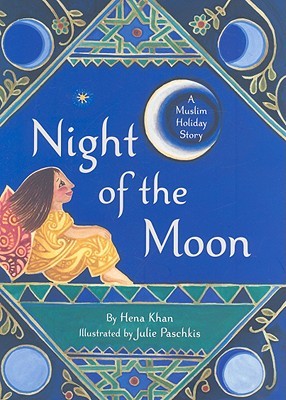
Description: Yasmeen, a seven-year-old Pakistani-American girl, celebrates the Muslim holidays of Ramadan, "The Night of the Moon" (Chaand Raat), and Eid. With lush illustrations that evoke Islamic art, this beautiful story offers a window into modern Muslim culture—and into the ancient roots from within its traditions have grown.

Review:  Yasmeen's mother points out the little sliver of the crescent moon to remind her of the beginning of a new month of Ramadan. The significance of the moon is directly correlated to the lunar Islamic calendar. As Yasmeen moves through the month and the moon changes its shape, she learns the lessons of the celebration. Night of the Moon expertly captures the spirit of observing Ramadan, the holiest month of the Islamic calendar, and celebrating Eid Al-Fitr, the festival that marks the end of Ramadan. I loved how the author weaves information about the cultural traditions of Ramadan and Eid along with Yasmeen's love of her family and growing understanding of her role in the outside world. The gentle and reflective text reflects the simple arc of the month focusing on the spirit rather than being bogged down to the minute details. The illustrations are colorful and stunning incorporating a lot of Islamic art. The Night of the Moon is a warm, lovely, educational read and highly recommended.

Rating: 4 stars

Words of Caution: None. Recommended for Grades 1-3.

If you like this book try: It's Ramadan, Curious George by Hena Khan
Rummanah Aasi

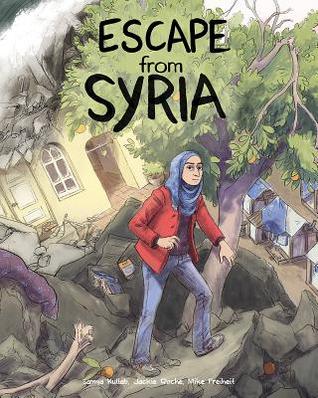
Description:  The story spans six years in the lives of Walid, his wife Dalia, and their two children, Amina and Youssef. Forced to flee from Syria, they become asylum-seekers in Lebanon, and finally resettled refugees in the West. It is a story that has been replayed thousands of times by other families.
  When the family home in Aleppo is destroyed by a government-led bomb strike, Walid has no choice but to take his wife and children and flee their war-torn and much loved homeland. They struggle to survive in the wretched refugee camps of Lebanon, and when Youssef becomes fatally ill as a result of the poor hygienic conditions, his father is forced to take great personal risk to save his family.
  Walid's daughter, the young Amina, a whip-smart grade-A student, tells the story. As she witnesses firsthand the harsh realities that her family must endure if they are to survive -- swindling smugglers, treacherous ocean crossings, and jihadist militias -- she is forced to grow up very quickly in order to help her parents and brother.

Review: While the news coverage of the Syrian Civil War and the refugee crisis has graced the headlines of newspapers for many years now, it is hard to personalize the many tragedies and losses of those who are involved and/or affected by the war. Escape from Syria, successfully depicts a fictionalized account of a family caught in the middle of the war. The author has captured the refugees's plight by using her knowledge as a Lebanese journalist who has covered the civil war in the English-language Lebanese newspaper called the Daily Star.  
  Amina's ordinary life in Aleppo, Syria, is forever changed when a bomb destroys her neighborhood and her family joins the millions of refugees fleeing Syria. The graphic novel uses flashbacks and spare text to narrate her journey from living a happy life in Syria to resettling in Canada as a refugee. We follow Amina and her family as they make a series of heartbreaking decisions such as leaving their home and loved ones behind in order to flee for safety in Lebanon, where they end up in a refugee camp. Amina is lucky enough to go to school, but it is a challenge as the school teaches in three languages: Arabic, English, and French. Soon their savings run out and her brother becomes sick. Once again the family makes hard choices in order to pay for his lifesaving medications. When the stress of renewing expensive visas becomes too much and unethical smugglers make life impossible, Amina finally finds help with a resettling agency.
 The story is eye opening and unforgettable, but never pandering to their reader's sympathy. The hardships that Syrian refugees face are written in a very matter of fact way. The reader connects to them as fellow humans not as "the other". There are plenty of dark moments throughout the book, but it does end on a hopeful bittersweet note on Amina's family trying to re-establish their home in a foreign land where many other obstacles are in their future. There are extensive endnotes at the end of the graphic novel which highlight the true events and explain references in the book. Escaping from Syria is a timely graphic novel that provides context on an ongoing, devastating, and complex war for readers.

Curriculum Connection: Social Studies, English

Rating: 4 stars

Words of Caution: War violence is depicted including images of heads of men impaled on sticks, sexual harassment is also alluded in the graphic novel. Recommended for Grades 8 and up.

If you like this book try: A Game for Swallows by Zeina Abirached, Persepolis by Marjane Satrapi
Rummanah Aasi

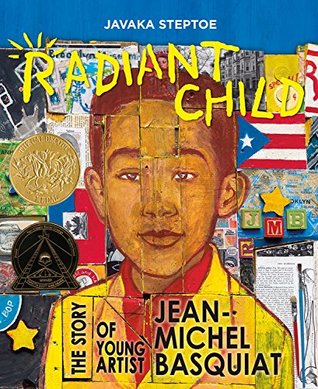
Description: Jean-Michael Basquiat and his unique, collage-style paintings rocketed to fame in the 1980s as a cultural phenomenon unlike anything the art world had ever seen. But before that, he was a little boy who saw art everywhere: in poetry books and museums, in games and in the words that we speak, and in the pulsing energy of New York City. Now, award-winning illustrator Javaka Steptoe's vivid text and bold artwork echoing Basquiat's own introduce young readers to the powerful message that art doesn't always have to be neat or clean--and definitely not inside the lines--to be beautiful.

Review: Radiant Child won the prestigious Caldecott Award last year for the best picture book for children. In this vibrant, colorful, energetic picture book we learn about the biography of artist Jean-Michel Basquiat, an artist that I was not familiar with before picking up this book. We are introduced to the artist's childhood and early career. Born in Brooklyn with a mixed heritage of Puerto Rican and Haitian, Basquiat loved art at an early age and was encouraged to pursue his dream of being a famous artist by his equally artistic mother. The artwork mirror's Basquiat’s signature style of eclectic pieces that weirdly work together. At first glance the illustrations can be chaotic and too busy until you take your time and dissect the layers. The illustrations also highlight some of Basquiat's trademarks such as the golden cartoon crowns, eyeballs, and vehicles scattered everywhere. Though we do get a glimpse of his mother dealing with mental health issues, there are no mentions of the troubles with addiction and early death that I found out after doing some research after reading this book. Considering it's a book for children, I think the writer made a good decision in having the book end with Basquiat achieving his dream and quotes of people talking about his work. 

Rating: 4 stars

Words of Caution: There is mention that Basquiat's mother was taken away to a facility in order to get treatment for her mental health issues. Recommended for Grades 1-5.

If you like this book try: A Splash of Red by Jennifer Bryant, Frida by Jonah Winter, Colors of the Wind by J.L. Powers


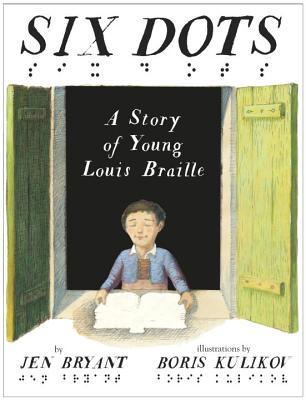
Description: Louis Braille was just five years old when he lost his sight. He was a clever boy, determined to live like everyone else, and what he wanted more than anything was to be able to read. Even at the school for the blind in Paris, there were no books for him. And so he invented his own alphabet—a whole new system for writing that could be read by touch. A system so ingenious that it is still used by the blind community today.

Review: Six Dots is a pictorial biography on the Louis Braille's life. As a child, Louis Braille was curious and energetic. Sadly, an accident blinded him in one eye and he lost his other due to a spread of infection. Though Louis learned to navigate daily life, he missed the knowledge gained through reading, and applied to the Royal School for the Blind, where books with raised letters provided a slow and unsatisfying alternative. When he was introduced to a French military code written in patterns of dots, Braille wondered if this would be a more suitable alternative to the raised letters and if it could be expanded into an actual language. Though I liked the way the book was written, I thought it was a bit too text heavy for young readers. I would have liked an inclusion of actual Braille in the book instead of the simple diagram of the Braille alphabet on the endpapers. Still, I think this is an important read based on the life of a very worthy inventor.

Rating: 4 stars

Words of Caution: None. Recommended for Grades 1-3.


If you like this book try: Who was Louis Braille? by Margaret Frith


Description: Stepping Stones tells the story of Rama and her family, who are forced to flee their once-peaceful village to escape the ravages of the civil war raging ever closer to their home. With only what they can carry on their backs, Rama and her mother, father, grandfather and brother, Sami, set out to walk to freedom in Europe. Nizar Ali Badr's stunning stone images illustrate the story.

Review: Stepping Stones is a heartbreaking and timely picture book depicting the plights of Syrian refugees who are forced to leave their homes and start their life over in a new country. The text is simple yet direct, written in blank verse and in dual English and Arabic. What steals the spotlight in this book is the the artwork, stone-collage illustrations created by Syrian artist Badr, who arranges the stunning, tactile creation of people formed entirely of rocks and pebbles (enlarge the book cover to get a sense of what I'm talking about). On every spread, a round pebble hovers over the refugees, providing light, like the moon or sun, as well as hope. I would highly recommend getting this book simply for the art itself. This is a unique picture book that I hope will open eyes, create empathy and understanding.

Rating: 4 stars

Words of Caution: None, but young readers will need background information about what is happening in Syria and about refugees. Recommended for Grade 3 readers and up.

If you like this book try: Silent Music: A Story of Baghdad by James Rumford
Rummanah Aasi
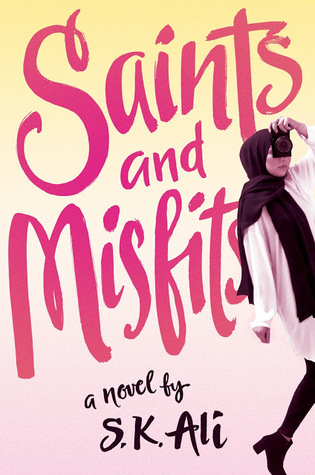
Waiting on Wednesday is a meme hosted by Jill of Breaking the Spine! This week I am waiting for the release of two debut books, one adult and one YA: Salt Houses by Hala Alyan and Saints and Misfits by S.K. Ali.


Salt Houses by Hala Alyan
Publish date: May 2, 2017
Publisher: Houghton Mifflin Harcourt


I first saw this book in a library journal and I knew I had to read it. I know it won't be an easy read, but I can definitely tell that it will be enlightening. 

On the eve of her daughter Alia’s wedding, Salma reads the girl’s  future in a cup of coffee dregs. She sees an unsettled life for Alia and her children; she also sees travel, and luck. While she chooses to keep her predictions to herself that day, they will all soon come to pass when the family is uprooted in the wake of the Six-Day War of 1967.   Salma is forced to leave her home in Nablus; Alia’s brother gets pulled into a politically militarized world he can’t escape; and Alia and her gentle-spirited husband move to Kuwait City, where they reluctantly build a life with their three children.

When Saddam Hussein invades Kuwait in 1990, Alia and her family once again lose their home, their land, and their story as they know it, scattering to Beirut, Paris, Boston, and beyond. Soon Alia’s children begin families of their own, once again navigating the burdens (and blessings) of assimilation in foreign cities.   Lyrical and heartbreaking, Salt Houses is a remarkable debut novel that challenges and humanizes an age-old conflict we might think we understand—one that asks us to confront that most devastating of all truths: you can’t go home again.


Saints and Misfits by S.K. Ali
Publish Date: June 13, 2017
Publisher: Simon and Schuster/Salaam Reads

 This is a YA debut for the Salaam Reads imprint, which I am really looking forward to reading. This book tackles several important issues that are timely and important.


How much can you tell about a person just by looking at them?

Janna Yusuf knows a lot of people can’t figure out what to make of her…an Arab Indian-American hijabi teenager who is a Flannery O’Connor obsessed book nerd, aspiring photographer, and sometime graphic novelist is not exactly easy to put into a box.

And Janna suddenly finds herself caring what people think. Or at least what a certain boy named Jeremy thinks. Not that she would ever date him—Muslim girls don’t date. Or they shouldn’t date. Or won’t? Janna is still working all this out.

While her heart might be leading her in one direction, her mind is spinning in others. She is trying to decide what kind of person she wants to be, and what it means to be a saint, a misfit, or a monster. Except she knows a monster…one who happens to be parading around as a saint…Will she be the one to call him out on it? What will people in her tight knit Muslim community think of her then?
Rummanah Aasi
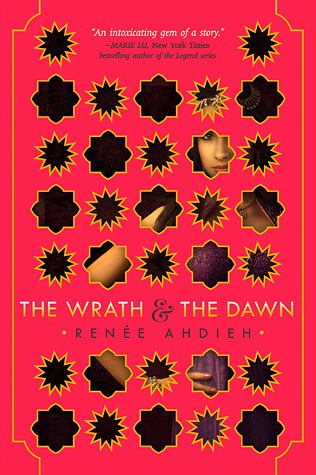
 I've wanted to read Renee Ahdieh's A Thousand and One Nights inspired duology ever since I heard about it. I've read glowing reviews for the series and many warned of a cliffhanger ending of the first book so I patiently waited until the second book was released. Unfortunately, my expectations for this series was just too high and in my opinion didn't really warrant all of the hype it received.

Description: In a land ruled by a murderous boy-king, each dawn brings heartache to a new family. Khalid, the eighteen-year-old Caliph of Khorasan, is a monster. Each night he takes a new bride only to have a silk cord wrapped around her throat come morning. When sixteen-year-old Shahrzad's dearest friend falls victim to Khalid, Shahrzad vows vengeance and volunteers to be his next bride. Shahrzad is determined not only to stay alive, but to end the caliph's reign of terror once and for all.
  Night after night, Shahrzad beguiles Khalid, weaving stories that enchant, ensuring her survival, though she knows each dawn could be her last. But something she never expected begins to happen: Khalid is nothing like what she'd imagined him to be. This monster is a boy with a tormented heart. Incredibly, Shahrzad finds herself falling in love. How is this possible? It's an unforgivable betrayal. Still, Shahrzad has come to understand all is not as it seems in this palace of marble and stone. She resolves to uncover whatever secrets lurk and, despite her love, be ready to take Khalid's life as retribution for the many lives he's stolen. Can their love survive this world of stories and secrets?

Review: The Wrath and the Dawn began with a promising prologue that grabbed my attention right away. Shahrzad, called Shazi by her friends and family, began as a fierce heroine who has volunteered to be the king's next bride and vowed to seek revenge for the murder of her beloved best friend. Unfortunately her so-called strength and tenacity began to fade very quickly. I was not convinced that she did all that she could to become a spy and act out her vengeance. She had many opportunities to do so, but hesitated and flip-flopped her loyalties and responsibilities constantly. What just seemed like three short days, she was awfully comfortable as a queen who was served hand to foot and dressed in lavish clothes and jewels.
 Unlike Shazi, King Khalid had much more of a mysterious aura. He had all the essential ingredients of a brooding YA love interest and while there is much more to him that meets the eye I wished his curse was revealed in parts rather than just an info dump of a chapter.
 While there is certainly chemistry between Shazi and Khalid, I was surprised how quickly it happened between given Shazi's aversion to Khalid and Khalid's relentless admission that he is not a very trusting person. Plus I had a really hard time rooting for this couple given Khalid being an actual murderer, his curse and not being convinced that he even tried to get rid of it. I actually really preferred Shazi's childhood love, Tariq, who I wished had a larger role. While there is a love triangle present, it did not really feel like one because Shazi has clearly made up her mind about Khalid.
 The world building in The Wrath and the Dawn was hastily built and takes a bit from various Middle Eastern cultures, especially Iran with Iranian phrases and words. While I liked the inclusion of the language, I would have liked it more if the story had talked about the setting and created it as a character of its own. There is, however, a nice build up of political intrigue and mention of magic, that is slowly developed in the background of the book and leaves the reader with many questions. Personally, I didn't think the ending to the book was a cliffhanger and I only picked up the sequel because I wanted to see what the author did with her subplots. Overall this was a fast, quick read but it left me wanting more.

Rating: 3.5 stars

Words of Caution: There is some language, allusions to sex, crude humor, and some strong violence. Recommended for strong Grade 8 readers and up.

If you like this book try: The Rose and the Dagger by Renee Ahdieh, A Thousand Nights by E.K. Johnston, The Forbidden Wish by Jessica Khoury


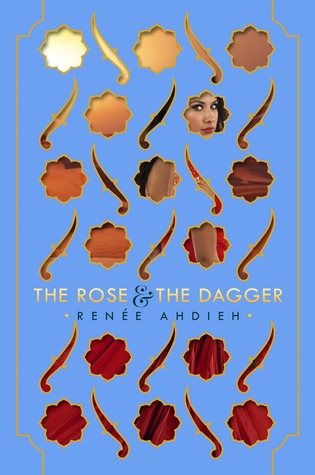
Description: In a land on the brink of war, Shahrzad is forced from the arms of her beloved husband, the Caliph of Khorasan. She once thought Khalid a monster—a merciless killer of wives, responsible for immeasurable heartache and pain—but as she unraveled his secrets, she found instead an extraordinary man and a love she could not deny. Still, a curse threatens to keep Shazi and Khalid apart forever.
  Now she’s reunited with her family, who have found refuge in the desert, where a deadly force is gathering against Khalid—a force set on destroying his empire and commanded by Shazi’s spurned childhood sweetheart. Trapped between loyalties to those she loves, the only thing Shazi can do is act. Using the burgeoning magic within her as a guide, she strikes out on her own to end both this terrible curse and the brewing war once and for all. But to do it, she must evade enemies of her own to stay alive.

Review: If you didn't enjoy The Wrath and the Dawn then I would not recommend picking up its sequel. I was able for the most part be okay with the problems of the first book in order to enjoy the book, but The Rose and the Dagger annoyed me so much more. While the book has lots of action and a quick pace, it felt rushed and underdeveloped in several places.
  Shazi is much more selfish, self-centered than the first book. She no longer cares about what happens to her family and friends as long as she gets back to Khalid. I had to agree with people of her tribe who are unable to comprehend her romance with Khalid. There were several times when I wanted to shake Shazi. I also thought her magical abilities, which was hinted in the first book, was not thoroughly explored. I wanted to know how she was able to have powers but not her much more likable sister. Shazi wasn't taught to use her magic, but it worked conveniently in order to move the plot along.
  Khalid was a least a bit more tolerable in this book. I was surprised to see how quickly Shazi and Khalid got the answer to lift his curse. It really annoyed me how quickly, easily, and anticlimactically it was resolved. While I understand that the romance between Shazi and Khalid is a major part of this series, but it happened at the wrong times especially when their lives were at risk. These parts didn't come across as swoony but more of eye roll moments.
 The political revolt, which was paced quite nicely in the first book, felt disjointed and rushed. There were unnecessary deaths and the secondary characters that actually shined in the first book didn't get as much page time as I would have liked. Overall this sequel is not an improvement from the first book. In this instance I really think the series would have benefited from a trilogy instead of a duology.

Rating: 3 stars

Words of Caution: There is some language, allusions to sex, crude humor, and some strong violence. Recommended for strong Grade 8 readers and up.

If you like this book try: A Thousand Nights by E.K. Johnston, The Forbidden Wish by Jessica Khoury, the Dark Caravan series by Heather Demetrios

Rummanah Aasi
 Blood Passage by Heather Demetrios is one of my most anticipated reads for this year. I am happy to report that this book did not disappoint me and it was just as engaging as the first book, Exquisite Captive. I am, however, still disappointed with the publisher's decision to change the cover, which does not resemble the book at all. Please note that this review is based on the advanced reader's copy of book that I received from HarperTeen.
Description: A jinni who's lost everything. A master with nothing to lose. A revolutionary with everything to gain.

When Nalia arrives in Morocco to fulfill Malek's third and final wish she's not expecting it to be easy. Though Nalia is free from the shackles that once bound her to Malek as his slave, she's in more danger than ever before.

Meanwhile, Malek's past returns with a vengeance as he confronts the darkness within himself, and Raif must decide what's more important: his love for Nalia, or his devotion to the cause of Arjinnan freedom.

Set upon by powerful forces that threaten to break her, Nalia encounters unexpected allies and discovers that her survival depends on the very things she thought made her weak. From the souks of Marrakech to the dunes of the Sahara, The Arabian Nights come to life in this dazzling second installment of the Dark Passage Cycle.

Review: Blood Passage deftly avoids the middle book syndrome by providing a complex, winding journey full of unexpected twists and turns that delivers more action, romance, and world building than its predecessor. The book opens right where Exquisite Captive left off, an almost free Nalia is forced to complete Malek's, her previous owner, last wish which is leading him to the location of Solomon's sigil, an item that will allow its wearer to rule every jinni on Earth. Once she fulfills this wish, Nalia will be free from Malek's cruel hand. Raif, the Arjinnan revolutionary leader is also interested in finding the sigil in hopes that it will aid him in freeing his people from the iron first of the Ifrit.  
  The book's plot arc is devoted to the Nali and company in search of the Solomon sigil. Of course the mission is not easy, moving from the crowded streets of Morocco to the vastness of the Sahara dessert, caves, and a lost city. Demetrios does a wonderful job in capturing and bringing the Moroccan culture to life from the details of clothes, setting, and the inclusion of Islamic tradition and mythology. It is clear that the author has done her research thoroughly and used it wisely in her book.
  Unlike the previous book which was mostly told from Nalia's point of view, Blood Passage is exclusively told in third person which allows the reader to get inside the heads of the major and secondary characters alike. For example Malek's past history brings a lot to his character arc as well as to the book's plot. We are now able to understand his obsession with power as well as the decisions that he regrettably made. While it didn't change my feelings towards Malek, I was able to understand him and his choices much more. In addition to Malek we also get to hear Zanari, Raif's sister's voice, in particular her inner conflicts of participating in the revolutionary war with her brother and her own personal desires of living her own life.
  Blood Passage also manages to explore familial love along side romantic love in the book that felt natural and real. The various siblings spar with one another, separate based on their personal beliefs and in some cases come back together to a stronger bond. Nali's and Raif's relationship follows a similar path. Though they are separated for quite sometime, their separation is legitimate and makes them question themselves. I appreciated how they took their time and slowly worked out their problems and got back together. I am curious, however, how their relationship will change in the next step toward their freedom in Arjinnna. I would like to note that I didn't have an issue with the romance at all since I never saw a love triangle in the story at all.
 In addition to the various relationships in the book, what I loved about this book (and series thus far) is the slow evolution of Nalia that began with a dire situation of being a slave to now a woman of agency and control. Nalia suffers a lot through this book, emotionally and physically, and I would have supported her if she decided to give up, but she is a real fighter who is always brave, resilient, and has a pure heart. I am very appreciative that Nalia's transformation is of her own doing and she reluctantly becomes a leader that people around her admire despite of the legacy of her jinni clan. I still have a lot of questions as to what will happen next, but I am happy that the book ends at a great place with no cliffhanger.

Rating: 4.5 stars

Words of Caution: There is some strong language, violence, disturbing scenes, and scenes of strong sensuality. There is also a fade to black sex scene that is alluded to in the story. Recommended for Grades 9 and up.

If you like this book try: The Wrath and the Dawn by Renee Ahdieh, Vessel by Sarah Beth Durst, Daughter of Smoke and Bone series by Laini Taylor, Shadow and Bone series by Leigh Bardugo
Rummanah Aasi
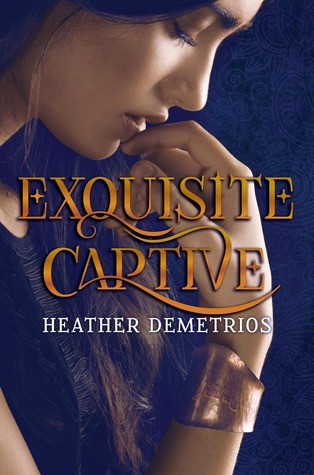
 Exquisite Captive is my favorite YA paranormal romance thus far this year. It was very hard to put this book down once you get sucked into Nalia's world of magic, politics, and romance. Inspired by the Arabian folklore, Exquisite Captive is a wholly original and enthralling story.


Description: Nalia is a jinni of tremendous ancient power, the only survivor of a coup that killed nearly everyone she loved. Stuffed into a bottle and sold by a slave trader, she’s now in hiding on the dark caravan, the lucrative jinni slave trade between Arjinna and Earth, where jinn are forced to grant wishes and obey their human masters’ every command. She’d give almost anything to be free of the golden shackles that bind her to Malek, her handsome, cruel master, and his lavish Hollywood lifestyle.
   Enter Raif, the enigmatic leader of Arjinna’s revolution and Nalia’s sworn enemy. He promises to free Nalia from her master so that she can return to her ravaged homeland and free her imprisoned brother—all for an unbearably high price. Nalia’s not sure she can trust him, but Raif’s her only hope of escape. With her enemies on the hunt, Earth has become more perilous than ever for Nalia. There’s just one catch: for Raif’s unbinding magic to work, Nalia must gain possession of her bottle…and convince the dangerously persuasive Malek that she truly loves him. Battling a dark past and harboring a terrible secret, Nalia soon realizes her freedom may come at a price too terrible to pay: but how far is she willing to go for it?

Review: Nalia, a powerful jinni from the world of Arjinna, has been on the dark caravan of the jinni slave trade for three years. After a deadly coup almost wiped out her entire clan, Nalia was captured by a slave trader who sells jinn to humans. Now she is trapped in Hollywood and bound to a handsome master, Malek, who is as ruthless as he is powerful. Malek showers Nalia with gifts, but refuses to give her what she wants most: her freedom. Nalia is desperate for the chance to return to Arjinna and rescue her captive brother-something that seems impossible while bound to her master and the bottle that can hold her prisoner. When Nalia agrees to a dangerous bargain with the leader of Arjinna's revolution, she will have to decide if any price can be too high for her freedom.
  I absolutely loved Nalia. She is unlike many heroines that we encounter in ordinary paranormal romances in that she doesn't run headlong and make impulsive decisions. Her goals are simple and focused: free herself so she can save her brother. She is very aware of her surroundings and threats that revolve around her, knowing that just one wrong move can place her in bottle that will slowly suck the life out of her. She uses her strengths to her advantage and delicately walks the tightrope of interacting with her master Malek. I was constantly on pins and needles as Nalia tried to get her hands on her bottle and her freedom from Malek within her grasp.
  Malek is a fascinating character who at once repulses you but also draws you in. His moods are violent and unpredictable. While you can never forget that he owns Nalia like an object, there is a light flicker of what could be "love". There is no way that Nalia can see him as a viable love interest, you can't deny that there is a very strong sexual tension between them.
  In addition to Nalia and Malek, Raif, the leader of the revolution is also a very compelling character. He bears the burdens the responsibility of the revolution from a very young age. Like Nalia he doesn't waste time dithering about but is very focused on saving his people and the world of Arjinna. I had a great time watching his relationship with Nalia shift from prejudice and wariness to a slow burn romance. I only wished we got to see him and Nalia have more quiet moments.
  The world building in Exquisite Captive is done very well. With nods to the jinni folklore as well as the blend of modern urban fantasy works very well in the novel.  I loved learning about the various jinns as well as their realm of magic, politics, spirituality, and history. Needless to say that it didn't take very long for me to get sucked into this story and world that the author created. The story unfolds at a fast and even pace. I really wish I could already have the second book in the series especially with how the book ends.

Rating: 4.5 stars

Words of Caution:  There is some strong language, sensuality, disturbing images, and violence. Recommended for Grade 9 and up.


If you like this book try: Daughter of Smoke and Bone series by Laini Taylor, Everneath series by Brodi Ashton, The Fire Wish by Amber Lough
Rummanah Aasi
  I have very fond memories of my parents telling me stories from the Arabian Nights during bedtime. Of course the stories were told in a G rated fashion and lead me to read various editions of the One Thousand and One Nights as I grew older. There is no official version of the One Thousand and One Nights as the stories were told orally for many generations. Acclaimed Lebanese writer Hanan al-Shaykh has selected nineteen of these stories, some of which I never read before, and translated them from Arabic into modern English, and knitted them together into an utterly captivating short story collection.


Description: Gathered and passed down over the centuries from India, Persia, and across the Arab world, the mesmerizing stories of One Thousand and One Nights tell of the real and the supernatural, love and marriage, power and punishment, wealth and poverty, and the endless trials and uncertainties of fate. They are related by the beautiful, wise, young Shahrazad, who gives herself up to murderous King Shahrayar. The king has vowed to deflower and then kill a virgin every night--but Shahrazad will not be defeated by the king's appetites. To save herself, she cunningly spins a web of tales, leaving the king in suspense each morning, and thus prolonging her life for another day.

Review: For those of you unfamiliar with the Arabian Nights, the over arching story is this: Ever since the king was outwitted by his lusty, philandering wife, he commands that he must marry a virgin woman a day and after their wedding night, the woman would be killed before she came to harm the king and his kingdom. Vizier’s daughter Shahrazad volunteers to marry this brutal king but in order to save her own life and the other young women of her kingdom she spun tales that lasted for one thousand and one nights. In this collection of nineteen short stories, al-Shaykh retells them to celebrate her ­rediscovery of the Arab classic’s stylistic artistry, portraying a complex society, and its stunning female characters in particular who are far from passive and fearful, quite aware of their social limits, yet full of will and intelligence and wit. For al-Shaykh, as for Shahrazad, stories are matryoshka dolls, nesting within one another and casting ghosts and shadows in all directions. Here, Shahrazad first tells the traditional tale of the fisherman and the jinni, and then brings together at the impressive home shared by three beautiful sisters, a porter, three dervishes, and three merchants. Over many hours, each character tells multiple stories for different goals in a context of ever-shifting personal and power relationships. These stories are like a jig saw puzzle, leaving the reader to wonder how do they connect. The stories themselves pulse with love, lust, magic, and moral ambiguities; while is a strong undercurrent of terrible violence that underscores moments of pure beauty. I thought it was very interesting to read these stories from the lens of both the Western and Eastern culture. The stories can be hilarious, horrifying, touching, enlightening, or revelatory, which reminds us of why we have been utterly fascinated and continue to be so by the One Thousand and One Nights.

Rating: 4 stars

Words of Caution: There are sexual situations and strong violence throughout as well as some language. Suitable for Adults only.

If you like this book try: Sharaz-de : tales from the Arabian nights written & illustrated by Sergio Toppi, Grimm's Fairy Tales, The Complete Fairytales of Hans Christen Andersen,
Rummanah Aasi
  After finishing Ferraris's debut novel, Finding Nouf, I wanted to know more about leading detectives Nayir and Katya. I was also interested in learning about the everyday life in Saudi Arabia from an author who personally lived there herself. City of Veils avoids the sophomore slump. In addition to a good mystery, we are also watch the characters grow and get a glimpse of their personal lives.
Description: The body of a young woman is discovered on the grimy sands of Jeddah beach; soon afterwards, a strong-minded American woman finds herself alone and afraid in the most repressive city on earth when her husband suddenly disappears. 
  Investigating police officer Osama Ibrahim, forensic scientist Katya Hijazi and her friend, the strictly devout Bedouin guide Nayir Sharqi join forces to search out the truth in the scorching city streets and the vast, lethal emptiness of the desert beyond.

Review: Ferraris's enjoyable and thought provoking second novel is again set in Saudi Arabia and features the desert guide Nayir Sharqi and forensic scientist Katya Hijazi, introduced in Finding Nouf. While I recommend reading Finding Nouf to get a better understanding of the leading detectives, it is not necessary. City of Veils could be read as a standalone.
 Nayir and Hijazi gingerly probe the death of an unconventional young woman found mutilated and half-nude on a beach near Jeddah. Ferraris takes her time in unraveling the identity of the victim, creating an image of a woman who is far from the stereotype of a Saudi woman: she is loud, flouted religious custom while making provocative films exposing the seamy side of Jeddah and even questioned the purity of the Quran, the Holy Book of Islam. The list of suspects who would harm her grows by the hour.
  While the aspect of questioning the purity of the sacred book was unsettling to me as a Muslim, I can see what the author was trying to do-not impose a religious opinion but rather show the intolerance of critical thinking. I was interested in finding out the "inconsistencies" and though the author refers to certain passages from the Quran, there are no notations of the passages.
  As Nayir and Katya work together, they also stumble upon the disappearance of an American security contractor, who, to the dismay of his American wife, had a "summer marriage" with the victim. Ferraris presents a complicating and at times searing portrait of Saudi Arabia. Though there are many indications of social injustices particularly where women rights are concerned, you can also see the lighter appreciative aspects of the culture as well such as dinner gatherings with friends.
  What draws me deeper into the story isn't necessarily the mystery, which is good, but rather the central characters. Nayir is a a sensitive, but traditional and orthodox Muslim. He battles himself with coming to terms with his own desire to be with Katya. I also find him inching toward realizing that a working relationship requires an equal balance. While independent-minded Katya struggles to establish her own identity as a professional woman and must pretend to be married in order to work as a technician in Jeddah's homicide force. In the Saudi society, women and men can't have any other relationship other than familial or of wife/husband. Katya's boss, Det. Insp. Osama Ibrahim, also goes through a personal change and loses his progressive self-image after he discovers his wife wants a career more than she wants his children.
  Readers looking for something more in their ordinary mysteries should definitely give Ferraris's book a try. The social commentary of the Saudi society, which is much hidden from our eyes, isn't heavy handed but engrossing. I'm also very curious to see if Nayir has the courage to propose to Katya and if she will accept. I look forward to picking up the next book in this series.

Rating: 4 stars

Words of Caution: Strong violence, most of which takes off the page, and some language. Recommended for teens and adults who enjoy learning about different cultures along with solving a good mystery.

If you like this book try: Kingdom of Strangers by Zoe Ferraris, Collaborator of Bethlehem by Matt Rees
Related Posts with Thumbnails