Showing posts with label War Veterans. Show all posts
Rummanah Aasi
Description: Emilia Torres has a wandering mind. It's hard for her to follow along at school, and sometimes she forgets to do what her mom or abuela asks. But she remembers what matters: a time when her family was whole and home made sense. When Dad returns from deployment, Emilia expects that her life will get back to normal. Instead, it unravels.
   Dad shuts himself in the back stall of their family's auto shop to work on an old car. Emilia peeks in on him daily, mesmerized by his welder. One day, Dad calls Emilia over. Then, he teaches her how to weld. And over time, flickers of her old dad reappear. But as Emilia finds a way to repair the relationship with her father at home, her community ruptures with some of her classmates, like her best friend, Gus, at the center of the conflict.

Review:  I have enjoyed every book by Pablo Cartaya thus far and Each Tiny Spark is no exception. This time Cartaya has been inspired by his own daughter and created a story that centers around a young Latinx girl named Emilia Rosa Torres. Emilia has inattentive type ADHD, which causes her trouble in keeping up with schoolwork and concentrating on one thing at a time, but her software-developer mother and super involved abuelita help her keep on task. Days before her father’s return to their Atlanta suburb from his most recent deployment, her mother goes on a business trip, leaving Emilia with her distant father and her abuela to take care of her. She struggles to juggle and understand her father's mood swings, her friend troubles, and her looming assignments all on her own. When a social studies project which debates whether or not students from a poor school be allowed to go to her school opens Emilia's eyes to injustices past and present, Emilia begins to find her voice and use it to make an impact on her community.
  Each Tiny Spark tackles tough subjects such as immigration, PTSD, and microaggressions sensitively and appropriately through the lens of a budding tinkerer and activist. Conversations on race and gender crop up through the narrative as Emilia’s grandmother likes to emphasize her family’s European heritage while her mother insists of celebrating her culture's Yoruba's roots. All of these larger issues are effortlessly woven in with skill and humor, as is the Spanish her family easily mixes with English. Emilia often doesn't understand the complex questions that surround her, but she asks insightful questions which is important for young readers to understand. This is another great realistic fiction book from Cartaya that will spark discussion, help build empathy, and offer a lot of food for thought after the last page.

Rating: 4 stars

Words of Caution: None. Recommended for Grades 4 and up.

If you like this book try: Fish in a Tree by Lynda Mullaly Hunt, Merci Suárez Changes Gears by Meg Medina
Rummanah Aasi

Description: In 1940, eighteen-year old Juliet Armstrong is reluctantly recruited into the world of espionage. Sent to an obscure department of MI5 tasked with monitoring the comings and goings of British Fascist sympathizers, she discovers the work to be by turns both tedious and terrifying. But after the war has ended, she presumes the events of those years have been relegated to the past forever. Ten years later, now a radio producer at the BBC, Juliet is unexpectedly confronted by figures from her past. A different war is being fought now, on a different battleground, but Juliet finds herself once more under threat. A bill of reckoning is due, and she finally begins to realize that there is no action without consequence.

Review: There are a plethora of fiction titles that are written about World War II and after a while all the books seem formulaic. I wanted to learn more of the inner workings of those who worked for spy agencies during the war so when I read the description of Kate Atkinson's latest Transciption I had high hopes considering I enjoyed her other title, Life after Life.
  Transcription is thriller-esque historical fiction that plunges the reader into the complex world of espisonage and the aftermath of World War II. The narrative jumps between two different timelines during the war and the current in which Juliet works for the BBC developing a children show in the 1980s. When she is given a death threat, we retrace her steps in the past and their consequences.
 At the tender age of 18 Juliet Armstrong is all alone in the world when she’s recruited by MI5. Her job is transcribing meetings of British citizens sympathetic to the Nazi cause. Soon, she’s pulled even deeper into the world of espionage, creating multiple identities and forging relationships that impact her life.
  It was fascinating watching Juliet make her way through the complex web of spying. She is very young and naive at the beginning but she soon realizes that she isn't playing a game but with people's actual lives. There are actual transcriptions in the book in which we over hear the British Fascists who think they’re passing secrets to the Third Reich but are actually giving them to an English spy; their crimes are both deadly serious, unfathomable yet funny at a dark level. There is intrigue in the book and even surprises that I didn't see coming and some I still yet to comprehend of the actions taken, but I think that is realistic given the extreme situation of war. With all of this in mind, readers who think this is a fast paced thriller will be disappointed. The plot moves at a leisurely pace, but it much more atmospheric and character driven that your standard thriller. I appreciate that the novel doesn't just end when the war concludes, but it shows its impact on those involved in it from fellow spies to war veterans who are dealing with PSTD. As one character states the line between nationalism and fascism is very thin, which unfortunately sounds very timely given our current political climate. 

Rating: 4 stars

Words of Caution: There is strong language, allusions to sexual situations, Anti-Semitic comments, and war violence in the book. Recommended to mature teens interested in World War II and adults only.

If you like this book try: The Alice Network by Kate Quinn, Trapeze by Simon Mawer
Rummanah Aasi
Description: Sylvie and Jules, Jules and Sylvie. Better than just sisters, better than best friends, they'd be identical twins if only they'd been born in the same year. And if only Sylvie wasn't such a fast—faster than fast—runner. But Sylvie is too fast, and when she runs to the river they're not supposed to go anywhere near to throw a wish rock just before the school bus comes on a snowy morning, she runs so fast that no one sees what happens…and no one ever sees her again. Jules is devastated, but she refuses to believe what all the others believe, that—like their mother—her sister is gone forever.
  At the very same time, in the shadow world, a shadow fox is born—half of the spirit world, half of the animal world. She too is fast—faster than fast—and she senses danger. She's too young to know exactly what she senses, but she knows something is very wrong. And when Jules believes one last wish rock for Sylvie needs to be thrown into the river, the human and shadow worlds collide.

Review: I had no idea what to expect when I picked up Maybe a Fox. I noticed that it was getting starred reviews from a lot of library journals and I thought I should read it to find out what all the fuss was about. I figured since it a fox in the title and story it would be a cute story, but I was so wrong. Maybe a Fox is a bittersweet middle grade novel about death, grief and the coping mechanisms we use to carry on living in the aftermath of devastating loss through magical realism of talking animals. It is a heavy read, but once I got over my shock and wrapped my head around the themes I was easily able to submerse myself into this quiet novel.
Sylvie is the older of the two Sherman sisters. She is the runner and the impetuous one. A year younger is Jules, the introverted thinker who is also a rock collector. The morning of the last snowfall of the season in rural Vermont, Jules and Sylvie build a miniature snow family before getting ready for school. After playing in the snow, Sylvie darts off into the woods, much against their father's orders, to throw a wishing rock into the Slip and that's the last time anyone sees her. At that moment, a fox kit is born. One of a litter of three, this kit is a "kennen," a being that has an understanding that others do not possess and a destiny that it cannot escape. It's tied to Jules and to Sylvie. Although Sylvie's body is not found, everyone knows she drowned in the river and is gone.
  The story is written in a dual narrative. One from Jule's point of view as she describes "the After Sylvie time" as she and her father grieve together and try to find some hope to move on.  Jules thinks of it as "the After Sylvie" time, and she and her father grieve together, struggling to cobble together some hope for the future. The other point of view belongs to the kennen fox kit who is observing Jules' movements and maybe the answer to Jules' question of where people go after they die.
 There are a lot of heavy elements in this beautifully written book. Jules alludes to the death of her mother in which she vaguely remembers her. The devastating and numbing experience of Sylvie's sudden loss and disappearance as well as the grieving of a neighbor who was deployed with his best friend to Afghanistan. At times these events drag the book done and I had to read it in spurts, but the inclusion of the magical foxes help bring it up a bit. The authors don't hold back nor are they afraid to not have answers about younger reader's questions about death either. They do convey to younger readers that grief is a journey that takes in many forms and a person can recover after a terrible loss and be hopeful for the future.

Rating: 4 stars

Words of Caution: There are a lot of questions about death in the book. There is also a war veteran who suffers from post traumatic disorder and whose suicide is alluded to in the book. Due to the strong topics in this book, I would recommend it to Grades 6 and up.

If you like this book try: Bridge to Terebithia by Katherine Paterson, Elsewhere by Gabrielle Zevin, After Eli by Rebecca Rupp, See You at Harry's by Jo Knowles
Rummanah Aasi
Description: Growing up in the shadows cast by two world wars, Annabelle has lived a mostly quiet, steady life in her small Pennsylvania town. Until the day new student Betty Glengarry walks into her class. Betty quickly reveals herself to be cruel and manipulative, and while her bullying seems isolated at first, things quickly escalate, and reclusive World War I veteran Toby becomes a target of her attacks. While others have always seen Toby’s strangeness, Annabelle knows only kindness. She will soon need to find the courage to stand as a lone voice of justice as tensions mount.


Review: Wolf Hollow is my favorite children's book of 2016. Set against the backdrop of World War II, eleven-year-old Annabelle lives in a rural Pennsylvania community in 1943. While the war rages on outside of her town, her life is mostly peaceful until Betty Glengarry's arrival. Betty is cruel and threatening and thrives on inflicting pain. She is virtually a sociopath with zero empathy and has selected Annabelle to be her victim. At first, Annabelle is slightly comforted to know that Toby is watching out for her. Toby is a local vagabond, a World War I veteran of few words who has become something like a friend of Annabelle's family. We don't know much about Toby though there are discussions that he is suffering from post traumatic stress disorder from the war as indicated by carrying firearms around with him and is likely to be unstable.
  As Betty's violent malice grows, she successfully makes herself become the innocent victim while placing the blame on others particularly on a kind German man and Toby. One day Betty goes missing and Toby immediately becomes the prime suspect in her disappearance. Gossip ranging from Toby aloofness to him possibly being a pedophile is spread among the community. Annabelle is sure of Toby's innocence and is determined to prove it. 
  The story of Wolf Hollow is powerful, complex, and relevant. As Annabelle grows, she loses her childish naïveté in a life-altering way. She begins to see the various spectrum of people in her community from those who are plainly cruel without any purpose, courageously kind people, and those who simply pass the gossip without seeking the truth and analyzing it. The witch hunt of tracking down Toby reminded me of The Crucible and his character is much like Boo Bradley in To Kill a Mockingbird. Thematically, this book raises some of the same issues as To Kill a Mockingbird, but with social status rather than racism as the basis for injustice. Despite the darker overtones in the book, the heart of this story is ultimately one of hope and empathy. There is plenty to discuss and talk about with this book and it would be an excellent choice for a book club pick for younger readers.  

Rating: 4.5 stars

Words of Caution: There are scenes of bullying with one incident being particularly violent. Recommended for Grades 5 and up.

If you like this book try: To Kill a Mockingbird by Harper Lee, Revolution by Deborah Wiles, 
All Rise for the Honorable Perry T. Cook by Leslie Connor
Rummanah Aasi
Description: As a child in the late 1800s, Horace Pippin loved to draw: He loved the feel of the charcoal as it slid across the floor. He loved looking at something in the room and making it come alive again in front of him. He drew pictures for his sisters, his classmates, his co-workers. Even during W.W.I, Horace filled his notebooks with drawings from the trenches . . . until he was shot. Upon his return home, Horace couldn't lift his right arm, and couldn't make any art. Slowly, with lots of practice, he regained use of his arm, until once again, he was able to paint--and paint, and paint! Soon, people--including the famous painter N. C. Wyeth--started noticing Horace's art, and before long, his paintings were displayed in galleries and museums across the country.

Review: A Splash of Red is a biography picture book of self-taught African-American artist Horace Pippin. As a child, Pippin drew pictures at every opportunity, but due to his family's economic struggles he had less free time for art and instead picked up other jobs such as stacking grain sacks, shoveling coal at a rail yard, and he even served in the army in World War I. Despite a war injury to his right arm, Pippin adapted in order to continue drawing and painting, eventually leading to recognition and fame in the art world. Before reading this book I knew virtually nothing of Horace Pippin, but this book's great artwork infused many art techniques such as collages that blend thick, solid color blocks with motifs that reflect Pippin's inner emotions and his wide range of artwork from war scenes to that of children at play. What really stood out to me were the quotations from Pippin about the psychological scars of war and his artistic process which are are hand-drawn and further emphasizes that for Pippin art wasn't just a past-time, but his means for catharsis and trying to understand the world around him.

Curriculum Connection: Art and Black History Month

Rating: 4 stars

Words of Caution: None. Recommended for Grades K-3

If you like this book try: Art from Her Heart by Kathy Whitehead, Draw What You See by Kathleen Benson


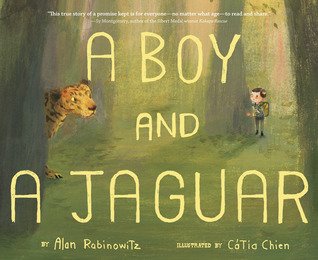
Description: Alan loves animals, but the great cat house at the Bronx Zoo makes him sad. Why are they all alone in empty cages? Are they being punished? More than anything, he wants to be their champion—their voice—but he stutters uncontrollably. Except when he talks to animals. Then he is fluent.

Review: A Boy and a Jaguar is a poignant autobiography in which author Alan Rabinowitz recalls the alienation he felt as a child who thought he was “broken” because he stuttered. While he had difficulties in speaking in class and around large groups of people, Alan could easily communicate with small groups of people and with animals. Thus his bond with and love for animals was born. As he grows up, Alan learns to both conquer and embrace the fact that he will always be a stutterer, and he soon becomes an advocate for animals.
 I really liked how the illustrations were a bit understated and more emphasis was given to the expressive faces that spoke more than the actual text. I also liked how the illustrator played around the sizes of the various characters of the book. For example, Alan is shown as this small boy who can easily be overlooked when he has to speak up in class and as his confidence grows so does he. The animals have a mystical and mysterious quality to them as Alan gazes into their eyes and "speaks" to them. I think this a great read that remind us that there are many ways to tell a story, with or without words.

Rating: 4

Words of Caution: None. Recommended for Grades K-3

If you like this book try: Can we save the tiger? by Martin Jenkins, The Tree Lady by H. Joseph Hopkins


Description: What is a haiku? It sounds like a sneeze. and isn't a lantern a light source? Actually, they are two types of ancient Japanese poetry.

Review: I always had difficulty in sparking interest in poetry for students, but If It Rains Pancakes makes poetry look fun and easy. In easy to understand language, the author explains two forms of Japanese poetry the hiaku and lantern poems. I was already familiar with hiaku, but I didn't know about lantern poems before this book. The examples of both forms of poetry are given withe a wide range of interests from a silly poem about a pet pig doing karate to the weather seasons. The illustrations like the poems are also fun and vibrant, complementing the poems nicely. If younger readers are having a hard time grasping the poem, they can use the illustrations as a reference and practice their inferring skills.

Curriculum Connection: English

Rating: 4 stars

Words of Caution: None. Recommended for Grades 1-3

If you like this book try: I Haiku You by Betsy Snyder, Guyku: A Year of Haikus for Boys by Bob Raczka
Rummanah Aasi
 I thoroughly enjoyed Heather Demetrios's paranormal romance, Exquisite Captive, and I couldn't wait to read another book by her. Many thanks to the publisher and Netgalley for an advanced reader's copy of the book.

Description: If seventeen-year-old Skylar Evans were a typical Creek View girl, her future would involve a double-wide trailer, a baby on her hip, and the graveyard shift at Taco Bell. But after graduation, the only thing standing between straightedge Skylar and art school are three minimum-wage months of summer. Skylar can taste the freedom—that is, until her mother loses her job and everything starts coming apart. Torn between her dreams and the people she loves, Skylar realizes everything she’s ever worked for is on the line.

Nineteen-year-old Josh Mitchell had a different ticket out of Creek View: the Marines. But after his leg is blown off in Afghanistan, he returns home, a shell of the cocksure boy he used to be. What brings Skylar and Josh together is working at the Paradise—a quirky motel off California’s dusty Highway 99. Despite their differences, their shared isolation turns into an unexpected friendship and soon, something deeper.


Review: I'll Meet You There is mixture of a coming of age, love story, and a war story. It is the story of two lost teens, Skylar and Josh, who live in a very small, rundown town in California, who are struggling to escape from their personal demons and desperately searching for a fresh, new start. 
 Skylar lives in a trailer with her mother and struggles to keep her little family afloat in the aftermath of her father’s death years before. She dreams about leaving her town of deadbeats and dead-ends for a new beginning of studying art in a college in San Francisco. I liked Skylar and admired her for taking up so much responsibility for a teen, acting more like the adult than her mother, as well as her resilence to move forward despite watching helplessly as her mother goes on a downward spiral into alcohol abuse. 
 Unlike Skylar it took me a while to warm up to Josh due to his several defensive walls that he built around himself and tries to distract himself from his own thoughts by seeking refuge in bad hookups and drinking. It is obvious that Josh is not the same person after his deployment. Most notably he is missing part of his leg and harbors internal wounds from the war. Demetrios does a great job in describing and tackling the issue of PTSD as well as survival guilt that slowly eats away Josh, which is clearly evident in the short chapters written in Josh's stream of consciousness. 
  The romance between Skylar and Josh is subtle and slow burn. They slowly begin to forge a friendship though I would say that definitely use each other as a distraction more than an anchor. Personally, I was not convinced of Skylar and Josh's relationship. I didn't feel any chemistry between the two characters mainly because I grew frustrated with both of them when they would not be open about their problems and they could have prevented melodrama and heart ache had they communicated effectively. Despite this issue, however, I did like how the romance did not conquer all of Skylar's and Josh's problems, but gave us a hopeful ending that they are on a hopeful and bright path. Overall I'll Meet You There is an enjoyable read that romance fans would certainly enjoy. 

Rating: 3.5 stars

Words of Caution: There is strong language including homophobic slurs, underage drinking and drug usage, two sex scenes which are mentioned but not in graphic detail. Recommended for Grades 9 and up.

If you like this book try: Something like Normal by Trish Doller, The Summer I Found You by Jolene Perry, 
Rummanah Aasi


Description: One snowy December morning in an old European city, an American man leaves his shabby hotel to meet a local woman who has agreed to help him search for an apartment to rent. The Apartment follows the couple across a blurry, illogical, and frozen city into a past the man is hoping to forget, and leaves them at the doorstep of an uncertain future—their cityscape punctuated by the man’s lingering memories of time spent in Iraq and the life he abandoned in the United States. Contained within the details of this day is a complex meditation on America’s relationship with the rest of the world, an unflinching glimpse at the permanence of guilt and despair, and an exploration into our desire to cure violence with violence.

Review: The Apartment is not recommended for readers who are plot driven, but rather for those who enjoy the stream of consciousness narrative. The plot of this book is very simple. A Navy veteran in his early 40s who has made big money working as a military contractor in Iraq explores an unnamed European city with a possibly romantic interest in a local woman, Saskia. The events in the book take place over the course of one day spent searching for an apartment with the anonymous, military worker who looks back on his role in the American military. The narrator is interesting especially in his cowardice and hypocrisy. Much of the book is exploring how the idea of American power is seen in the global context and how it is actually played in the real world. Transporting an American outside of America is good device of doing so, but I kind of wished the author took this idea a step further and placed his character beyond the Euro-centric country. Nonetheless The Apartment is very well written but be warned there isn't much happening within the pages and the pacing is quite slow despite its short pages.

Rating: 3 stars

Words of Caution: There is some language and mature themes. Recommended for adults only.

If you like this book try: The Things They Carried by Tim O'Brien, Redeployment by Philip Kay
Rummanah Aasi
  It seems fitting to review Laurie Halse Anderson's latest novel, The Impossible Knife of Memory, in observance of Veterans Day. The book written about the difficulties some veterans face in assimilating back to civilian life after going off to war.

Description: For the past five years, Hayley Kincaid and her father, Andy, have been on the road, never staying long in one place as he struggles to escape the demons that have tortured him since his return from Iraq. Now they are back in the town where he grew up so Hayley can attend school. Perhaps, for the first time, Hayley can have a normal life, put aside her own painful memories, even have a relationship with Finn, the hot guy who obviously likes her but is hiding secrets of his own. Will being back home help Andy's PTSD, or will his terrible memories drag him to the edge of hell, and drugs push him over?

Review: The Impossible Knife of Memory is a compelling and well timed story about a family who struggles to hold itself together in the wake of war. Hayley Kincain and her father, Andy, a decorated veteran, have returned to their small upstate New York hometown after years of so-called homeschooling and long-haul trucking. They have returned so that Hayley can have a typical senior year of high school and think about her post-high school future, but it's clear that Andy's untreated post traumatic stress disorder has made it impossible for him to make a living as a trucker.
  I really liked Haley as a character. She is forced to grow up and mature quickly into the role of a caretaker as her father's mental and physical health deteriorate. She has been a loner for so long, putting up defensive walls to prevent others from getting close to her in fears of her family's secret coming out that she is having a hard time to opening up to people who care about her including her sweet, bantering boyfriend Finn who wiggles his way into her heart. I also liked how the romance between Haley and Finn allowed Haley a chance to live a "normal teen" life and allowed some levity with the book's tough topic. Though there are many secondary characters in this book that are important, I wish they were fleshed out a bit more. For instance, we get hints that Finn has his own family problems as well as Gracie but I would have liked to know more.
 The book really shines in depicting the emotional torment of Andy as he tries to repress his agonizing memories during his four tours in Iraq and Afghanistan and his failed attempts to self medicate himself with drugs and alcohol. We get to see first hand how debilitating PSTD can be and Anderson addresses the many problems such as physical recovery, grief and survivor's guilt, chemical dependency, panic attacks and suicidal tendencies--that veterans can face when trying to reintegrate. Despite my minor issues, The Impossible Knife of Memory is an important novel that honestly and deeply explores the lingering internal scars of war.

Rating: 4 stars

Words of Caution: There is some strong language, scenes of drinking, and drug use as a way to self medicate. Recommended for Grades 9 and up.

If you like this book try: Something Like Normal by Trish Doller, Things a Brother Knows by Dana Reinhardt
Rummanah Aasi
  I've been meaning to pick up a book by Suzanne LaFluer for quite sometime now. I eyed Love, Ruby but I wasn't ready for a melancholic tone after reading some heavy books before it. I decided to try her latest, Listening for Lucca, which had a higher potential to be an uplifting read and it definitely hit the mark.

Description: "I'm obsessed with abandoned things." Siena's obsession began a year and a half ago, around the time her two-year-old brother Lucca stopped talking. Now Mom and Dad are moving the family from Brooklyn to Maine hoping that it will mean a whole new start for Lucca and Siena. She soon realizes that their wonderful old house on the beach holds secrets. When Siena writes in her diary with an old pen she found in her closet, the pen writes its own story, of Sarah and Joshua, a brother and sister who lived in the same house during World War II. As the two stories unfold, amazing parallels begin to appear, and Siena senses that Sarah and Joshua's story might contain the key to unlocking Lucca's voice.


Review: Listening for Lucca is an enticing story that effectively blends history, mystery, paranormal, and family in an enjoyable and quiet story. As the story begins, Siena moves from New York City to a Maine coastal town before she starts eighth grade. The move, which would irritate many her age, springs a new hope for Sienna and the the possibility of resolving her problem of connecting to people and curing her brother Lucca's mutism.
  Siena is unlike most teens. She is prone to have strange visions of the past in which transport her not only into another person's life and but also in a different time period. Afraid to mention her visions and being forever marked a weirdo, Siena keeps things to herself and hopes that a new home and atmosphere will maker her visions go away. She also harbors a deep guilt that she is responsible for Lucca's silence and spends lots of time with him and hoping that he will talk. She also collects all sorts of found items that she deems abandoned. 
  In Maine, she sees and hears members of the family who lived in her house during World War II. When she writes with an old pen found in the house, it produces not her handwriting, but that of Sarah, a girl from the earlier period. Even more astonishing, she seems to actually enter Sarah's mind, seeing and feeling everything along with her. Siena finds a lot of commonalities between herself and Sarah: the yearning to connect to someone, the love for a sibling, etc. She also is able to share Sarah's brother Joshua's war experiences, which send him home psychologically damaged and like Lucca completely removed from his family. 
  Through a compassionate act of courage, Siena's gift ultimately provides satisfying solutions for Sarah's family and her own. LaFleur deftly handles the tale's many layers, never allowing readers to get lost nor bored. Events and characters are fully developed and are completely believable, without making it feel contrived. 
  The paranormal aspect of Listening Lucca is very subdued, not meant to scare its readers but are suspenseful and draw you closer to the story. I also think this device serves a more complex purpose-allowing the reader to get a glimpse into Siena's psyche- her fears, vulnerabilities, guilt, and desires. Her visions bring her a renewed confidence and allows her to make new friendships who find her visions interesting and cool, even a budding new romance. Her ability to see, interact with, and even alter the past eventually provides her with the insight to help her brother regain his desire to speak and to reestablish their shaking sibling relationship. 
 Though the secondary characters are also well written and fleshed out, the story belongs to Siena and her journey to self acceptance. The first half of the book is a bit slow but soon picks up when the visions are introduced. Listening for Lucca is a heartwarming experience. I think readers will forgive its slow start and enjoy its satisfying conclusion. 

Rating: 4 stars

Words of Caution: There are glimpses of the battlefields of World War II but they are tastefully done, not too graphic or overwhelming for young readers. Recommended for Grades 5 and up.

If you like this book try: When You Reach Me by Rebecca Stead, Across the Reach by Cynthia Furlong Reynolds, or Flip-Flop Girl by Katherine Paterson
Rummanah Aasi
  I've had Benjamin Alire Saenz's Aristotle and Dante Discover the Secrets of the Universe, on my reading list for quite sometime. I moved it up my list this year after it was awarded the Printz Honor, Stonewall Book Award, and the Pura Belpre Award. I'm so glad that I didn't delay any longer in picking up the book. It is an excellent and thought provoking read.

Description: Aristotle is an angry teen with a brother in prison. Dante is a know-it-all who has an unusual way of looking at the world. When the two meet at the swimming pool, they seem to have nothing in common. But as the loners start spending time together, they discover that they share a special friendship—the kind that changes lives and lasts a lifetime. And it is through this friendship that Ari and Dante will learn the most important truths about themselves and the kind of people they want to be.

Review: Brilliant, simple, poetic, and profound, Aristotle and Dante Discover the Secrets of the Universe is no doubt one of the best books I've read all year. Most of the reviews I've read on this book focus on the character's exploration of their sexual identity, which in my opinion is just the tip of the iceberg. I think it would be more accurate to say that Aristotle and Dante Discover the Secrets of the Universe encompasses all aspects of our identity from our socially constructed roles of being a man or a woman to our cultural identity which we may embrace or ignore. What is astonishing is that all of these huge epiphanies sneak up on us subtly as we are swept away by fantastic characters and an engaging plot.
  The summer of 1987 is going to be a banal summer for Ari, short for Aristotle, filled with the usual disconnect from his family who refuses to talk about their family secrets and spending most of his time alone. Ari doesn't know why his older brother is incarcerated, since his parents and adult sisters refuse to talk about it. His father, a Vietnam veteran, is always aloof and keeps his war experience in Vietnam locked up inside. On a whim, Ari heads to the town swimming pool, where he meets Dante, a boy he's never met offers to teach him to swim. This single moment will redefine both characters though they might not be aware of it. 
  Dante is the exact opposite of Ari. He is self-assured, open in expressing his emotions, and artistic. Unlike Ari, Dante knows what he wants from life. The two develop an easy yet deep friendship, ribbing each other about who is more Mexican, discussing life's big questions, and wondering when they'll be old enough to take on the world. They are the type of friends who can sit comfortably in a moment of silence without the need for someone to fill it. The friendship between Ari and Dante is my favorite part of the book. It grows and evolves naturally to love and brings their families closer. Two events in Ari's and Dante's lives makes them, especially Ari, look at their world and themselves differently. Things come nicely together as Ari, adding up the parts of his life, begins to define himself. There were many moments that made me teary eyed in this book, many happy than sad. I could easily picture these characters, even the secondary ones that are finely nuanced and fleshed out. In the end I finished this book with a huge grin on my face. I highly recommend Aristotle and Dante Discover the Secrets of the Universe if you are in the mood for an excellent realistic fiction read.

Rating: 5 stars

Words of Caution: There is some strong language, underage drinking, and drug usage. Recommended for strong Grade 8 readers and up.

If you like this book try: The Vast Field of Ordinary by Nick Burd, Getting It by Alex Sanchez
Rummanah Aasi
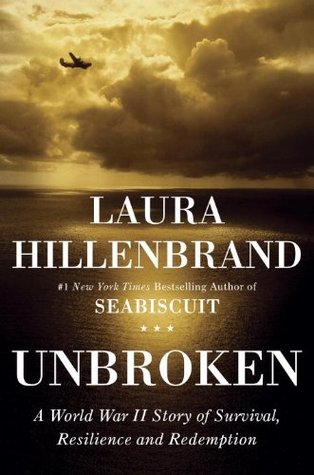
  Like many libraries, Unbroken by Laura Hillenbrand has been extremely popular. The book has been checked out constantly, close to about 100 times the last time I checked my libraries stats. Though released in 2010, it has stayed on the New York Times Bestsellers list and has taken me three years to finally read the book.

Description: On a May afternoon in 1943, an Army Air Forces bomber crashed into the Pacific Ocean and disappeared, leaving only a spray of debris and a slick of oil, gasoline, and blood. Then, on the ocean surface, a face appeared--Lt. Louis Zamperini. Captured by the Japanese and driven to the limits of endurance, Zamperini would answer desperation with ingenuity; suffering with hope, resolve, and humor.

Review: Hillenbrand shifts her focus from the usual Nazi Germany focus to the horrors of WWII Japan's most brutal POW camps. With a plot so ready made for the movies, you are left astounded that this actually took place and it happened to a real person. The core of the novel is Louie Zamperini, a loveable hero that exudes charm and wit, but also is a rough around the edges. He is  a disciplined champion racer who ran in the Berlin Olympics and his love for life is cruelly tested when he becomes an Army Air Corps bombardier in 1941.
   The young Italian-American from Torrance, Calif., was expected to be the first to run a four-minute mile. After an astonishing but losing race at the 1936 Olympics, Louie was hoping for gold in the 1940 games but the war ended those dreams forever. In May 1943 his B-24 crashed into the Pacific. After a record-breaking 47 days adrift on a shark-encircled life raft with his pal and pilot, Russell Allen "Phil" Phillips, they were captured by the Japanese. In the "theater of cruelty" that was the Japanese POW camp network, Louie landed in the cruelest theaters of all: Omori and Naoetsu, under the control of Corp. Mutsuhiro Watanabe, a sadist who never killed his victims, but got pleasure out of watching them slowly suffer. With his defiant and unbreakable spirit, Louie was Watanabe's perfect target.  After two incredibly grueling years and near death, Naoetsu was liberated in mid-August 1945 and Louie was freed.
  Hillenbrand doesn't just stop writing her story when Louie was rescued from the POW camp, but she also sheds light on the aftermath of war, particularly Louie's descent toward alcohol abuse and struggling with post-traumatic syndrome. For me, I was more interested in the second half of the book rather than the first. The first half started a bit slowly for me, but soon took off once the preparation for WW II began. I couldn't help but cringe and put the book down the torture in the POW camps became too much. The second half  digs a little deeper into Louie's psyche and troubles, reminding us that is just like any other fallible human being.
  Unbroken is unlike many WW II books that I've read in that it doesn't categorize its self as a history book, but crosses genres of survival literature and biography. It is a story of heroism, cruelty, life, death, joy, suffering, remorselessness, and redemption. It's a book that you don't want to miss.

Rating: 4 stars

Words of Caution: There is strong language and graphic description of torture and abuse in prison war camps. Recommended for mature teens interested and adults interested in survival stories, World War II, and history.

If you like this book try: Devil at My Heels: A Heroic Olympian's Astonishing Story of Survival as a Japanese POW in World War II by Lost in Shangri-la by In Harm's Way: The Sinking of the U.S.S. Indianapolis and the Extraordinary Story of Its Survivors by
Rummanah Aasi
  You may have noticed about a lack of adult book reviews posted lately. I've been through a really bad adult fiction reading slump lately. I'm trying several genres to help me snap out of it and so far it's been working. I thought I would give my first adult historical mystery a shot and picked up the first book in the Sebastian St. Cyr series. I have a friend who really enjoys this series and suggested I give them a shot during my slump. I read and enjoyed the first one.


Description (from Goodreads): It's 1811, and the threat of revolution haunts the upper classes of King George Ill's England. A beautiful young woman is found savagely murdered on the altar steps of an ancient church near Westminster Abbey, and the dueling pistol found at the scene and the damning testimony of a witness both point to one man--Sebastian St. Cyr.

Review: The first book in the Sebastin St. Cyr series is off to a racing start with the gruesome near-decapitation and rape of a lovely actress. Sebastian St. Cyr, the youngest but only surviving son of an earl, stands accused of brutally raping and murdering a young actress. As he's led away by police, an accidental knifing of a police officer is also attributed to him. Sebastian runs, bent on finding the real murderer and clearing his own name. and an innocent man on the run. What turns out to be a simple murder mystery, quickly evolves into what seems to be a political game where the Whigs try to gain control of the government before the Tory prince becomes regent.
  I was pleasantly surprised by the fast-paced plot of this Victorian mystery. Harris does a great job in  pitting the sophisticated, overly mannered elite against the grimier lower echelons of 1811 London society. We see all social classes at work in the book as the plot and mystery unfold. I thought the mystery was very well interwoven. At first I was a bit disoriented by the sheer amount of characters that are introduced, but I quickly got over that when I realized that all of these seemingly unconnected people leads to a maze set with clues connecting everyone from the high-ranking politicians to actresses who have side jobs. What I found unusual is that a lot of the character development of Sebastian comes from the people who is associated with him.
  Since this is the first book in a series, there is much we don't know about Sebastian. We know that he was an intelligent officer in the army during the Napoleonic War and suffers from shell shocks or from post traumatic stress disorder. He does have a real life genetic mutation, which allows him to have uncanny seeing and hearing abilities. The author describes him as a Darcy and James Bond combo, so far I do find him charming and he does have the skills to be an effective sleuth. I am interested to get to know him better as I continue the series. What Angels Fear will appeal to readers who like historical fiction, political intrigue, romance, and of course mystery.

Rating: 4 stars

Words of Caution: There is some language, small sex scenes, and violence (which mostly happens off the page). Recommended for older teens and adults only.

If you like this book try: Silent in the Grave by Deanna Raybourn, And Only to Deceive by Tasha Alexander, The Face of a Stranger by Anne Perry
Rummanah Aasi
  I don't consider myself to be a music expert, but I am definitely a fan and I do love a variety of music genres. Like movies, music is another form of storytelling. Movies use images, dialogue, and actors to express a story and emotion. Whereas music uses melody, instruments, and lyrics to tell its story. Both are unique and fascinating that allow us to express our emotions when we are not able to do so. Sometimes if you throw literature into the mix, it becomes even better or just scrambled and forced like it did in Adios, Nirvana.

Description: It's been a year since Jonathan has lost his twin brother in a fatal bus accident. He has been unable to come to terms with his grief and faces the possibility of repeating his junior year unless he gets his act together. The only way to move to next year and stay with his friends, Jonathan must attend all of his classes, help an ailing 88 year old war veteran write his memoir, and perform his principal's favorite song at graduation in front of the school community. Will Jonathan come through or will he say adios to nirvana?

Review: It is hard to describe Adios, Nirvana. The themes of grief and death are definitely serious, dark and heartbreaking, but the author tries to save his book from being another after-school special by infusing it with countless references to music, particularly of the Seattle grunge scene, as well as poets such as Whitman and Homer. Instead of being uplifting it becomes uneven both in plot as well as character development.
  The mission given to Jonathan by his principal is both unrealistic and too convenient. Of course it allows the school to show their support in Jonathan's long recovery, but it is just to easy to achieve. By meeting an ailing man in hospice is the driving force that allows Jonathan to learn and accept death; however, as a reader I don't buy his growth. I still see the sarcastic and cynical Jonathan from the beginning of the novel and I think this is due to the fact that everything wraps up too quickly just when they are starting to slowly unravel.
  It is obvious that Jonathan is in a dark place. When we first meet him, he is suicidal and tries to fall of a bridge. He only saves himself by thinking about how the loss of his life will affect his thicks, best friends, and his mother. He constantly drinks Red Bull and takes No Doz to avoid sleeping and meeting the 'dragon' that haunts him. He only seeks refuge in writing poetry, which he received brief celebrity status at his school, and secretly plays music. Jonathan has always seen himself as his brother Telemachus's shadow. This is told to us by Jonathan, but never shown. Telemachus never appears, neither in flashbacks or in spirit, in the book at all, which is a shame because that would allow the reader to track Jonathan's development and get into his psyche a bit better. As for the other characters, they don't make much of any impression and come across as one dimensional.
  There are several allusions to songs, which ironically is not a lot from the band Nirvana as I expected, but rather from a potpourri of artists and music genres. Their connections are either fully explained to the reader or not at all, thus lose their significance and come across as the author making his knowledge known to the reader. Similarly, there are also lots of allusions to literary figures and poems, but they don't necessarily fit with the narrative and characters. Adios, Nirvana is a mess, but I think readers who love music and poetry will take to this book.


Rating: 3 stars


Words of Caution: There is some language in the book as well as crude humor. There is also some allusion to sex. Recommended for Grades 10 and up.

If you like this book try: Notes from the Midnight Driver by Jonathan Sonnenblick
Rummanah Aasi
  I hope everyone enjoyed their Labor Day weekend. I took a mini-vacation to the east coast and lost track of time. I didn't mean to fall off the radar with the blog. Please bear with me as I try to catch up on writing reviews. The first review is The Mailbox by Audrey Shafer.

Description: 12 years old Gabe lives with his Uncle Vernon, a Vietnam war veteran and Gabe's sole guardian. On one unexpected afternoon, Gabe discovers his uncle dead. He keeps Uncle Vernon's death a secret and tries to manage on his own. Gabe receives help from a mysterious, unseen well-wisher who communicates by notes in Gabe's mailbox. How did Uncle Vernon die? Who is this mysterious well-wisher?

Review: The Mailbox is an interesting book with an original premise and strong characters. While the book is mostly a character driven novel, it also does show how people are inter connected with one another. As Gabe mourns for his uncle and struggles to make his uncle proud, the readers get to know the strong and caring people surrounding him, and to see the enormous impact made by his uncle. Gabe learns to reach out to others for help as well as what it means to have a best friend. Horrifying glimpses of the Vietnam War and its aftermath are also discussed. My biggest problem with the book is that it moves very slowly. Although it less than 200 pages, it took me days to read it because I kept putting it down and getting bored with the story. The book finally picked up for me in the last 10 chapters when the mysterious well wisher's identity is finally revealed. Nevertheless, The Mailbox shows us how we impact each others lives even though it may not seem like it.

Rating: 3.5 stars

Words of Caution: There is mild language and some disturbing images in the book. Recommended to Grades 5 and up.

If you like this book try: Waiting for Normal by Leslie Connor
Related Posts with Thumbnails