Showing posts with label World War 1. Show all posts
Rummanah Aasi
Description: This nonfiction picture book explores art, desperation, and one man's incredible idea for saving ships from German torpedoes in World War I. Dazzle camouflage transformed ordinary British and American ships into eye-popping masterpieces.

Review: I know very little about World War I, but I learned a lot from Dazzle Ships: World War I and the Art of Confusion. This short picture book is packed with information and uses art, history, and the military in a very clever way. During World War I, the British were in danger of starving because so many German U-boats were sinking American and British supply ships. Norman Wilkinson, a Royal Naval Volunteer Reserve lieutenant-commander, had the idea to paint boats in such a manner as to confuse the German submarine captains, and the concept of "dazzle ships" was born.
 In accessible text and Ngai's stunning and vibrant illustrations, Barton chronicles the creation and implementation of the strategy, including the team of women artists who designed the patterns and the laborers who painted the ships. Readers learn that the wild, striped designs fooled the U-boat captains into thinking the Allies' ships were headed in opposite directions, thus leading to confusion and failed offenses for the Germans. I would have loved to have seen some texts from the German's perspective to see how successful this technique turned out to be and their thoughts on it. There is a lot of back matter at the end of the book that explains the detail process of the dazzling process.

Curriculum Connection: Art, Social Studies

Rating: 4 stars

Words of Caution: None. Recommended for Grades 3 and up.

If you like this book try: The Secret Project by Jonah Winter


Description: Meet Beauty, the bald eagle that made world news when she was injured, rescued and received a 3D-printed prosthetic beak. Follow Beauty's brave and inspiring story as she grows up in the wild, is rescued after being illegally shot, and receives a new beak specially engineered by a human team including a raptor biologist, engineer and dentist. Learn more about how bald eagles as a species came back from near extinction, and about nationwide efforts to conserve this American symbol.

Review: Beauty, a bald eagle, was shot in the face by a poacher and lost most of her upper beak. She was unable to eat, drink, or preen (keeping her feathers in top shape for protection and warmth), and would have died had she not been rescued. Since her beak did not regenerate, Beauty eventually made her way to a raptor center in Idaho, where she received and still receives continuous care. Coauthor Veltkamp, a raptor biologist (someone who studies birds of prey) and rehabilitator, worked with engineers, a dentist, and other animal experts to create an artificial beak by using a 3-D printer for Beauty. After arduous testing, an appropriate beak was created and attached. Beauty could now drink and eat on her own.
 I learned a lot of fun facts about bald eagles while reading this book. I had no idea that the bald eagle is the only bird of prey who has the ability to see in color, which is how they are able to track down their food. I also learned that the bald eagle has seven extra bones in their neck which allows them to rotate their necks all the way around. How cool is that?! Beauty and the Beak has outstanding full-page photographs of bald eagles and Beauty that accompany this uplifting account. It is amazing how far we have come with technology and how we reversed the near extinction of bald eagles in the U.S. The book's back matter includes resources for further study and additional information on the life cycle of eagles, and their habitats. 

Curriculum Connection: STEM
 
Rating:

Words of Caution: None. Recommended for Grades 3 and up.


If you like this book try: Winter's Tale: How One Little Dolphin Learned to Swim Again by Juliana Hatkoff

Rummanah Aasi
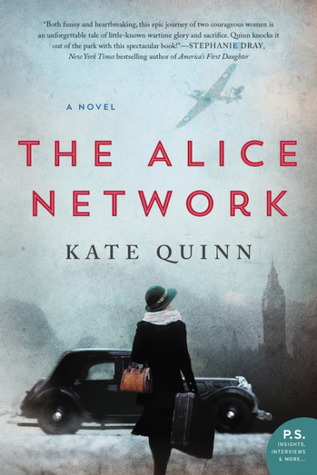
Description: 1947. In the chaotic aftermath of World War II, American college girl Charlie St. Clair is pregnant, unmarried, and on the verge of being thrown out of her very proper family. She's also nursing a desperate hope that her beloved cousin Rose, who disappeared in Nazi-occupied France during the war, might still be alive. So when Charlie's parents banish her to Europe to have her "little problem" taken care of, Charlie breaks free and heads to London, determined to find out what happened to the cousin she loves like a sister.
 1915. A year into the Great War, Eve Gardiner burns to join the fight against the Germans and unexpectedly gets her chance when she's recruited to work as a spy. Sent into enemy-occupied France, she's trained by the mesmerizing Lili, the "Queen of Spies", who manages a vast network of secret agents right under the enemy's nose.
 Thirty years later, haunted by the betrayal that ultimately tore apart the Alice Network, Eve spends her days drunk and secluded in her crumbling London house. Until a young American barges in uttering a name Eve hasn't heard in decades, and launches them both on a mission to find the truth --- no matter where it leads.


Review: The Alice Network is your standard historical fiction though it had potential to become a memorable read. The story is told in two point of views. In May 1947, we follow socialite Charlotte "Charlie" St. Clair who is a pregnant and unwed. She and her mother have crossed the Atlantic so Charlie can discreetly rectify her "problem". Lately, Charlie has been thinking about her cousin who was more like a a sister, Rose, who disappeared during World War II. A chance to search for Rose, gives Charlie the courage to break free and head to London. Rose may have been involved in the French Resistance, and her last known connection was a woman named Eve, who carries her own war secrets. 
  Eve Gardner was a spy in the Alice Network, a real-life network during the World War I. Being a spy allowed Eve to show herself and others her capabilities despite having a speech impediment. Presently, Eve suffers from PSTD and alcoholism as she tries to escape the horrors of the wars. As Eve and Charlie join forces to solve the mystery surrounding Rose, Eve also has her own special mission of seeking revenge on the individual who destroyed the network.
   What lessened my enjoyment of the book was the uneven plot-lines. I found Charlie's chapters to be boring and the mystery surrounding Rose was anticlimactic as you knew from the beginning that it can end only one way. Eve's chapters is what kept me reading this book. Her chapters are written earnestly and were suspenseful as you never knew what would happen to her. I wanted to know more about the Alice Network and Eve's comrades who were full of life. The book would have been much stronger if you took Charlie's story line completely out. As a result, the story drags quite a lot until the end where Eve finally meets her past. Despite the backdrop of two horrific wars, the story ends up on a hopeful note. I would recommend this book to readers who can't get enough of World War II historical fiction.

Rating: 3 stars

Words of Caution: There is some strong language in the book, fade to black sex scenes, a scene where a character has an abortion, and a scene of torture. Due to the complex themes in the book, I would recommend it only to adults and mature teen readers.

If you like this book try: Lilac Girls by Martha Hall Kelly, High as the Heavens by Kate Breslin
Rummanah Aasi
Description: As a child in the late 1800s, Horace Pippin loved to draw: He loved the feel of the charcoal as it slid across the floor. He loved looking at something in the room and making it come alive again in front of him. He drew pictures for his sisters, his classmates, his co-workers. Even during W.W.I, Horace filled his notebooks with drawings from the trenches . . . until he was shot. Upon his return home, Horace couldn't lift his right arm, and couldn't make any art. Slowly, with lots of practice, he regained use of his arm, until once again, he was able to paint--and paint, and paint! Soon, people--including the famous painter N. C. Wyeth--started noticing Horace's art, and before long, his paintings were displayed in galleries and museums across the country.

Review: A Splash of Red is a biography picture book of self-taught African-American artist Horace Pippin. As a child, Pippin drew pictures at every opportunity, but due to his family's economic struggles he had less free time for art and instead picked up other jobs such as stacking grain sacks, shoveling coal at a rail yard, and he even served in the army in World War I. Despite a war injury to his right arm, Pippin adapted in order to continue drawing and painting, eventually leading to recognition and fame in the art world. Before reading this book I knew virtually nothing of Horace Pippin, but this book's great artwork infused many art techniques such as collages that blend thick, solid color blocks with motifs that reflect Pippin's inner emotions and his wide range of artwork from war scenes to that of children at play. What really stood out to me were the quotations from Pippin about the psychological scars of war and his artistic process which are are hand-drawn and further emphasizes that for Pippin art wasn't just a past-time, but his means for catharsis and trying to understand the world around him.

Curriculum Connection: Art and Black History Month

Rating: 4 stars

Words of Caution: None. Recommended for Grades K-3

If you like this book try: Art from Her Heart by Kathy Whitehead, Draw What You See by Kathleen Benson


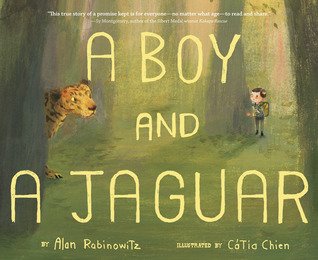
Description: Alan loves animals, but the great cat house at the Bronx Zoo makes him sad. Why are they all alone in empty cages? Are they being punished? More than anything, he wants to be their champion—their voice—but he stutters uncontrollably. Except when he talks to animals. Then he is fluent.

Review: A Boy and a Jaguar is a poignant autobiography in which author Alan Rabinowitz recalls the alienation he felt as a child who thought he was “broken” because he stuttered. While he had difficulties in speaking in class and around large groups of people, Alan could easily communicate with small groups of people and with animals. Thus his bond with and love for animals was born. As he grows up, Alan learns to both conquer and embrace the fact that he will always be a stutterer, and he soon becomes an advocate for animals.
 I really liked how the illustrations were a bit understated and more emphasis was given to the expressive faces that spoke more than the actual text. I also liked how the illustrator played around the sizes of the various characters of the book. For example, Alan is shown as this small boy who can easily be overlooked when he has to speak up in class and as his confidence grows so does he. The animals have a mystical and mysterious quality to them as Alan gazes into their eyes and "speaks" to them. I think this a great read that remind us that there are many ways to tell a story, with or without words.

Rating: 4

Words of Caution: None. Recommended for Grades K-3

If you like this book try: Can we save the tiger? by Martin Jenkins, The Tree Lady by H. Joseph Hopkins


Description: What is a haiku? It sounds like a sneeze. and isn't a lantern a light source? Actually, they are two types of ancient Japanese poetry.

Review: I always had difficulty in sparking interest in poetry for students, but If It Rains Pancakes makes poetry look fun and easy. In easy to understand language, the author explains two forms of Japanese poetry the hiaku and lantern poems. I was already familiar with hiaku, but I didn't know about lantern poems before this book. The examples of both forms of poetry are given withe a wide range of interests from a silly poem about a pet pig doing karate to the weather seasons. The illustrations like the poems are also fun and vibrant, complementing the poems nicely. If younger readers are having a hard time grasping the poem, they can use the illustrations as a reference and practice their inferring skills.

Curriculum Connection: English

Rating: 4 stars

Words of Caution: None. Recommended for Grades 1-3

If you like this book try: I Haiku You by Betsy Snyder, Guyku: A Year of Haikus for Boys by Bob Raczka
Rummanah Aasi
 After thoroughly enjoying In the Shadow of Blackbirds and The Cure for Dreaming by Cat Winters, I was really looking forward to picking up her adult debut novel, The Uninvited. I really wanted to like The Uninvited and though I did enjoy parts of the book, I did have many issues with it.

Description: Twenty-five year old Ivy Rowan rises from her bed after being struck by the flu, only to discover the world has been torn apart in just a few short days. But Ivy s life-long gift or curse remains. For she sees the uninvited ones ghosts of loved ones who appear to her, unasked, unwelcomed, for they always herald impending death. On that October evening in 1918 she sees the spirit of her grandmother, rocking in her mother s chair. An hour later, she learns her younger brother and father have killed a young German out of retaliation for the death of Ivy s older brother Billy in the Great War.
   Horrified, she leaves home, to discover the flu has caused utter panic and the rules governing society have broken down. Ivy is drawn into this new world of jazz, passion, and freedom, where people live for the day, because they could be stricken by nightfall. But as her uninvited guests begin to appear to her more often, she knows her life will be torn apart once more, but Ivy has no inkling of the other-worldly revelations about to unfold.


Review: Cat Winters deftly paints a grotesque picture of 1918 America in The Uninvited. While the World War I is taking place in Europe, it has caused unrest at home. Racism, xenophobia, and hysteria are just some of the illnesses that plague America. Immigrants, especially those originating from Germany, are regarded with suspicion. Prejudice has given way to discrimination and even murder. Making matters worse is the deadly influenza pandemic, which has taken a disproportionate number of young. 
  While I loved the setting of the book, the characters hindered my overall enjoyment. I didn't find Ivy likable at all. I found her voice to be much younger than her actual age. While I understood she sacrificed a lot in her life for the sake of her brothers, I got tired of hearing that before she made horrible choices such as jumping insta-lust with the German, which did not make sense to me at all and I found it distracting to the story since I felt zero chemistry between the two characters. Ivy's decisions, in my opinion, did not match with those of the time period. In addition to Ivy, I also found that the characterizations of the secondary characters were merely sketches, which is a shame because they had the potential to be great characters. 
 The blurb regarding the paranormal element is a bit misleading. Though Ivy and the other female members of her family have an unusual gift of seeing ghosts of the dead, the ghosts don't really appear into the second half of the story. The apparitions are suppose to function as a warning and a harbinger of death, however, their appearance comes across haphazardly. The twist in the story was nicely done, but had I been invested in the characters, it would have packed a more of an emotional punch rather than a clever move. 
  Due to my high expectations, The Uninvited left me unsatisfied. I wanted more out of the characters rather than just a caricature of who they were suppose to be. Though I struck out with this book, I still look forward to reading what Cat Winters has to offer. 

Rating: 3 stars

Words of Caution: There are sexual situations in the book, but they are not graphic. There is strong violence, which occurs off the page. Recommended for older teens and adults who enjoy historical fiction with light paranormal elements.

If you like this book try: In the Shadow of Blackbirds by Cat Winters, Gemma Doyle series by Libba Bray, Born of Illusion by Teri Brown
Rummanah Aasi
 Sherlock Holmes is back in pop culture, but for many he never left. While anxiously waiting for the new season premiere of the BBC Sherlock, I needed to get my sleuth fix. There are many series and books that feature Sherlock Holmes, but the Mary Russell and Sherlock Holmes series are highly recommended and are well written. I read the first book, The Beekeeper's Apprentice, which I really enjoyed and wanted to get back to this series. Note: If you are a Sherlockian purist, you may have issues with this series but I still think it's worth checking out.


Description: Looking for respite in London after a stupefying visit from relatives, Mary encounters a friend from Oxford. The young woman introduces Mary to her current enthusiasm, a strange and enigmatic woman named Margery Childe, who leads something called "The New Temple of God." It seems to be a charismatic sect involved in the post-World War I suffrage movement, with a feminist slant on Christianity. Mary is curious about the woman, and intrigued. Is the New Temple a front for something more sinister? When a series of murders claims members of the movement's wealthy young female volunteers and principal contributors, Mary, with Holmes in the background, begins to investigate. Things become more desperate than either of them expected as Mary's search plunges her into the worst danger she has yet faced.

Review: Monstrous Regiment of Women is the second book in the Mary Russell and Sherlock Holmes series. Though this book could be read without reading the first book, I would suggest reading the first book, The Beekeeper's Apprentice,  to get a firm grasp of the character development of Mary Russell and how Sherlock Holmes is portrayed. In this second book, Mary Russell has graduated and is about to debut her first Academic Article that is not attached to being a student. She is a full fledged, independent adult who get away from her distasteful, money grubbing Aunt whom has controlled her inheritance. Mary is going through many transitions as a student to a teacher, a child with an allowance to an heiress, girl to woman, and the strange tension between Sherlock Holmes and herself – she is no longer an apprentice and can she be trusted to handle a case on her own.
Mary finds herself in not just one but two mysteries in London while waiting to come into her inheritance. She runs into an old school friend, Veronica, who pulls Mary into her life. We learn of the first mystery involving Veronica's drug addicted fiance who has returned from the war. Veronica believes her fiance is a simply a drug addict, but Mary thinks there is a more serious problem but can't quite put her figure on it. The second mystery, which is more compelling, revolves around an organization called The Temple, which Veronica is a member of and holds it high regard.   

 The Temple is an organization run by a very smart and charismatic woman named Margaret, who is   rallying women who previously were nurses and running the country in the absence of the men sent to war. Now that the war is over these women are left without a place. There are simply too many women and few men returned. The men that did return, however, came back damaged and many weren’t choosing to marry, preferring to fall into paths of self-destruction. To fill the gap The Temple is giving these young women something to do: teaching women to read and build literacy, providing safety and supplies to battered women and their families, providing medical care, and working to increase women’s rights now that the vote has passed. The problem is when you have a large group of the disenfranchised that are being directed and utilized by a leader are their actions really charitable or could there be a deeper agenda at work? That is what Mary is trying to find out.
  The book is extremely well researched and written. I really liked how The Temple was constructed. It was easy to stand behind it and support its effort in helping women, which dangerously allows you to overlook the more sinister moves behind the curtains. I learned a lot regarding the time period, which was so clearly described and was sucked into the period concepts of class structure, feminism, gender roles, addiction, and PTSD. I believe King did a remarkable job exploring these subjects without being overly biased or sacrificing the pace of the book. Although this book had a lot of great ideas, I still feel conflicted about the twist at the end of the book. I prefer Sherlock the way he was originally created by Doyle and I'm having a hard time seeing him in this new light. I'm not sure if I can fully support it but I'm curious to see how it works out in later books.  
 I do recommend this book despite my issues with the ending, especially to anyone who enjoys mysteries that are well researched and have great characters.


Rating: 4 stars

Words of Caution: There are allusions to drug usage and sex. Recommended for teens and adults.

If you like this book try: The Sweetness at the Bottom of the Pie  by Alan Bradley or A Letter of Mary (Book 2 of the Mary Russell series) by Laurie King or Another Scandal in Bohemia by Carole Nelson Douglas
Rummanah Aasi
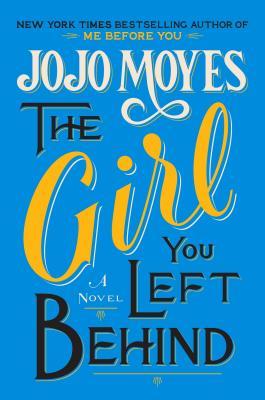
  Jojo Moyes is quickly becoming of the many authors that is constantly checked out at my library. Although she has been writing for quite some time, just recently she has appeared in the spotlight in the United States. I think what draws readers to her books are the wonderful relationships that she creates between her characters and the extra care she gives to her female protagonists. Though I didn't enjoy The Girl You Left Behind as much as I did Me Before You, I thought it was a decent read.

Description: In 1916, French artist Edouard Lefevre leaves his wife Sophie to fight at the Front. When her town falls into German hands, his portrait of Sophie stirs the heart of the local Kommandant and causes her to risk everything - her family, reputation and life - in the hope of seeing her true love one last time.
  Nearly a century later and Sophie's portrait is given to Liv by her young husband shortly before his sudden death. Its beauty speaks of their short life together, but when the painting's dark and passion-torn history is revealed, Liv discovers that the first spark of love she has felt since she lost him is threatened.

Review: The title of Moyes' latest book is the name of a fictional painting that serves as catalyst in linking two loves stories, one set in occupied France during World War I, the other in 21st-century London. In occupied France, Sophie is helping the family while her husband, an artist who studied with Matisse, is off fighting. I liked Sophie right away and admired her tenacity in standing up to the German occupiers and to her suspicious neighbors who believe she is a German sympathizer. Sophie's vibrant personality draws the interest of the new German kommandant in the village. It turns out that the German kommandant is also an art lover and notices the portrait of Sophie, drawn by her husband, which captures her essence and her husband's adoration. Arranging to dine regularly at Sophie's inn with his men, the German kommandant begins a cat-and-mouse courtship trying to lure Sophie in by providing her more food for her family and security, but Sophie resists. In what could be described as emotional blackmail, Sophie learns that her husband is being held in a particularly harsh "reprisal" camp and she must decide what will sacrifice for his freedom: "The Girl You Left Behind" or herself.
  Jumping to 2006, we are faced with a different moral puzzle also entangled in a relationship. Liv is a young widow who has been struggling financially and emotionally since her husband David's sudden death. In an attempt to move on, she meets Paul in a bar after her purse is stolen. The two have chemistry and he is the first man she's been drawn to since she was widowed. They spend time together and their relationship blooms but things turn tumultuous when Paul notices that the "Girl You Left Behind" portrait on Liv's wall and rushes away with no explanation. There is no doubt that Paul is as smitten as Liv, but his career is finding and returning stolen art to the rightful owners specifically Liv's portrait is what threatens them apart. Liv and Paul soon find themselves on opposite sides of a legal battle.
  My issue with this book lies with the under-developed and the off-pace of the story lines. While I found Sophie's story heartbreaking in the depictions of a squalled occupied France and was drawn to the details of this story, I found it to be slow. I couldn't tell if the German kommandant was actually drawn to Sophie as a person or how she was represented in the portrait. I would have liked to have a bit more moments shared between Sophie and her husband which would give the portrait a more prominent role.
 Interestingly enough I found Liv's story line had a better pace and I was able to support the romance between Liv and Paul, who were adorable together, the legal battle went on much longer than needed. I grew restless towards the end and found myself skimming some sections just to see what would happen to Liv and Paul's relationship.
  If you are looking for a book that has a bit more emotional intensity, I would suggest reading Moyes' Me Before You instead of this book. If you're interested in art and World War I history without having your heart ripped out, you might enjoy this one a bit more.

Rating: 3 stars

Words of Caution: There is some strong language, allusion to rape, and sexual situations. Recommended for older teens and adults only.

If you like this book try: Birdsong by Sebastian Faulks, The Eight by Katherine Neville
Rummanah Aasi
   Usually when we hear about shipwrecks, our attentions are always focused on the hows and whys of the accident. Rarely do we take a look at what the survivors on a boat went through. Charlotte Rogan's Lifeboat presents us a captivating, ambiguously ethical story of survival and human nature.

Description: Grace Winter, 22, is both a newlywed and a widow. She is also on trial for her life.
  In the summer of 1914, the elegant ocean liner carrying Grace and her husband Henry across the Atlantic suffers a mysterious explosion. Setting aside his own safety, Henry secures Grace a place in a lifeboat, which the survivors quickly realize has exceeded capacity. For any to live, some must die.
  As the castaways battle the elements and each other, Grace recollects the unorthodox way she and Henry met, and the new life of privilege she thought she'd found. Will she pay any price to keep it?

Review: Lifeboat is an engrossing and complex psychological and moral drama. Set at the beginning of World War I, Grace Winter is a newlywed and widow, newly minted heiress who survives a harrowing three weeks at sea following the sinking of her ocean liner (a la the Titanic) and the disappearance of her husband, Henry. Safe at home in the U.S., Grace and two other survivors are put on trial for their actions aboard the under-built, overloaded lifeboat. Were their actions out of self defense or calculated and intentional?
   Grace, guided by her lawyer Mr. Reichmann, who has had her write down her day-by-day account of events, pleads not guilty. The story is thus divided into the present trial and Grace's murky memory. I really liked how Rogan leaves it up to the reader to decide how reliable a narrator Grace may be. Grace is a multi-layered and complex heroine. Though we feel horrible that she had to survive such a drastic ordeal and wouldn't want to be in her shoes, her actions are not faultless. She is actually pretty calculating.  Newly impoverished after her father's financial ruin and subsequent suicide, New Yorker Grace set her sites on the wealthy young financier Henry Winter even though he's already engaged. Grace and Henry sailed together, pretending to be married, to London, where he had business and they legally wed before boarding Empress Alexandra (a nice foreshadowing of the soon-to-be-assassinated Tsarina) to return home. When an unexplained explosion rocks the ship, Henry gallantly places her, perhaps with a bribe, into a lifeboat already packed to over-capacity. She never sees him again. 
  Things get interesting when we re-live Grace's memories of the lifeboat. An Empress crew member, Mr. Hardie, quickly takes charge of the passengers, distributing the limited rations and organizing work assignments with godlike authority. Declaring who is worthy to climb aboard the boat or to kill those who are desperately clinging to the boat in hopes of survival even women and children. This portion of the story gave me goosebumps and made me wonder if fight or flight instincts would kick in. As hope for quick salvation dims, passengers fall into numb lethargy. Some go mad. There are natural deaths and drownings (voluntarily or was it murder?). 
  It is really interesting that the author doesn't judge Grace, leaving it up to the readers to form their own opinion and to wonder what it really means to be human when faced with an impossible situation. If you're own life is on the line would you honestly save someone else?

Rating: 4 stars

Words of Caution: There is some language and disturbing images. Recommended for older teens and adults.

If you like this book try: The Cove by Ron Rash, A Land More Kind Than Home by Wiley Cash
Rummanah Aasi

 I'm delighted to be part of the Shadows of Asphodel blog tour hosted by CBB book promotions! Today I have a guest post from the author, Karen Kincy, on her top ten favorite words along with my review of Shadows of Asphodel. You can follow the Shadows of Asphodel tour here and be sure to check out the awesome giveaway below my review.

Karen Kincy's Top Ten Favorite Words 
Karen Kincy

Since I’m a linguistics major, I’m going to have to go with my top ten favorite words. – Karen

1. Syzygy. This word is so hard to spell it’s awesome. It’s used to describe three celestial bodies in a straight line, like when you get the Sun, the Earth, and the Moon in a row during an eclipse.

2. Antediluvian. It means “before the flood” and looks appropriately epic. I used to have this word as part of a wifi password until the number of syllables drove my husband crazy.

3. Serendipity. Also has a lovely meaning. I always like happy accidents or pleasant surprises.

4. Absinthe. This one word evokes the Art Nouveau world of the Belle Époque for me. The word itself sounds smoky and slithering.

5. Lavender. Ironically, lavender makes me sneeze, but I love how this word feels in my mouth.

6. Archangel. Also brings to mind seraphim, which is another awesome word. I always loved the name Serafina Pekkala from Philip Pullman’s His Dark Materials for that reason. I believe he said he found the name in a Finnish phone book.

7. Maelstrom. This is why I love English. It borrows so many badass-sounding words from other languages. Maelstrom is basically a Viking word for a big whirlpool.

8. Chocolate. Especially when used in the same sentence with “Karen” and “eat.”

9. Evanescence. I think the band has put permanent dibs on this word for the time being. To evanesce means to disappear like vapor, the way a rainbow does eventually.

10. Labyrinthine. I wouldn’t want to be trapped in a labyrinth, but this word sounds like a fantasy story waiting to happen.


Review of Shadows of Asphodel

Description: When Ardis discovers a man bleeding to death on the battlefield, she knows she has to walk away. 1913. In her work as a mercenary for Austria-Hungary, Ardis has killed many men without hesitation. One more man shouldn't matter, even if he manages to be a charming bastard while he stands dying in the snow. But when he raises the dead to fight for him, she realizes she must save his life.

If a necromancer like Wendel dies, he will return as a monster--or so the rumors say. Ardis decides to play it safe and rescues him. What she doesn't expect is Wendel falling to one knee and swearing fealty. Ardis never asked for the undying loyalty of a necromancer, but it's too late now.
Ardis and Wendel forge an uneasy alliance underscored with sexual tension. Together, they confront rebels, assassins, and a conspiracy involving a military secret: robotically-enhanced soldiers for a world on the brink of war. But as Ardis starts to fall for Wendel, she realizes the scars from his past run more deeply than she ever imagined. Can Ardis stop Wendel before his thirst for revenge destroys him and everyone else around him?

Review: Shadows of Asphodel is my first dieselpunk romance, which is much like steampunk but the alternative setting is not Victorian but rather pre-World War I and the gadgets are centered on diesel instead of steam. It is clear that the author loved and did her research of this time period really well. The setting is vivid and I can imagine myself on the battlefields where we find Ardis and Wendel, the stars of the novel. Unlike some authors, Kincy doesn't dump large chunks of information on her readers, but gives us little clues as to how the society works- both on a fantasy angle as well as a social structure. Important historical figures of the time such as Francis Ferdinand and Rudolf Diesel were mentioned or even characters themselves in the story. The more I read, the book I was sucked into the world that Kincy created.
  Ardis and Wendel are both very intriguing characters who have hidden scars and haunted pasts. Though they may act as if they are two very different people, they are very similar in many ways. Ardis is afraid of death though she makes no hesitation in killing someone. Wendel is afraid of his necromancy skills but yet is fascinated by it at the same time. I also loved the fact that Ardis is of mixed race, but I wish we got to unravel the mystery of Chun Yi, Ardis's sword and family heirloom and of her father. Wendel is a character that had me curious at the start. For the longest time I was ambivalent towards Wendel. He could be at times sweet and vulnerable while other times I just wasn't sure if I could trust him. I was really surprised how fast Ardis trusted him with they first met.
  The romance between Ardis and Wendel started a bit too quickly for me. While I liked the sexual tension between the characters, I would have liked to see their relationship grow slowly since both have issues with trust, but I did enjoy their banter and their romance is sweet. I really appreciated that the romance of Shadows of Asphodel didn't overshadow the plot but rather enhanced it, showing how Ardis and Wendel came together to overcome their obstacles.
  Besides the rushed romance, the only other problem I had with Shadows of Asphodel is that the dialogue was all in modern American voice even though the characters came a different backgrounds and they should have been a bit different considering their different nationalities. The story's timeline is also a bit inconsistent sometimes such as Ardis can stay up late through one night but really three nights have past and we don't know what happened in those days. Though the action was nonstop in the book, I didn't get my reading groove into the story for about the first 6 chapters or so which is not to say a problem of the book but me trying to wrap my head around the setting and characters. Overall, I enjoyed Shadows of Asphodel and readers looking for a fun read to cleanse their reading palates should really consider picking this one up.

Rating: 3.5 stars

Words of Caution: There is some strong violence, some language, and graphic sexual situations. Recommended for older teens and adults.

If you like this book try: The Friday Society by Adrienne Kress, Her Ladyship Curse by Lynn Viehl

GIVEAWAY


Rummanah Aasi
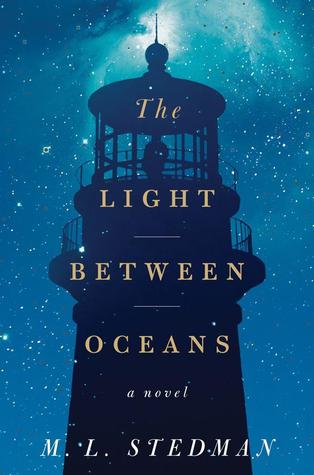
  If you are looking for a provocative page-turner, read The Light Between Oceans by M.L. Stedman. With delicious moral complexity and great writing, Stedman creates a world where there is no right answer and where justice for one person is another person's tragic loss. 

Description: After four harrowing years on the Western Front, Tom Sherbourne returns to Australia and takes a job as the lighthouse keeper on Janus Rock, nearly half a day’s journey from the coast. To this isolated island, where the supply boat comes once a season and shore leaves are granted every other year at best, Tom brings a young, bold, and loving wife, Isabel. Years later, after two miscarriages and one stillbirth, the grieving Isabel hears a baby’s cries on the wind. A boat has washed up onshore carrying a dead man and a living baby. 
   Tom, whose records as a lighthouse keeper are meticulous and whose moral principles have withstood a horrific war, wants to report the man and infant immediately. But Isabel has taken the tiny baby to her breast. Against Tom’s judgment, they claim her as their own and name her Lucy. When she is two, Tom and Isabel return to the mainland and are reminded that there are other people in the world. Their choice has devastated one of them. 


Review: The Light Between Oceans is a haunting tale that can only end in heart break. It is a story of moral dilemmas centered around two couples, a desperate attempt at happiness, and a life forever changed. Tom Sherbourne is an emotionally scarred World War I war veteran who returns to Australia looking for the comfort of solitude as a lighthouse keeper on remote Janus Rock island. While others complain of being far removed from other locals, Tom finds peace and unexpectedly falls in love with the vibrant and spirited Isabel. Their romance is sweet and progresses naturally. They marry and hope to start a family, but Isabel suffers miscarriages then loses a premature baby. Stedman effectively describes their gut wrenching pain, the slow fractures in Tom and Isabel's relationship. Tom desperately wants things to go back to normal, the pain reminding him of the war he can not shake off while Isabel sees a cold man and feeling along in her own personal war. My heart ached for both of the characters and I really hoped that they would get some ray of sunshine after some really rough months. 
  The sunshine does indeed come after two weeks after their last catastrophe. Miraculously a dinghy washes ashore containing a man's body and a crying infant. Isabel wants to keep the child, which she sees as a gift from God; Tom wants to act correctly and tell the authorities. Isabel's joy and attachment to the baby is so immense and the prospect of giving her up so destructive, that Tom gives way. 
  Like many things in life, all good things must come to an end. Years later the identity of the baby and her real family history resurface. Once again Isabel and Tom are faced with another moral dilemma: to admit to their mistake or to hide? As a reader I became so absorbed in this story not because of its plot but for the way Stedman puts her characters through the moral wringer. The plot as if almost ready made for a movie is so cleverly constructed and precise in providing character development that makes even the reader struggle for a resolution. Normally in stories of similar cases you could easily identify who is being selfish and clearly in the wrong, but with knowing the context of the situation things aren't easily black and white. The suspense leading to the resolution is fantastic and makes you turn the page quickly. With lush descriptions of Austrailia and vivid characters, this is a great debut novel and a perfect choice for a book club selection.  

Rating: 4 stars

Words of Caution: There is some strong language and gory descriptions of a miscarriage and delivery of a baby.

If you like this book try: The Pilot's Wife by Anita Shrieve, Atonement by Ian McEwan, The Husband's Secret by Liane Moriarity
Rummanah Aasi
  I'm a big fan of Downton Abbey, a British drama series that details the lives of the people that live and work in the manor called Downton Abbey. With counting down the days (102 and counting!) until the premiere of Season 4, I thought I give a graphic novel parody of the show a try.

Description: While the Granville family dutifully entertain their guests at Devonton Abbey, an ace team of Secret Service agents camp out as unsuspecting household staff, protecting the Royal Crown and her citizens from impending world war.
   Who is aware of the international intrigue concealed below stairs? Will Agent Gates save Britain from her enemies while ensuring Devonton Abbey’s reputation is upheld? Will Lady Margaret secure a proposal from Martin Crawhill, the heir to the estate? Will Thompson and O’Malley ever get lung cancer? 
Review: Agent Gates tries to be a parody and a spy story, but doesn't quite succeed in both. I think readers who aren't aware of the series and don't really know anything about the characters might at a loss to see what all the hoopla is about. While the writers manage to make fun of the daily routine of the servants below the stairs and the histrionics of the upper-class, the spy story unfolds awkwardly in the middle of the book which doesn't really add to the graphic novel. As a result, I only chuckled a few times, especially when the Dowanger with an acid tongue and a stony glare appeared on the page, throughout the graphic novel but it got old fast.
  The illustrations of the graphic novel were a bit inconsistent. Some of the characters mirror the actors in some of the panels but don't look anything recognizable in the next. Beyond tackling the major events of Season 1, Agent Gates is a parody in the same vein as the Scary Movies and reads like fan fiction rather than being something truly remarkable. Still I would recommend it if you need a laugh and a quick read.

Rating: 3 stars

Words of Caution: There is some minor language. Recommended for teens and adults who enjoy watching Downton Abbey.

If you like this book try: Hunger Pains by The Harvard Lampoon, Fifty Shames of Earl Grey by Fanny Merkin
Rummanah Aasi
  I know very little about the Spanish flu except that it killed millions of people and that it occurred during World War I. I also remember that the deadly disease killed the once human Edward Cullen and served as the climax for the second season of Downton Abbey. Cat Winter's great debut novel ties together the Spanish flu pandemic of 1918, WWI shell shock, national prejudice, and spirit photography to show just how far people will believe and do almost anything in the time of desperationThis review is based on an advanced reader's copy of the book provided by the publishers and Netgalley. Thank you!

Description: In 1918, the world seems on the verge of apocalypse. Americans roam the streets in gauze masks to ward off the deadly Spanish influenza, and the government ships young men to the front lines of a brutal war, creating an atmosphere of fear and confusion. Sixteen-year-old Mary Shelley Black watches as desperate mourners flock to séances and spirit photographers for comfort, but she herself has never believed in ghosts. During her bleakest moment, however, she’s forced to rethink her entire way of looking at life and death, for her first love—a boy who died in battle—returns in spirit form. But what does he want from her?

Review: As soon as the book opens, we are immersed in a world cloaked with darkness and paranoia. Mary Shelly Black, named after the author of Frankenstein, is an extremely bright and likable young woman who is caught between science and spiritualism in her quest to make sense of a world overcome with war and disease in 1918 California.
  Mary Shelley's life has not been easy. She lost her mother as an infant and her father was recently arrested for alleged treason at their home in Portland, Ore. World War I is underway and those those who speak out against it, like her father, find themselves persecuted and arrested for high crimes. Mary Shelley flees to her Aunt Eva in San Diego to avoid possible fallout from the arrest and since it might be a better place to wait out the influenza epidemic that is sweeping the country. Her new home allows her to reconnect with the family of her first love, Stephen, now a soldier fighting in the war.
  I loved the relationship, though short-lived, between Mary Shelly and Stephen. Winters does a great job in showing how much they cared for one another in their brief moments together from exchanging letters, sweet memories, as well as the horror and anxiety when Stephen suddenly begins to haunt Mary Shelley.
 Winters' impeccable research is evidently shown from the popularity of spiritualism in which anxiety and fear increases as the toll from war and disease climb and sends families grasping at anything to alleviate their pain.    Some readers have commented that the plot of the book seems to mutate into different genres, but I disagree. Winters strikes just the right balance between history and ghost story, neatly capturing the period of the times, as growing scientific inquiry collided with heightened spiritualist curiosity. The pacing of the book moves quite nicely and I kept turning the pages because I had to find out why Stephen haunts Mary Shelly and whether or not he truly died under the usual circumstances. I'd definitely recommend this book to readers who enjoy historical fiction as well as a murder mystery with a hint of a romance.

Rating: 4 stars

Words of Caution: There is some language, disturbing war images, and mentions of opium use. Recommended for Grades 8 and up.

If you like this book try: Haunting Violet by Alyxandra Harvey, Captivity by Deborah Noyes, We hear the dead by Dianne K. Salerni
Rummanah Aasi
  Like many people, I'm enraptured with the television show Downton Abbey. Every Sunday I tune into the show and can't wait to discuss it with fellow fans at work. While it's sad to see Season 3 come to an end and  to theorize what the cliffhanger that we will all agonize over, I didn't want to leave the world of Downton Abbey just yet. There have been a slew of books written and published about the era of the television show, a sheer marketing ploy to ride on the curtails of the show's popularity. Some are incredibly horrible while others like the Lady Almina and the Real Downton Abbey is insightful and informative.

Description (from the publisher): Lady Almina and the Real Downton Abbey tells the story behind Highclere Castle, the real-life inspiration for the hit PBS show Downton Abbey , and the life of one of its most famous inhabitants, Lady Almina, the 5th Countess of Carnarvon and the basis of the fictional character Lady Cora Crawley. Drawing on a rich store of materials from the archives of Highclere Castle, including diaries, letters, and photographs, the current Lady Carnarvon has written a transporting story of this fabled home on the brink of war. Much like her Masterpiece Classic counterpart, Lady Almina was the daughter of a wealthy industrialist, Alfred de Rothschild, who married his daughter off at a young age, her dowry serving as the crucial link in the effort to preserve the Earl of Carnarvon's ancestral home. Throwing open the doors of Highclere Castle to tend to the wounded of World War I, Lady Almina distinguished herself as a brave and remarkable woman. This rich tale contrasts the splendor of Edwardian life in a great house against the backdrop of the First World War and offers an inspiring and revealing picture of the woman at the center of the history of Highclere Castle.

Review: Fans of the extremely popular television show, Downton Abbey, will love this book that profiles some of the real nobility who lived in Highclere Castle in its grand day in the late 1890s through to the end of the Great War as well as provide historical and social context to the show. For those of you familiar with the show, you can see where Julian Fellowes, the television show creator, got his inspiration for story ideas for Seasons 1 and 2 of Downton Abbey after reading this short biography of Lady Almina, the Countess of Carnarvon. Lady Almina lived in Downton Abbey during the early 1900's to 1922 with her husband, the famous Earl of Carnavon who financed Howard Carter's Egyptian discoveries, particularly finding tombs of famous pharaohs  Unfortunately, her life story in this book stops after the death of her husband in 1922 when her son became the next Earl of Carnarvon and she thus had to move out of Downton Abbey, the family home.
  While I initially took the book out because it was associated with my favorite television show, I actually learned a lot about the important topics the show touched upon, particularly of the arrangement of the downstairs staff and why certain positions were move coveted more than others. I also gained a great deal of insight of World War I and the efforts people took to take care of wounded soldiers. Unlike World War II, I don't really have a clear grasp and the implications of why the war occurred  The book also does a great deal of name dropping of famous, rich people of the time as well as intricate details of the parties given and gone to and monies spent on these entertainments. Informative and engrossing, I highly recommend picking up Lady Almina and the Real Downton Abbey if you like the television show or if you're just curious as to what has drawn so many people about the show.

Rating: 4 stars

Words of Caution: None. Recommended for teens and adults interested in

If you like this book try: The World of Downton Abbey by Jullian Fellows, Up and Down stairs: History of the Country House Servant by Jeremy Musson, Rose: My Life in Service to Lady Astor by Rosina Harrison
Rummanah Aasi
 The Cove by Ron Rash is a haunting, powerfully moving novel, set in the rural backwoods of North Carolina near the end of World War I. The gripping plot, Gothic atmosphere, and striking descriptions, in particular of the dismal cove, The Cove would is my recommendation for a great romantic suspense read.

Description:  Living deep within a cove in the Appalachians of North Carolina during World War I, Laurel Shelton finally finds the happiness she deserves in Walter, a mysterious stranger who is mute, but their love cannot protect them from a devastating secret.

Review: In the Appalachians of North Carolina near the end of WWI, lonely Laurel Shelton lives with her brother, newly returned from the war, in a forbidding place known as the cove. Shunned all of her life by the townsfolk of Mars Hill because of a large purple birthmark which they believe is mark of her witchcraft, Laurel despairs of ever making a life for herself. Believed to be doomed to a life of solitude and loneliness in an isolated and presumably haunted cove, Laurel stumbles upon a stranger who plays the flute beautifully. Stunned that a person would actually volunteer to be near the cove, Laurel is drawn to the possibility of human contact. She momentarily flees and chides herself that it was only an illusion until she sees same flute player the next day, but only this time he isn't playing his beautiful music but is shaking from the cold and many bee bites. Laurel makes a rapid decision to heal the stranger and nurses him back to health.
  The stranger is later revealed by a note in his clothes claiming his name is Walter and that he is mute. Walter, however, is hiding his true identity because he is well aware that it would place all the lives he has come across in grave danger. As Walter recovers from his injuries, he is able to help Laurel and her brother on the farm as his thanks for their assistance in sheltering and providing for him. Slowly, Walter and Laurel form a bond of trust, friendship, and soon much more. There are not overt gestures of love exchanged between Laurel and Walter, but the romance is clearly evident in the quiet times they spend together. For Walter, Laurel presents an opportunity to forget his past and get a fresh start. For Laurel, Walter is her hope for normalcy and a chance of having to live her life in reality rather than in her dreams. Unfortunately, Laurel and Walter have to face uncertainty and test their relationship as Walter's real identity is revealed. While readers could easily have figured out who the real Walter is, I was more engrossed in how Rash effortlessly summons the rugged Appalachian landscape as well as the small-mindedness and xenophobia of a country in the grip of patriotic fervor, which I don't think is a coincidence considering our politics today. Each character that Rash has created is three dimensional and fully realized. Though the book's ending broke my heart and made me wonder if that cove is truly haunted, I thought the story was powerful and was satisfied that the social commentary stayed at the subtle yet at the same time profound level. I look forward to reading more books by Rash.

Rating: 4 stars

Words of Caution: There is some language including racial slurs, a brief scene of implied rape, and sexual situations that are not explicitly described. Recommended for older teens and adults only.

If you like this book try: This Rock by Robert Morgan or Winter's Bone by Daniel Woodrell
Rummanah Aasi
  I have always been a fan of Sherlock Holmes. I love his idiosyncrasies and his use of the scientific method to solve mysteries and crimes. I do not, however, like how pompous, patronizing, and misogynistic he can often be. I don't know if that is how Doyle perceived him to be or if Sherlock is simply a product of the Victorian Ages. I recently discovered a series where an American girl of 15 named Mary Russell becomes Sherlock Holmes' apprentice and together they solve crimes. Well, needless to say I was intrigued and just finished the first book, The Beekeeper's Apprentice,  in what is currently a 10 book series. I really enjoyed this book.

Description: In the early years of World War I, Mary Russell encounters Holmes, retired in Sussex Downs where Conan Doyle left him raising bees. Mary, an orphan rebelling against her strict, guardian aunt, impresses the sleuth with her intelligence and acumen. Holmes initiates her into the mysteries of detection, allowing her to participate in a few cases when she comes home from her studies at Oxford. The real collaboration and true partnership really comes to fruition when the kidnapping in the daughter of an American senator takes place in Wales. The sleuthing duo find signs of the hand of a master criminal, and after Russell rescues the child, attempts are made on their lives. The more Mary and Sherlock investigate their death attempts, it soon becomes clear that there is a  master criminal who is out to get Holmes and all that he holds dear.

Review: The Beekeeper's Apprentice is not a Sherlock Holmes book. King makes no attempts to change the famous detective or other main characters in Doyle's classic series. King does however remain true the personalities of Holmes, Watson, and Mrs. Hudson that were in the original series. I immediately felt that I was reading about the originals in a different setting. Holmes is just as withdrawn, subtle, witty, and intelligent as he always been. I was able to see him in a different light, he is much more human, which brought out by his close relationship with Mary. He is extremely likeable. I can't wait to see how his character changes in the series.
   Another great thing about this book is the strong female protagonist, Mary Russell. She is extremely intelligent, witty, has insecurities, and a dark past. It was refreshing to watch her grow (the book is told in her perspective) and see how she at times outsmart Holmes and stands up to him. She proves to Holmes that she is very much capable of being his partner instead of being a passive aid like Watson. Holmes is constantly trying to go around the subject that Mary is female. It was interesting to note how he is sometimes surprised by her femininity. I also loved Mary and Holme's relationship. Mary sees Holmes as her substitute father, mentor, and best friend. Holmes sees her as a person who is equally intelligent to him, which he finds extremely fascinating.
  I only had a small problem with the book, which is why I gave it 4.5 stars instead of 5. The pacing of the story and the main case kind of lags in the middle. There is a section where Holmes and Mary go to Jerusalem, which doesn't really add to the story. I look forward to reading more adventures with Mary and Sherlock. Hope you do too.


Rating: 4.5 stars

Words of Caution: There are drug references, mostly due to Sherlock history of taking opium and other drugs. There is also mild language in the book. I would easily recommend this title to YA readers who love Sherlock Holmes. It's also a great adult book too.

If you like this book try: The Sweetness at the Bottom of the Pie  by Alan Bradley or The Monstrous Regiment of Women (Book 2 of the Mary Russell series) by Laurie King or Another Scandal in Bohemia by Carole Nelson Douglas
Related Posts with Thumbnails