Showing posts with label Stereotypes. Show all posts
Rummanah Aasi
Description:
 Drew Ellis recognizes that he is't afforded the same opportunities, no matter how hard he works, that his privileged classmates at the Riverdale Academy Day School take for granted, and to make matters worse, Drew begins to feel as if his good friend Liam might be one of those privileged kids and is finding it hard not to withdraw, even as their mutual friend Jordan tries to keep their group of friends together.

Review: Class Act is a companion graphic novel to Jerry Craft's Newbery Award winner New Kid and could be read on its own. Class Act follows Drew Ellis, a friend of Jordan, who also struggles with racial microaggressions and trying to fit in his predominately white and affluent Riverdale Academy. Craft points out other differences that separates Drew from his other classmates though some differences make a bigger impact than others. Drew is physically developed at a faster rate than Jordan and it is hinted in the graphic novel that Drew would now be considered a "dangerous man" in society. 
  What struck me the most in this graphic novel is the economic disparities in the graphic novel. Drew lives with his loving grandmother and they struggle to stay afloat financially. In contrast, his white and affluent friend Travis lives in a mansion-like house with a hired Latinx nanny and a Black driver though Travis parents are absent from his life. Another telling moment when a school visit from a predominately Black and Latinx students take in the differences between their school and Riverdale Academy.  
  The Class Act is another accessible and discussion starter graphic novel that highlights inequity, which younger readers are just beginning to be socially aware and question. 

Rating: 4 stars

Words of Caution: None. Recommended for Grades 4 and up. 

If you like this book try: Clean Getaway by Nic Stone
Rummanah Aasi
Description: The year is 1946, and the Lee family has moved from Chinatown to Downtown Metropolis. While Dr. Lee is eager to begin his new position at the Metropolis Health Department, his two kids, Roberta and Tommy, are more excited about being closer to the famous superhero Superman!

Tommy adjusts quickly to the fast pace of their new neighborhood, befriending Jimmy Olsen and joining the club baseball team, while his younger sister Roberta feels out of place when she fails to fit in with the neighborhood kids. She's awkward, quiet, and self-conscious of how she looks different from the kids around her, so she sticks to watching people instead of talking to them.

While the Lees try to adjust to their new lives, an evil is stirring in Metropolis: the Ku Klux Klan. The Klan targets the Lee family, beginning a string of terrorist attacks. They kidnap Tommy, attack the Daily Planet, and even threaten the local YMCA. But with the help of Roberta's keen skills of observation, Superman is able to fight the Klan's terror, while exposing those in power who support them--and Roberta and Superman learn to embrace their own unique features that set them apart.

Review: I am not a fan of Superman. I find him boring and one dimensional, but I am curious to see what Gene Luen Yang was going to do with this iconic superhero in his retelling of a popular 1940s radio drama. Superman Smashes the Klan takes on racism and white supremacy while also touching about the plight of immigrants' decision to assimilate in order to 'fit' in America. This graphic novel does a great job in explaining these difficult and important topics.
  The Lee family has moved from Chinatown to the Metropolis suburbs in 1946. Mr. Lee is excited to start his new job while Mrs. Lee struggles to remember to speak only English. Siblings Roberta and Tommy are also trying to settle into their new community. Roberta and Tommy face overt and subtle racism and they both have very different ways of dealing with microaggressions. Roberta is an introvert and the constant references to her otherness makes her withdraw further into herself. Tommy, due to his uncanny pitching skills, joins a local baseball team and wins friends, but uses self deprecating humor to deflect racial microaggressions and finds assimilation much easier. The theme of fitting in is a constant source of contention between Roberta and Tommy. 
  Yang does a great job in showing how systemic racism works in various and (unfortunately) authentic ways for instance one of their father's coworkers implies that the Lee family eats dog. A more overt and visual example is the a cross set ablaze on the Lee's front lawn by the Klan of the Fiery Kross (a hate group analog to the KKK) in order to intimidate them and drive them away. Interestingly, Superman's involvement in the Lee's story parallels Roberta's story. Like Roberta, Superman is not using all of his powerful abilities in hopes of fitting in Metropolis. He has a hard time accepting his own alien roots, because of his own fear and the xenophobia of others. The plot moves at a snappy pace full of action and a nice balance of humor and potential romance for Roberta.  
  The artwork of the graphic novel is a blend of manga and western artwork. The backgrounds echo the historical fiction setting and compliments the dialogue well. Superman is larger than life in his physical appearance but he is also approachable and relatable. The back matter which includes historical context and Yang's own family immigrant story is important and gives the graphic novel more depth. If more Superman graphic novels were written like this I may change my mind about him. 

Rating: 4 stars

Words of Caution: There are some racist slurs and racist depictions in the book, which are discussed and explained in the graphic novel's back matter. Recommended for Grades 6 and up.

If you like this book try: Miles Morales by Jason Reynolds, Wonder Woman: Tempest Tossed by Laurie Halse Anderson
Rummanah Aasi

Description: Unlucky in love once again after her possible-marriage-partner-to-be proves a little too close to his parents, Sofia Khan is ready to renounce men for good. Or at least she was, until her boss persuades her to write a tell-all expose about the Muslim dating scene.
As her woes become her work, Sofia must lean on the support of her brilliant friends, baffled colleagues and baffling parents as she goes in search of stories for her book. In amongst the marriage-crazy relatives, racist tube passengers and decidedly odd online daters, could there be a a lingering possibility that she might just be falling in love ?

Review: Marketed as a "Muslim Bridge Jones Diary", I took a chance on reading Sofia Khan is Not Obliged. While it is a romantic comedy and it is narrated via a blog/diary format, Sofia Khan is far from Bridget Jones and thank goodness for that. Sofia is a wickedly funny and smart first generation Pakistani Muslim hijabi living in London and working in the book publishing industry. Just bouncing back from a broken engagement with a man, Sofia is ready to swear off men except, she accidentally pitches a book about Muslims "dating" to her publicity director. Suddenly she has a book deal and is frantically trying to pull it off. The book is much more than a romantic comedy as it tackles many of the stereotypical and preconceived notions others may have about Muslims and our cultures and is presented in such a funny way. I loved the constant sarcastic dialogue, how the cultural aspects were infused and how Malik gave insight into a genuine Muslim family.

  Sofia is an observant Muslim who chooses to wear the hijab, prays five times a day (even during work), but she is not angelic. She swears and smokes. She is also very stubborn and often makes poor decisions with good intentions. She's independent, witty and an incredible friend. Most importantly, she's human.
  Malik captures the Pakistani culture beautifully from capturing the right accent of her Punjabi speaking family and relatives and by fleshing out Sofia's family. There were may laugh out loud moments that I found in this book in particularly how her parents bickered with one another and all the craziness of family. Sofia also has a great solid group of friends from different backgrounds that also provide a glimpse on how others live their lives.
  The romance part of the book was not as well developed as Sofia and her family and friends. The potential love interests were distinct and had my interest, but I wanted to know more about the guy she chose at the end of the book.
This is a solid start for a romantic comedy featuring Muslim characters and I really hope more books like this will get published and are available.

Rating: 4 stars


Words of Caution: There is some language and sexual situations. Recommended for teens and adults.


If you like this book try: The Other Half of Happiness by Ayisha Malik
Rummanah Aasi
  I've been a Libba Bray fan ever since I read and loved her Gemma Doyle series. Each of her books are completely different from one another, which shows how versatile she is as a writer. I've had the great opportunity to meet her in person and she is genuinely awesome. When I first heard about Beauty Queens I knew I had to get my hands on a copy of the book and read. As a side note, for information about the giveaway winners please scroll down this post.

Description: When a plane crash strands thirteen teen beauty contestants on a mysterious island, they struggle to survive, to get along with one another, to combat the island's other diabolical occupants, and to learn their dance numbers in case they are rescued in time for the competition.

Review: Beauty Queens is a satire done right. With extremely witty and spot-on social commentary, surreal plot elements, and feminist themes Bray's Beauty Queens is a book of many layers. At the book's surface level is it modern rendition of Golding's Lord of the Flies with sparkles, lip gloss, and a cast full of caricatures.  The plot itself is outlandish as we follow a group of beauty pageant contestants stranded on a remote island after a plane crash. Undaunted by disaster, the teens hone their survival skills as they practice dance routines and pageant interviews, while a ruthless corporation secretly plans to use them as pawns in an arms deal with an insane dictator.
  Beneath the absurdity and the laughs lies a thought-provoking exploration of society's expectations for how young women should look, feel, think, and act. Wry footnotes lampoon the media and pop culture. Hilariously scripted and well timed "commercial breaks" interrupt the narrative, leading readers to question the pervasiveness of self-improvement products that make consumers feel inadequate. There were many times where I laughed out loud and shook my head in agreement with the various products advertised. Bray's off beat humor shines in Beauty Queens. While some readers thought the breaks were annoying, I absolutely loved them and thought they demonstrated her purpose quite well.    
    There is quite a large cast of characters in Beauty Queens and I was a bit worried that not all of them would get a change to shine, but thankfully Bray rises admirably to the challenge. Each pageant contestant is given a confessional of sorts that exposes their true personality, conveying both strengths and insecurities  Not only do we get to hear their distinct voices, but we are shown how each girl possesses much more than surface-level beauty, and even the most stereotypical ditzy girl offers unique and unexpected strength. Readers from all backgrounds will identify with the representation of various religions, ethnicities, and sexual orientations among the characters. There are moments when you are cheering these girls on the sidelines especially when they embrace their own individuality and drop their facade. I love the empowering theme of self-acceptance and the affirming message that women should not underestimate themselves or others makes in this novel and that's why it is a standout to me and one of the best satires I've read in a very long time.
  As a side note, I've heard from many readers that Beauty Queens is a bit hard to read due to the "commercial breaks" so I would suggest you look for the audiobook which is narrated by Bray herself and she does a marvelous job. The audiobook might be easier to follow.

Rating: 4.5 stars

Words of Caution: There is some strong language, frank discussions about sex, and a small non-explicit sex scene. Recommended for strong Grade 8 readers and up.

If you like this book try: The Disreputable History of Frankie Landau-Banks by E. Lockhart, So Yesterday by Scott Westerfeld, Feed by M.T. Anderson


GIVEAWAY WINNERS!

  Unfortunately, last week got the best of me and I wasn't able to post the winners for the Freak and War Stories giveaways. Thank you to the authors for stopping by the blog to talk about their books and for their generosity. Thank you to all of the readers who entered the giveaway. The winners were all chosen by Random.org. Congrats goes out to Elizabeth from Nightmare on Bookstreet, Suzy, and Bn100! Winner have already been confirmed and notified. 
Rummanah Aasi

  Welcome to The Reel Shelf, a new weekly feature here at Books in the Spotlight where I imagine what's on my favorite TV/Movie character's book shelves. When I watched Bend It Like Beckham for the first time I loved it immediately. The movie did such a great job in showcasing the traditional Indian culture, along with a strong and diverse cast, and a comedy that I think everyone can relate to one some level regardless of their own backgrounds.

Anyone can cook aloo gobi, but who can bend a ball like Beckham?  Image and quote from IMDB.com

  Today I'm featuring the protagonist of Bend It Like Beckham, Jesminder "Jess" Kaur Bhamra. Jess comes from a traditional Sikh family who lives in England. She's loves football (aka soccer) with a passion and has absolutely no desire to stay and learn how to cook. Jess walks the thin line between modernity and traditions that I often find myself walking on too. You really can't help but root for her. On Jess's bookshelves you will find a wide assortment of sport books featuring a female athlete. You will also find books that explore the different aspects of the Southeast Asian culture. Please note all the book descriptions are from Goodreads and/or from the book's panels.

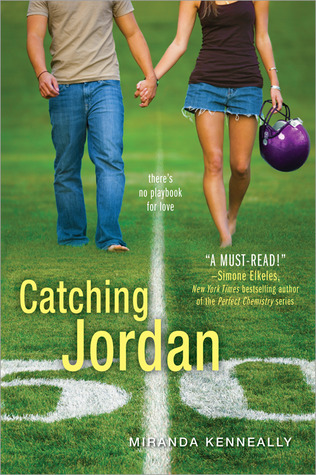
Catching Jordan by Miranda Keneally 

What girl doesn't want to be surrounded by gorgeous jocks day in and day out? Jordan Woods isn't just surrounded by hot guys, though--she leads them as the captain and quarterback of her high school football team. They all see her as one of the guys and that's just fine. As long as she gets her athletic scholarship to a powerhouse university.  But everything she's ever worked for is threatened when Ty Green moves to her school. Not only is he an amazing QB, but he's also amazingly hot. And for the first time, Jordan's feeling vulnerable. Can she keep her head in the game while her heart's on the line?


Born Confused by Tanuja Desai Hidier

Dimple Lala doesn't know what to think. Her parents are from India, and she's spent her whole life resisting their traditions. Then suddenly she gets to high school and everything Indian is trendy. To make matters worse, her parents arrange for her to meet a "suitable boy." Of course it doesn't go well -- until Dimple goes to a club and finds him spinning a magical web . Suddenly the suitable boy is suitable because of his sheer unsuitability. Complications ensue. This is a funny, thoughtful story about finding your heart, finding your culture, and finding your place in America.


Girl Got Game by Shizuru Seino

   Kyo Aizawa is very excited about getting to attend Seisyu Academy, which is famous for its adorable girls' uniforms. Her spirits are crushed, however, when she opens the package containing her school uniform to find a boy's uniform. Her father explains to her that, as Seisyu Academy is also famous for its boys' basketball program, he enrolled her as a boy so she can fulfill his own dream of becoming an NBA basketball star. 
   When she gets to the school, she has to try out for the team. At tryouts, she sees a handsome boy who is an amazing athlete and wonderful at basketball. However, when she meets him, all he does is make fun of her height and acts like a jerk. It is bad enough to have to act as a boy, but to make matters worse, her roommate is the same boy she came to hate at tryouts.


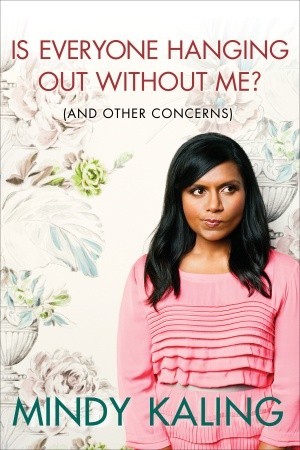
Is Everyone Hanging Out Without Me? by Mindy Kaling

Mindy Kaling, best-known as a writer-actress on the American version of The Office, traces her path from sensitive, chubby, Indian girl to woman-about-town in TV's comedy scene in observant, bracingly hilarious, and surprisingly poignant essays and lists.


Hooked by Liz Fichera

When Native American Fredricka ‘Fred’ Oday is invited to become the only girl on the school’s golf team, she can’t say no. This is an opportunity to shine, win a scholarship and go to university, something no one in her family has done. 
  Fred’s presence on the team isn’t exactly welcome — especially not to rich golden boy Ryan Berenger, whose best friend was kicked off the team to make a spot for Fred, but there’s no denying that things are happening between the girl with the killer swing and the boy with the killer smile.


Motherland by Vineeta Vijayaraghavan

Born in Kerala, Maya spent the first four years of her life there, cared for mainly by her grandmother, Ammamma, until she was sent to live with her parents in New York. At 15, with her parents' marriage undergoing a rough patch, she is sent back to India to stay with her Aunt Reema and Uncle Sanjay, their 10-year-old daughter, Brindha, and Ammamma at their house in the tea hills above Coimbatore. It's been years since Maya came to visit, and this time she is keenly aware of cultural differences: the different spheres of men and women and the persistence of the caste system. She feels stifled by the attentions of Ammamma and resentful of the time she must spend with the old woman. When Maya suffers an accident while most of the family is away, she and Ammamma grow closer, and Maya learns a hidden family fact. But only when Ammamma falls ill and the entire family gathers, including Maya's parents from New York, does Maya begin to comprehend more deeply the complexities of relationships.


Dairy Queen by Catherine Gilbet Murdock

After spending her summer running the family farm and training the quarterback for her school's rival football team, sixteen-year-old D.J. decides to go out for the sport herself, not anticipating the reactions of those around her.


Oleander Girl by Chitra Divakaruni

Orphaned at birth, seventeen-year-old Korobi Roy is the scion of a distinguished Kolkata family and has enjoyed a privileged, sheltered childhood with her adoring grandparents. But she is troubled by the silence that surrounds her parents’ death and clings fiercely to her only inheritance from them: the love note she found hidden in her mother's book of poetry. Korobi dreams of one day finding a love as powerful as her parents', and it seems her wish has come true when she meets the charming Rajat, the only son of a high-profile business family.   But shortly after their engagement, a heart attack kills Korobi's grandfather, revealing serious financial problems and a devastating secret about Korobi's past. Shattered by this discovery and by her grandparents' betrayal, Korobi undertakes a courageous search across post 9/11 America to find her true identity. Her dramatic, often startling journey will, ultimately, thrust her into the most difficult decision of her life.


First Crossing: Stories About Teen Immigrants by Donald R. Gallo

Fleeing from political violence in Venezuela, Amina and her family have settled in the United States. Sarah, adopted, is desperate to know her Korean birth parents. Adrian’s friends have some spooky — and hilarious — misconceptions about his Romanian origins. Whether their transition is from Mexico to the United States or from Palestine to New Mexico, the characters in this anthology have all ventured far and have faced countless challenges. Each of these stories is unique, and each one has something to say to all of us.


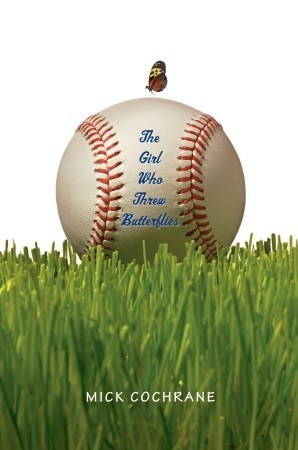
The Girl Who Threw Butterflies by Mick Cochrane

Molly Williams has had a difficult time. Her father died in a car accident; her mother has withdrawn into herself. Molly, however, wants to be known for something positive -- like joining the boys' baseball team. Over the course of a baseball season she learns to redefine her relationships with family, friends, and the things she loves.
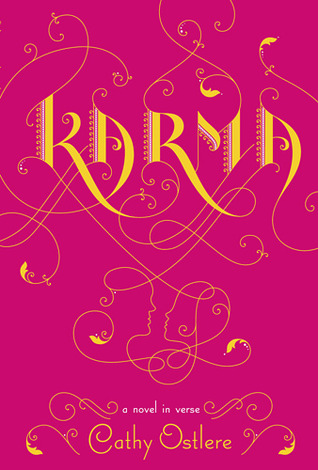
Karma by Cathy Ostlere

On October 31, 1984, Indira Gandhi is gunned down by two Sikh bodyguards. The murder sparks riots in Delhi and for three days Sikh families are targeted and killed in retribution for the Prime Minister’s death. It is into this chaos that sixteen-year-old Maya and her Sikh father, Amar, arrive from their home in Canada. India’s political instability is the backdrop and catalyst for Maya’s awakening to the world.
Rummanah Aasi
  I had a wonderful time participating in the Middle East Reading Challenge hosted by Helen at Helen's Book Blog. I just wished that I registered much earlier so I could have fit in more books, however, I do plan on reading more books in this region. I've learned so much. I read G. Willow Wilson's memoir titled The Butterfly Mosque as my last entry for this reading challenge.


Description: The author describes her conversion to Islam and journey to Egypt where she taught English, learned about the Middle Eastern culture, and fell in love with an Egyptian man. 


Review: The Butterfly Mosque is a satisfying, well written memoir that is equally a romance and travelogue. When I started The Butterfly Mosque, I didn't know what to expect. I had never read a book about someone converting to a religion, especially Islam. After an illness forces her to face her own mortality at age 18, Wilson, the child of two atheists, finds herself in search of religion. The faith fits her needs is Islam, but post 9/11 she faces difficulties embracing it fully, feeling as if she is betraying her country, etc. However her interest in studying Islam, Arabic, and learning about the Middle East continues to grow. When she is given the opportunity to move to Cairo and teach at an English-language school that she is able to immerse herself in the religion she has come to love and become a Muslim.
  Her experiences at Cairo are eye opening and fascinating, especially with those of us who know absolutely nothing of the Egyptian culture. When she falls in love with Omar, an Egyptian physics teacher, Wilson becomes increasingly open about her faith. She openly claims Islam despite the fears that her friends and family will not accept her. Though Wilson finds herself warmly welcomed Omar's family, adjusting to life in Egypt takes time and patience. Despite speaking Arabic, following the social mores, and being an observing Muslim, Wilson isn't fully embraced by the Cairo dwellers and will probably always be known as the foreigner.
  Wilson avoids preaching how to be the "right" Muslim, keeping faith personal and instead focuses on the stereotypes of Arabs, particularly of the religious fundamentalists, and breaks them as she learns more about the religion, talks with natives, observes the society around her. As Wilson lives in Cairo, she also makes note how the different genders interact. Women's rights are most discussed, though at times the problematic issues are a bit glossed over. Still I found the memoir an enjoyable and approaching read and would recommend it to others. 


Rating: 4 stars

Words of Caution: There is some strong language in the book. Recommended for Grades 9 and up.

If you like this book try: Love in a Headscarf by Shelina Zahra Janmohamed or The Muslim Next Door by Sumbul Ali-Karamali
Rummanah Aasi
  Looking back on my high school required reading list, I only seem to have read just one book about slavery and racism which was Huck Finn by Mark Twain. I hope to read To Kill a Mockingbird later this year and recently finished John Howard Griffins amazing personal account of racism in his modern classic nonfiction novel, Black Like Me.

Description: Before the Civil Rights Movement occurred, journalist John Howard Griffin pondered what is was like to be black in the Deep South. If he only changed the color of his skin, how different would his life be? Black Like Me is a personal account on how humans reacted in the response to something is essentially really trivial, the color of ones skin. 

Review: Griffin spent a little over a month, some of November and December of 1959 with his skin artificially darkened by medication. He wanted to do a sociological experiment in how people reacted to race in America's South. Going into this project, he realized that it wasn't going to be easy and sought out help and support from various people. During those months, he traveled through Louisiana, Mississippi, Alabama and Georgia, finding out at first hand what it is like to be treated as a second-class citizen. While we all have read several stories of injustices, the lynchings, the civil rights cases before, Griffin's experiences are raw and thrust in front of faces. We both participate as both the observer and the participant of these daily injustices such as the rudeness of the clerk when he tried to pay for a train ticket with a big bill; the difficulty he had in finding someone who would cash a traveler's check for a Negro; the bus-driver who wouldn't let any blacks off the bus to use the restrooms; the white man who followed him at night and threatened to mug him.
   In attempts to not generalize, Griffin provides both from both races who helped him regardless of his race at the time. As you can imagine, this report created a lot of stir when it was officially released. Many of the people who replied to Griffin's story wrote that they too feel guiltily and ashamed about how the minority have been treated but are afraid to stand up because of the strong back lash they would feel if they had let their opinions be known and heard. While some may argue that Black Like Me is "the white experience of racism", I would actually argue that this book forces everyone regardless of their race to think about racism and stereotypes we project upon each other.
 Black Like Me is a powerful, unflinching, influential, and gripping story. Though it is nonfiction, it does not read like a textbook but rather as a nonfiction narrative with many similar characteristics of an adventure story. Like Griffin, I was always scared that someone would find out the truth. His interior monologue how he himself is transformed by simply darkening his skin is utterly fascinating. Just the simple act of writing his wife a letter explaining that he is okay seems like a crime. Though Griffin only spends a month with dark skin, his revelations of how we treat each other is still relevant today. Black Like Me is a must read and I now understand why it has been on a required reading list for many schools.

Rating: 5 stars

Curriculum Connection: English, Social Studies

Words of Caution: There is some strong language in the book. Recommended for high school students and up.

If you like this book try: White Like Me by Tim Wise or "Why Are All the Black Kids Sitting Together in the Cafeteria?" by Beverly Daniel Tatum
Rummanah Aasi
  The Girl in the Tangerine Scarf by Mohja Kahf was recommended to me by my dad or more accurately-one of my dad's student had recommended it to him, but since my dad doesn't read "novels", he passed it on to me. I wasn't in the mood to read a preachy book and thus had the title sitting on my shelf for about five years until I put in my list of top 10 books I resolved to read in 2011. I'm glad that I can finally pull it off from my bookshelf, but I can't seem to shake off my frustration with the title.

Description: Khadra Shamy recalls what it was like growing up as a Syrian Muslim American during the 1970s in Indianapolis, Indiana. Her devout parents raise Khadra and her older brother, Eyad, to be observant of Islamic customs. As Khadra grows older, she reaches a cultural crossroad that forces her to question what it means to be "Muslim", "Syrian" or "American."

Review: The Girl in the Tangerine Scarf is a very ambitious novel that seems to tackle all the important complex issues tied to identity: religion, race, and politics. For Muslim Americans (such as me), the book forces them to see the rising problems in the Islamic community that are still relevant today. For those who are not familiar with Islam, the book is an eye opening experience of looking at America from a "foreigner's" point of view. Regardless from what perspective you are reading the book, it is undeniable that the issues it brings up is important, timely, and much needed, however; I can't honestly recommend it without some reservations.
 I had a really hard time reading this book. It's not that the language or themes were beyond my comprehension, but rather I found the writing and editing to be so poorly done. The Girl in the Tangerine Scarf has no plot, at least in the way we traditionally think of plot (beginning, middle, end or events leading to a climax and a resolution- depending on how you define plot). The prologue establishes our protagonist, Khadra, on a trip back home to Indianapolis, Indiana for a project she has to do for work. She has some trepidations in coming back home. The book immediately goes back in time to her childhood through adulthood with abrupt transitions to the present. There are large plot holes in the novel, particularly with the books timeline. In fact by the last few chapters of the story, I completely forgot Khadra was on a trip at all because I didn't know what she was doing in the present.
  In addition to the plot holes, there is an inconsistency with the translations of important Arabic phrases that are used throughout the book. While I have background knowledge of Islam, I did not have a problem understanding the terms, however, those who are not familiar with the Islamic faith could easily get confused and miss out its significance. I don't consider myself a lazy reader who is not willing to look up information in order to understand a book nor do I feel that an author needs to spoon feed me the information in order to enjoy his/her novel, but I do strongly believe there needs to be some context in which phrases are used. The author doesn't give any context clues nor a glossary, but only a haphazardly thrown bibliography of books that influenced her writing.
  Along with the book's disorganization, I did not feel there was any character growth for the characters. Kahf throws in characters right and left as if she's a chef preparing a complex dish. Characters disappear without leaving any impression on the reader. I didn't like Khadra at all. For the first half of the book, I found her to be insulting and condescending. She sees religion in its most puritanical form and those who don't follow her rules are deemed as unobservant and are "going to hell". While the book is a coming of age novel and most novels in this genre show the protagonist question authority and go on a quest to find their own identity, Khadra does neither for the first 300 pages. She follows the beliefs that her parents taught her blindly and absolutely. It is not until her trip to a politically charged Syria, does she reconsider her beliefs and only then her epiphany is only about 5 pages, which I found very hard to digest and believe.
 While the book addresses important issues such as gender equality, how one interprets religion, and tolerance, it superficially addresses them. One can argue that the book isn't really a novel with a message, but rather an expository piece that shows how fractured the Muslim community is in terms of what constitutes a Muslim identity and what is the correct way to interpret Islam in the 21st century. In that case, I can't help but think the book succeeds in this aspect only by the stereotypes it presents to the reader. 
 I appreciate the author's attempt in exploring the identity of a Muslim American, which has been routinely questioned by those who are first generation Muslim Americans (including myself). For most of us, our parents have raised us to follow Islam and the Islamic code the way they have been taught by their elders, however, things get murky when you live in a secular society like America (and that's not always a bad thing). Books like The Girl in the Tangerine Scarf that explores the identity crisis of Muslim Americans are desperately needed and I think book is in the right direction. Some readers may think the book is poignant and a great choice for book discussions, but it's definitely not for me.


Rating: 2 stars

Words of Caution: There is strong language in the book including racial slurs. There is also allusions to rape and murder. Recommended to mature teens and adults only. For those readers who are unfamiliar with Islam, I would highly suggest you read some introductory materials to gain some background knowledge first before reading this book.

If you like this book try: The Namesake by Jhumpa Lahiri
Rummanah Aasi
  I'm always surprised when I read a book by Neal Shusterman, mainly because I never know what to expect from his books. What I do know, however, is that each time I read one of his novels I always have a different, fresh reading experience that leads me to think about the book much longer after I have finished it. His latest title, Bruiser, is no exception.

Description: Tennyson is furious when he learns that his twin sister, Bronte, is dating the odd and somewhat frightening Bruiser (real name Brewster), but Bronte insists that Bruiser is just misunderstood. Tennyson, like many of his peers, think Bruiser is a psychopath in the making, but his sister insists her boyfriend is not. After observing Brewster, Tennyson eventually realizes that Brewster is a sensitive, intelligent guy. The twins can't help but notice unusual and unexplainable events happen whenever they are near Brewster. Brewster refuses to talk and keeps to himself, but how long can he hold on to his secret before being exposed by new friends? What will Tennyson and Bronte do after they find out Brewster's secret?

Review: Bruiser is one of the rare books where I didn't really like any of the characters per se, but still enjoyed the book. For me this is odd, because I have a hard time enjoying a book where I don't like or care for the characters but I think that is the very point that Shusterman is trying to make in his novel. Bruiser is a philosophical, ethical, exploration of friendship. The novel is told from 4 point of views: Tennyson, Bronte, Bruiser aka Brewster, and Brewster's little brother Cody. Although it is very easy to lump these voices together, Shusterman does a great job in making each voice unique and distinct. He also juggles with prose, tone, and Brewster's novel in verse format which is something that I haven't read before. The writing style Shusterman chose for his character is fitting to their personality and voice while not interfering with his fast pace plot.
  Tennyson and Bronte are twins and children of two English professors whose marriage seems to be falling apart. Both characters are very observant of their surroundings. I did not like Tennyson from the very start. He is arrogant, a bully, and very condescending to those around him. Unlike Tennyson, Bronte seems to be a bit more likable, however, her "let's save the strays" attitude irked me. Nonetheless, I enjoyed how these characters interacted with Brewster. Both siblings view Brewster as 'their' project with a very similar tone to My Fair Lady (a musical that has always irritated me). While we praise Tennyson and Bronte for changing their misconceptions of Brewster, we can't help but question their motives and the basis of their friendship. Are they really, truly his friends or is he a charity case for them to take on so they could feel good about themselves?
   Brewster is a very unique character that I have not read in a really long time. I felt sorry for him when I witnessed him being bullied in school and by his guardian uncle yet I was angry at him for being so passive. I didn't understand why he simply let things happen to him until his supernatural secret is discovered. The supernatural aspect of the book is suitable for Brewster's character and it actually come off as if it was plausible. I just wanted more information as to how it got started, but nonetheless it made me understand why Brewster prefers to be a outsider yet he is grateful for having 'new found' friends. Even though his friends might be using him, Brewster can't help but feel like he is using them too.
    Bruiser can be read as an homage to Ginsberg's Howl poem. Brewster's desperation, loneliness, and the yearning to be normal leaps off the page and tugs at our heart strings much like the emotions that stir us when we read Howl. I couldn't help but wonder what would I do if I were in Brewster's place.
  Shusterman poses a lot of food for thought questions for his readers: Are Brewster's abilities a gift or a curse? Should Tennyson and Bronte take advantage of Brewster's abilities once they discovered what he can do? Is there power in friendships and if so, who is abusing theirs?  Even after finishing this book over the weekend, I still don't have the answers which is why I think this book would make a great book discussion.
 
Rating: 4 stars

Words of Caution: There is some language and scenes of child abuse. Recommended for 8th grade and up.

If you like this book try: Rules of Survival by Nancy Werlin
Rummanah Aasi
  I was in fourth grade when my older brother suggested that I read Elizabeth George Speare's The Witch of Blackbird Pond. I clearly remember looking at the title and cover, briefly skimming the excerpt of the book, and then said, "No thanks". Looking back, I realized that I would probably not appreciate the book as I do now.

Description: In 1687 Kit Tyler moves from her luxurious place in Barbados after her grandfather dies to live with her aunt's Puritan household. Feeling out of place, she befriends an old woman who is called a witch by the community and suddenly finds herself standing trial for witchcraft.

Why it was banned/challenged: In 2003, The Witch of Blackbird Pond was challenged at a middle school in Cromwell, Connecticut on concern that it promotes witchcraft and violence. Source: Marshall University Library

Review: My fourth grade self would not have liked The Witch of Blackbird Pond. The pace of the book moves pretty slowly with a little bit of action towards the end of the book. The characters were not instantly likeable either. Pace and the likability of the characters were two important things that I looked for in a book as both a reluctant and avid reader. If I'm not interested, my attention goes elsewhere and I simply don't care what happens.
  The Witch of Blackbird Pond takes time to open up to the reader. At first I had to adjust the historical context of not only what was happening in 1687 America/New World, but also the mannerisms and speech of the characters. I liked Kit's impulsiveness and her refusal to conform her society's thoughts and ways. She was an independent mind and free spirit. It's no wonder why she would connect the outcast Hannah, who is thought to be a witch and practice witchcraft.
 Although there are rumors of witchcraft amongst the community members in the book, there is no element of fantasy in the entire book. Contrary to the challenger's fears, the book's central theme is to avoid jumping to conclusions, not being prejudice towards others who don't share the beliefs as yours, and to be frightened of the mob mentality that many had during that certain period in American history.  

Rating: 4 stars

Words of Caution: None. I think this title would be appropriate for Grades 6 and up.

If you like this book try: The Lottery by Shirley Jackson
Rummanah Aasi
  Tony DiTerlizzi is probably most known for his contributions to the popular and best selling Spiderwick Chronicles series for children. He brings the same amount of whimsical and energetic feeling to one of his stand alone titles called Kenny and the Dragon. The book not only celebrates friendship but also the love of the reading.

Description: Kenny Rabbit befriends a dragon named Grahame. Grahame is very different from the dragons that Kenny has read in his beloved books. When the people of Roundbrook village find out that there is a dragon living in their community, they call for an immediate extermination. Will Kenny lose his new best friend?

Review: I really enjoyed Kenny and the Dragon. I loved Kenny, who is both bookish and adorable. I also loved learning about the misunderstood, intelligent, and very funny Grahame. Young readers will easily be able to follow the straightforward story. They would also enjoy the themes of diversity, debunking stereotypes, and the joys of reading. Adults will enjoy the literary allusions and innuendos in the story. The illustrations are great and add another layer to the story.  I haven't read the original classic story by Kenneth Grahame, but you don't really need to read it before reading this book. Overall, a great story for all ages. Recommended for Grades 3 to 6. 

Rating: 4.5 stars

Words of Caution: None.

If you like this book try: The original story called The Reluctant Dragon by Kenneth Grahame or The BFG by Roald Dahl
Rummanah Aasi
  Friendships are complicated and varied. Some last for a lifetime while others just last for a few days or seasons. A Friendship For Today is loosely based on the real-life experiences of author, Patricia McKissack, and the school integration in St. Louis.

Description: After the ruling of Brown v. Board of Education,  Rosemary's colored school in Kirkland, MO is closed, and students are distributed to neighboring white elementary schools. Determined to prove she is not remedial and up to par with her white schoolmates, Rosemary excels academically and refuses to be racially intimidated or stereotyped. She strikes up an unlikely friendship with mean Grace Hamilton, who is labeled and stereotyped "white trash" by snobby classmates. Rosemary and Grace both open their eyes, witness their similairities, and develop a friendship inspite of the challenges they face.

Review:  I enjoyed reading this book. Rosemary is a smart, observant, and brave girl. She refuses to be trapped in stereotypes and bullied by her classmates. She has a good head on her shoulders. The story does not only focus on Rosemary's difficult transition to a new school but also includes watching her parents get a divorce and her best friend dealing with polio. Rosemary and Grace's friendship is realistic. At one poignant part of the story is where Grace embarrassingly admits that her father believes that white people are superior to other races. It's her friendship and dialogue with Rosemary that Grace now knows better. Even for one day, they both embrace tolerance and similarities.
  While I loved the message of the book and the characters, my main problem with this book is that I didn't like how it was written. I felt that I was being told a story rather than reading one. I wished the author showed more instead of telling. Otherwise this a great historical fiction book for grades 3 to 5.

Rating: 3.5 stars

Words of Caution: The "n" word does appear in the book.

If you like this book try: Freedom Walkers by Russell Freedman
Rummanah Aasi
  Today I have the honor and pleasure in bringing you an author interview with Julie Halpern. Julie is a middle school librarian in the Chicagoland area and an author. While not always wanting to be an author, Julie was always writing. Her passion for writing first began when she was a pen pal, wrote short stories for her friends, and even created her own zine.
    Julie has currently written three books. Her first book is a picture book called Tobey and the Snowflakes, which tells the story of Tobey finding new friends when his best friend moves away. Her second book, Get Well Soon, is her debut YA novel where her main character Anna Bloom is sent to a mental hospital to deal with her depression and panic attacks. Her third book, Into the Wild Nerd Yonder, follows Jess as she navigates the cliques in high school while trying not to lose herself. Into the Wild Nerd Yonder was released last year and like her previous books has gained fans and acclaim alike. I read and loved Into the Wild Nerd Yonder. If you haven't read the book, pick it up! It's fabulous! Help me welcome Julie Halpern to Books In The Spotlight.

Rummanah: Julie, welcome and thank you for stopping by. I have to say that Into the Wild Nerd Yonder was an awesome book that made me laugh, think, and smile. I can empathize with Jess in her struggle to not lose herself as her friends try to join cliques in high school. How did you come up with her character?

Julie: Thanks so much for the sweet words and for inviting me by! Jessie’s character started with my own situation in high school, where I always felt like the sidekick. Most of my friends were these super punk or alternative kids, and while I was into the music, I never felt like I fit in with those groups. Instead, I sort of floated around to the punks, alternative kids, the metal-heads, and the nerdier kids. And most of the time I just hung out with my one best friend, Tracy. I wanted Jess to be an individual who also didn’t fit in with a certain group. Then there was the piece where I wanted to showcase the Dungeons and Dragons crowd. I run the Dungeons and Dragons Club at the middle school where I’m a librarian, and the kids are amazing and smart and funny, not to mention the awesomeness of the game. So I wanted to show how a really cool individual would find her way into the Dungeons and Dragons crowd. And how accepting they would be of her. 

Rummanah: I have to say that one of my favorite parts of the book is where Jess plays her first Dungeons and Dragons D game. I was lost just like her, but was amazed how passionate people are about the game. I think my vague knowledge of Dungeons and Dragons as a cartoon show in the 1980s helped me just a little in visualizing what was going on. Were you always a fan of Dungeons and Dragons or did you have to learn about the game when you wrote Into the Wild Nerd Yonder?

Julie: I watched the cartoon, too! I played a little Dungons and Dragons in high school. I have no idea what made me interested in playing, but at some point I fell in love with the concept of pretending to be someone else in a fantasy setting. Then when I went to college, I found a group of people to play with (college is perfect for Dungeons and Dragons because you can stay up all night and you all live in the same building when you’re in a dorm). Starting the Dungeons and Dragons Club with my middle schoolers allows me to play every week while passing on the game to new kids. It’s amazing what a sense of self playing Dungeons and Dragons gives these kids. You know Vin Diesel? He wrote a brilliant intro to the book Thirty Years of Adventure: A Celebration of Dungeons and Dragons about how Dungeons and Dragons changed his life.

 Rummanah: You already know that I have a huge crush on Barrett, Jess’s hot, funny, and smart brother. *Sigh* Do you have any crushes on literary characters?

Julie: I’ve been marinating on this question for a while now, and I think I have become an old, jaded person. In high school, I was in love with every book character I met, particularly Holden Caulfield (duh) and Simon from Lord of the Flies (which is just weird). As much as I love The Hunger Games, I didn’t form an attachment to any of the guys, and I’m not a Twilight fan (not a hater, either, just didn’t get into them). I guess Ron Weasley is my most current literary crush, although he’s very much a hybrid book/movie character. Barrett was pretty amazing :).

Rummanah: Like you, I’m also a librarian. I always love to hear how people got into this awesome profession. What inspired you to become one?

Julie: In college I double-majored in Communication Arts (Radio, TV, Film) and Women’s Studies. But I also worked in several libraries, both college and public. Then I moved to Australia. Libraries were so useful to me, even on the other side of the world, that when I came back I decided to get my MLIS. I think I am an excellent librarian. I have a knack for matching kids with perfect books, and I have already redesigned two libraries. It’s an amazing, fun, diverse career.

Rummanah: Did you always want to be a writer and write for young adults? If so, why?

Julie: I don’t think I ever really knew what I wanted to be. In middle school I thought I wanted to be an accountant. And with my college major I realized the film business wasn’t for me. But I have always loved to write, whether it’s letters or little home newspapers or short stories for creative writing classes or zines. Being surrounded by books, it’s hard as someone who has always written to not want to try it themselves. And why YA? Because that’s pretty much all I read. I like the directness of it.

Rummanah: What is your writing and revision process like?

Julie: I hand-write my novels from start to finish in a series of notebooks. I rarely look back while I write the first draft, so I don’t freeze up and want to change everything. After that is my least favorite part, which is typing the novel into my computer, also a huge revision piece. I then print the book out, read it, and scribble revisions all over that. At that point, I’m usually ready to send it off to my editor. I’m a pretty low fuss author; I don’t revise huge amounts, and my editor has yet to ask me for large numbers of revisions. I hope I didn’t just jinx that.

Rummanah: I know that you’re a big TV watcher. What are your top favorite shows that you can’t miss?

Julie: I have probably said this before, but I have never gotten over "Buffy" going off the air. Because of that, I haven’t been able to commit myself to any hour long dramas. So I watch mostly crap-ish reality shows, which really aren’t crap, but aren’t anywhere near replacing the quality and joy Buffy brought into my home each week. I like "Project Runway", "Top Chef", and most of the Bravo reality shows (although not really any of the Housewives anymore). I also like to watch [I say sort of embarrassedly] "19 Kids and Counting" and "Jonas LA". Yeah. And "iCarly". Oh! And I love the online show, "The Guild". Really, I could talk about TV all day.

Rummanah: Speaking of "Buffy", I couldn't help but notice that you got to meet The Joss Whedon at Comic Con in San Diego. I’m incredibly jealous. I spent this winter watching "Buffy" and I could not get enough of Spike. I know that you also love Buffy, do you have a favorite character?

Julie: Every so often, I try to re-watch all of Buffy. It’s gotten harder with a child. Part of my birth plan was to have Buffy going the entire time I was giving birth! I don’t know if this sounds generic or not, but my favorite character is Buffy. I admire her and relate to her and root for everything she does. That’s why I totally cried when I met Joss.

Rummanah: I’m always looking for the next great read, what is your favorite book that you’ve read this year?

Julie: This is such a hard question to answer because I am sitting on my couch, not surrounded by the library where I work. I kind of have to scan book shelves in order to remember anything I read. I hope this doesn’t sound snobby. I pretty much like almost all books I read because I love being somewhere else during the time I read them. I just have a crappy memory. I’m taking the next year off of work, so I won’t be of help for another year!

Rummanah: What are you working on now? Can you tell us something about it and when we can expect it to come out?

Julie: My next novel, Don't Stop Now, will be out next spring (early summer? Release date becomes official in September). It’s the story of a girl and her annoyingly platonic male best friend who go on a road trip to find their friend after she faked her kidnapping. It’s got a lot of my humor in it, but I also wrote alternating chapters from the perspective of the tragic friend. I’m really proud of it! And right now I’m smack in the middle of writing the sequel to Get Well Soon. I am at about the half-way point, and it is about the same length as Don't Stop Now was when I finished it. I’ll either have a really long book (for me), or I’ll be cutting a lot out when it’s finished.

Rummanah: You can count on me putting those on my to be read pile! Thank you so much for stopping by, Julie!

Julie: Thank you very much for having me! What a great interview!

If you would like to know more about Julie, visit her website, read her blog, and find her on MySpace
Rummanah Aasi
  Have you ever felt guilty in not liking a book that everyone has seemingly read and loved except for you? Or where you read the reviews of a book and have a high expectations for it only to be completely let down and disappointed? Well, welcome to my world. I just spent most of my weekend trudging through Major Pettigrew's Last Stand by Helen Simonson and would like to get my hours reading back.

Description: Major Pettigrew is a very proper, English widower of 68 who resides in the quaint village of Edgecombe St. Mary in Sussex, England. He is the father of Roger, a social climber and selfish young man who feels the values of his father are archaic. The Major is also the accidental suitor of the village mini-mart owner, Jasmina Ali, a 50-something Pakistani widow who shares his love of Kipling and his company. The two of them must navigate the gossip and outright prejudice of their stilted society in order to be together.

Review: I really wanted to love this book. It has a charming setting and writing style. The Major and Mrs. Ali are both likable main characters. Despite all this, I found the book flat, slow moving, and filled with stereotypes.
    When I began this book I was intrigued on how the author is going to explain the tumultuous history between Pakistan and England, particularly of how Pakistani-British citizens are treated in contemporary England, but the book doesn't talk about the issue pretty much at all. Sure, there are misconceptions and a scene of an reenactment of the violent Partition happening at a dinner party, but the author doesn't go in depth nor do the characters really seem to care. I know this book isn't meant to be a political analysis on race relations, but when it is marketed as a (paraphrasing the book jacket): "an examination on race, religion, and a clash of cultures", the book falls flat. In fact, the majority of the story, I would argue, is not about Major Pettigrew and Mrs. Ali's relationship, but rather the ongoing conflict of who will own the precious pair of guns that the Major inherits.
  In addition to being mislead, I was constantly annoyed when Mrs. Ali's nationality of being a Pakistani who was born in Britain is constantly viewed as Indian. Though Pakistan and India share similarities, they are entirely two different countries with very different cultures. I was also bothered that Mrs. Ali's extended family were stereotypical Pakistanis who were rigid, ignorant, and frankly 'backwards'.
  While the Major is charming and funny, I found him caught in between preserving his old English traditions and yet at the same time willing to abandon them without any care as long as got Mrs. Ali. To be honest, I didn't care for the Major and Mrs. Ali's relationship mainly because it wasn't developed beyond small meetings between the characters. I wasn't convinced that they loved one another, but rather used one another as a way to avoid being lonely. Overall, a big disappointment and very misleading.    

Rating: 2 stars


Words of Caution: There's mild language and sex is alluded to in the book. It's definitely an adult book since the characters are adults. Teens would get very bored with the book and it's very slow moving plot.

If you like this book try: The Three Weissmann of Westport by Cathleen Schine
Rummanah Aasi
 I was on a waiting list for about a month to read Perfect Chemistry by Simone Elkeles. During that time, I kept hearing great buzz about the book, which is being marketed as a modern day star-crossed lovers with an urban twist. When I hear the book was set in a Chicagoland suburb, I was intrigued and couldn't wait to read the book. Now that I finished it, I wish I didn't waste my time on it.

Description: Brittany and Alex are two polar opposites. Brittany is a North Sider who is wealthy and seemingly perfect. Alex Fuentes is a South Sider, Mexican American gangster. When the two meet as chemistry lab partners, sparks fly and they soon develop a relationship, which is disapproved by their family and friends.

Review: Let me preface this review by saying that I have no problem with reading a romance. I know that they are general conventions of the genre that require the reader to suspend disbelief and that the characters will have their happy ending. I absolutely fine with those requirements. So, why did I hate Perfect Chemistry so much? Well, it's mainly because of the characters and how the story is told. Perfect Chemistry is simply a modern retelling of the West Side Story with a happy ending. The plot is very predictable from the first page. You don't have to be Albert Einstein to figure out that the two main characters will initially hate each other, develop a strong attraction which they can't explain, fall in love, and then face a conflict that involves the gang life. I can overlook a simplified plot, but not the characters.
    Brittany, Alex, and the other characters are walking and talking stereotypes. Brittany is the beautiful, rich girl, who has a problem. Whereas Alex is a gangster who secretly is sensitive and smart.  I wanted to strangle both of them and knock some sense into them when they continue to play along with the stereotype instead of breaking them. I've heard arguments that the characters do, indeed, break their stereotypes in the book. It just takes them about 300 pages to do so and with a half heart. I don't think these characters really do change, but rather perpetuate the stereotypes.
   There are some serious issues that the book lightly brings up. There is no gang member that selects what he or she gets to do unless they are a leader. As for dating a gang member, there is not a single alarm that goes off in Brittany's parents. I believe in the power of love, but what I don't believe in is that getting out of gang is a simple process. I've known people like Brittany and Alex in real life and they would never have dated. The guys like Alex have wasted their talents either in jail, died, or have remained with their gangs.

  If you're not bothered by the stereotypes, dialogue filled with cliches, and a very syrupy epilogue in your romance, then this is the book for you but I think I'll pass.     

Rating: 1 star

Words of Caution: I would not recommend this book to anyone below 16 years old. There is strong and crude language throughout the book-both in English and in Spanish. Sex is discussed and occurs in the book. There is also gang violence, which includes beatings and shootings.

If you like this book, try: Rules of Attraction by Simone Elkeles
Related Posts with Thumbnails