Showing posts with label 2013 Classics Double Challenge. Show all posts
Rummanah Aasi
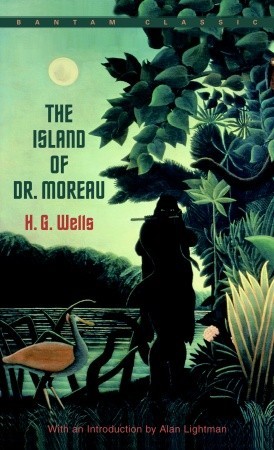
  I remember a really bad movie called The Island of Dr Moreau which featured Marlon Brando and Val Kilmer back in the 1990s as a kid and always thought it was so weird, but I didn't realize it was an adaptation of a book. It's not until hearing lots of publicity of Megan Shepherd's debut novel, The Madman's Daughter, a loosely adapted YA retelling of Well's original story did I decide to pick it up. The Island of Dr. Moreau is well worth picking up and reading, especially if you enjoy science fiction and Gothic horror.

Description: In The Island of Dr. Moreau a shipwrecked gentleman named Edward Prendick, stranded on a Pacific island lorded over by the notorious Dr. Moreau, confronts dark secrets, strange creatures, and a reason to run for his life. 

Review: Unsettling, bizarre, and most definitely ahead of his time, H.G. Well's lesser known novel, The Island of Dr. Moreau, is a very slim novel that tackles a variety of themes along with giving its readers a full dose of suspense, horror, and science fiction. Edward Prendick finds himself shipwrecked on an island with Doctors Montgomery and Moreau. Montgomery is the protege and follower of the Moreau, mad scientist and vivisectionist. A vivisectionist is someone who cuts and injures living animals for the purpose of scientific research. Beyond these scientists, Prendick finds himself intensely frightened (that's an understatement) by these creatures roaming around the island. 
  Prendick discovers that Moreau captures the island's animals and painfully turns them into half-men, then forces them to live by strict standards that he believes will overcome their bestial natures. These creatures of treated as subservient slaves, obligated to follow Moreau's commandments much like the Ten Commandments in which the number one rule is to not eat meat. It doesn't take a mad scientist to know that all of this is a recipe for disaster with horrible consequences. I really like how Wells juxtaposed the notion of bestial behavior by pitting the natural craving for meat against the humans conducting so-called 'experiments' just to see if things can be done. 
  Prendick finds himself in a predicament. Though appalled by Moreau's plan, he actually becomes a participant in Moreau's society of vivisection. Prendick is drawn to Moreau's brilliance and is enchanted by  the notion that Moreau could actually be right but that haze of illusion is cleared when the animals inevitably rebel and he becomes the last man on the island, watching the tortured animals return to their natures and throw off Moreau's pseudo-society. The true horror of the book isn't just the creatures no matter how strange they look, but rather the human monster who creates in the name of advancement.
 Though overlooked by other more popular horror novels such as Dracula and The Strange Case of Dr. Jekyll and Mr. Hyde, The Island of Dr. Moreau is relevant more now than ever with our outstanding and always progressing technology. Genetics, animal experimentation, psychology, colonization, imperialism, patriarchy, scientific chauvinism, religion, and ethical imposition are seriously and intelligently explored within the layers of the story. Wells' implied conclusions may be unsettling at times, but that is the point.

Curriculum Connection: Ethics, Science, and Debate

Rating: 4 stars

Words of Caution: The violence in the novel is quite tame compared to today's books, but I would still recommend this book to older readers due to the book's themes.

If you like this book try: Dr Franklin's Island by Ann Halm, The Madman's Daughter by Megan Shepherd, Frankenstein by Mary Shelley
Rummanah Aasi
  I'm really enjoying the Classics Double Challenge hosted by One's Librarian Book Reviews. The object of this challenge is to read a classic (the term is used loosely to include fairy tales, mythologies, classics, any kind of original story) and couple it with a retelling (the original and the newer book have to relate in some way that you can define; it doesn't have to be a straight-forward retelling). My objective with this challenge is to read some classics and discover new authors that I've haven't read yet.

Description (from book's panel): Juliet Moreau has built a life for herself in London—working as a maid, attending church on Sundays, and trying not to think about the scandal that ruined her life. After all, no one ever proved the rumors about her father's gruesome experiments. But when she learns he is alive and continuing his work on a remote tropical island, she is determined to find out if the accusations are true.
  Accompanied by her father's handsome young assistant, Montgomery, and an enigmatic castaway, Edward—both of whom she is deeply drawn to—Juliet travels to the island, only to discover the depths of her father's madness: He has experimented on animals so that they resemble, speak, and behave as humans. And worse, one of the creatures has turned violent and is killing the island's inhabitants. Torn between horror and scientific curiosity, Juliet knows she must end her father's dangerous experiments and escape her jungle prison before it's too late. Yet as the island falls into chaos, she discovers the extent of her father's genius—and madness—in her own blood.

Review: The Madman's Daughter is a retelling of H.G. Wells's often overlooked science fiction/horror novel The Island of Dr. Moreau and is told from the point of view of the mad doctor's teenage daughter. While Shepherd takes many liberties with the original story, this dark novel blends the basic premise of the original with new insights, characters, and terror. despite some flaws, it succeeds as a horror novel. 
   In an excellent rendition of the dark, desolate Victorian England, we meet Juliet who has a taint on her reputation. Her father, Dr. Moreau, an infamous scientist who has been banished out of London due to his outlandish and shocking experiments, has left his wife and daughter destitute. When her mother dies, Juliet has just enough money to survive until she is fired from her hospital cleaning job for rebuffing the advances of one of the doctors. Terrified that she has to resort to prostitution as a means for survival, she runs into her old friend, childhood crush, and her father's assistant, Montgomery, and learns that her father is actually alive on an remote island. Montgomery fails to deter Juliet from seeing her father after several logical explanations, Juliet convinces Montgomery to take her to her father's island. The perilous trip on a pirate ship and the rescue of Edward, a castaway, naturally foreshadows the dangers and horrors that they will all see once they reach to their destination.
  I liked how Shepherd tries to give contexts to a very bizarre story. Dr. Moreau, while thoroughly detestable and selfish, comes off as a charismatic madman who in his twisted ways make his horrific experiments of mixing genes of animals and human a rather brilliant experiment. By making him a father (both literally and figuratively) to his subservient human-like creatures who obey him as if he was god, we get to see Dr. Moreau as a human which cleverly touches upon the colonial mindset of the times and brings up a really interesting issue of religion. Unlike her father, Juliet comes off as a character who is inconsistent; her mannerisms are thoroughly Victorian though her dialogue seems to be too forthright to be a Victorian girl. She is incredibly uptight and prissy, but I did welcome her take charge personality though her indecisiveness and impulsive nature irritated me, it didn't deter me from enjoying the disturbing aspects of the story. 
  The pace of the story reflects upon the traditional Gothic horror stories by always having something lurking in the background. The tapping of windows, the screams coming far away yet somehow close to the characters all build suspense quite well. I even liked the slow discovery of the Moreau's experiments. Though we are horrified to see what these creatures are, we do grow a relationship to some of them and sympathize with them.
   While Shepherd does a good job in evoking the settings and giving a new spin of the characters, the love triangle in The Madman's Daughter is the weakest point of the story and drags the book down. While Montgomery and Juliet have a natural chemistry that has been built over time, Juliet's attraction to Edward is just too convenient and contrived. Though we are expected to pit our affections for Montgomery and Edward against each other, only one of them comes out as a clear winner and makes us wonder if the other love interest was a superfluous invention. Though Montgomery and Edward are equally charismatic characters, I would have liked to learn more about them as individuals without Juliet swooning about their good looks. I do, however, have a theory about Edward and I'm waiting to see if I'm right or wrong in the next book of this series. 
 Though I read The Island of Dr. Moreau before reading this book, there were a few surprises that were a welcoming addition to the story such as how the book ends. While knowledge of Wells's novel would perhaps lead to a more satisfying reading experience, The Madman's Daughter whets the appetite for the original story and tackles some of the essential themes with some good old fashion scares. I'm looking forward to where Shepherd takes her characters next as the series continues.

 Rating: 4 stars

Words of Caution: There is a scene of attempted rape, some gore, and violence which mostly takes place off the page. Recommended for Grades 9 and up.

If you like this book try: The Island of Dr. Moreau by H.G. Wells, His Dark Endeavors series by Kenneth Oppel, The Great and Terrible Beauty by Libba Bray
Rummanah Aasi
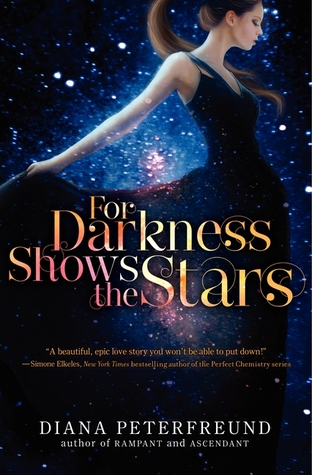
  For my last challenge of 2013, I'm participating in the Classics Double Challenge hosted by One's Librarian Book Reviews. The object of this challenge is to read a classic (the term is used loosely to include fairy tales, mythologies, classics, any kind of original story) and couple it with a retelling (the original and the newer book have to relate in some way that you can define; it doesn't have to be a straight-forward retelling). My objective with this challenge is to read some classics that I've haven't read yet.


Description (from Goodreads): It's been several generations since a genetic experiment gone wrong caused the Reduction, decimating humanity and giving rise to a Luddite nobility who outlawed most technology.
   Elliot North has always known her place in this world. Four years ago Elliot refused to run away with her childhood sweetheart, the servant Kai, choosing duty to her family's estate over love. Since then the world has changed: a new class of Post-Reductionists is jumpstarting the wheel of progress, and Elliot's estate is foundering, forcing her to rent land to the mysterious Cloud Fleet, a group of shipbuilders that includes renowned explorer Captain Malakai Wentforth--an almost unrecognizable Kai. And while Elliot wonders if this could be their second chance, Kai seems determined to show Elliot exactly what she gave up when she let him go.   But Elliot soon discovers her old friend carries a secret--one that could change their society . . . or bring it to its knees. And again, she's faced with a choice: cling to what she's been raised to believe, or cast her lot with the only boy she's ever loved, even if she's lost him forever.

Review: For Darkness Shows the Stars is a retelling that does everything right. Though it superficially maintains the plot points and themes of Jane Austen's Persuasion, it goes beyond and creates a new darker, post-apocalyptic world. Some readers were not thrilled by how Peterfreund dealt with rough handled morality in the story, but I would disagree. I think her decision to narrow her focus on the society enriched my pleasure of reading Austen's original work considerably. 
  The world that Peterfreund created is very intricate and detailed. While it takes some time for the world to unfold and one to grasp the social hierarchy, I was never confused but rather engrossed. Elliot North is our heroine who happens to be a Luddite, one of the elite destined to care for the mentally Reduced remnant after human genetic engineering went catastrophically wrong. 
  Eliot is just as charming as she is in the original book. She is duty bound to her family and her society, but the more she works with the Reduced, the more she has begun to question her duty; her family seems more interested in luxurious leisure than estate management. Her people will starve without recourse to forbidden technology, and more and more Post-Reduced children are being born. 
  One of the "Posts" that we get to know intimately is that of Kai Wentworth, Eliot's secret best friend turned romantic interest. Kai is extremely intelligent and longs to explore the world outside his designated boundaries. He and Eliot both know their romance is doomed due to their social status and the gap of his disappearance has wounded our heroine deeply. Now he has returned with the fleet of Post explorers who could be the last hope for saving Elliot's heritage, but his bitterness toward Elliot may be hiding a more dangerous secret. 
  I loved how the author gave insight to Eliot and Kai's relationship by interspersing letters written by their younger selves. You can see how naturally their relationship grew and evolved unlike the Austen original which underplayed the romance and reducing it to body language and signals. His passion rubs off on Eliot and we understand where their spark comes from. Though I already knew the outcome of the story, I couldn't help but feel frustrated whenever an obstacle came in Eliot and Kai's happily ever after, which I think is a sign that the author knows how to write a romance. 
While I liked that the society was different and original but still addressed the major themes of social and class distinctions, the book still felt a bit unfinished. I would have liked to see how the issues of slavery, anti-intellectualism and fundamentalist religion play out and hopefully it will be explored more when Peterfreund revisits the world in a different angle in her companion novel, Across a Star-Swept Sea, which will be released this fall. Readers looking for a swoony romance that isn't hindered by some depth, a steady pace, and a likable heroine should definitely check this book out. 

Rating: 4.5 stars

Words of Caution: There are rumors of possible sexual situations involving a character but it's never really explored or clarified. Recommended for strong Grade 7 readers and up.

If you like this book try:
Rummanah Aasi
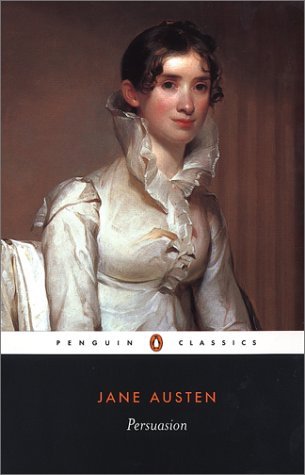
  Persuasion, published posthumously in 1818, is Jane Austen's last completed novel. Though it isn't as recognizable as Pride and Prejudice, Emma, or Sense and Sensibility, it is perhaps my favorite Austen novel. The writing and social satire is sharp and biting. The romance, of course, is sweet, satisfying, and the center of the book.

Description (from Goodreads): When Anne Elliot falls in love with a handsome and charming young man, she must make a wrenching decision. The man she loves is perfect in every way...except one: he lacks the wealth and social status that would make him a suitable match for Anne. At least, that is what friends and family persuade Anne to believe. So Anne breaks off the match and sends Wentworth away, but she can't help wondering: Did I do the right thing? It is a question that will haunt her for years until, unexpectedly, Wentworth returns. His circumstances have improved greatly, but is it too late for Anne?

Review: Like all of Austen's novels, the plot of the book is very straightforward. Our heroine, Anne Elliot, made a mistake eight years ago and the question of "What if?" has haunted her ever since. Anne was in love with a navy officer named Frederick Wentworth when she was nineteen years old. Wentworth was everything that Anne wanted in a spouse except he lacked two important things: social stature and money. Through persuasion and influence from her peers and society, Anne went against her gut instincts and declined Wenthworth's marriage proposal. Now in her late 20s (which is an old maid in Austen's times!), Anne has been shuffling between and living with vain, superficial, and irritating family members and friends. And with the unpredictable hands of fate, she once again encounters Wentworth who is now a renowned Captain in the Royal Army. The two are now forced to revisit old wounds and perhaps make amends.
  I absolutely adored Anne and I think she's probably the most realistic heroine that Austen created. She is logical, quiet, calm, and thoughtful. She isn't the first one to make impulsive decisions or rash prejudices against people she's met, but an observer of human behavior. Her thoughtfulness is her flaw as she over thinks everything. Though we may frown at her decision to decline Wentworth's proposal, we can understand why she declined. Without money and social stature, the two that made her society go round, there wasn't much of a future for Anne and Frederick. The prospects of attaining a future that went beyond attending balls, house visiting, and taking care of families is what Anne and Frederick both wanted. With that understanding in mind, her sacrifice of happiness leaves a bitter taste in our mouths as we watch Anne get belittled and brushed over. Anne immediately gets our sympathy and we hope for the moment where she stands up for herself.
   Unlike Anne, Frederick is a hard character to like at first. He is distant and appears extremely cold. His actions don't always make sense as he tries to make Anne jealous by being someone else's suitor, but we have to remember that is what Anne perceives him to be as we are watching the story unfold in her eyes. I thought it was interesting how our perceptions of Frederick changes as we hear other characters' opinion of him.
  The romance of Persuasion is very subdued, immersed in the quiet glances and in the body language of Anne and Frederick. The two play around the fire of attraction though their pride and resentment is what keeps them apart even though their pairing is now acceptable in the eyes of society. It is completely frustrating watching these two characters who are obviously in love with one another to come clean and actually communicate, but when they do the book soars. If you love romance and second chances, do pick up Persuasion.
 
Rating: 4.5 stars

Words of Caution: None. Recommended for teens and adults.

If you like this book try: For Darkness Shows the Stars by Diane Peterfreund, Captain Wentworth's Diary by The Family Fortune by Laurie Horowitz
Rummanah Aasi


4/4 books

  For my last challenge of 2013, I will partake in the Classics Double Challenge hosted by One's Librarian Book Reviews. The object of this challenge is to read a classic (the term is used loosely to include fairy tales, mythologies, classics, any kind of original story) and couple it with a retelling (the original and the newer book have to relate in some way that you can define; it doesn't have to be a straight-forward retelling).

Examples:

Frankenstein by Mary Shelley
The Apprenticeship of Victor Frankenstein series by Kenneth Oppel.
The Apprenticeship of Victor Frankenstein is a prequel series to Frankenstein.

Jane Eyre by Charlotte Bronte
Jane by April Lindner.
Jane is a retelling of Jane Eyre, set in a modern day.

 If you need some inspiration for retellings, the hostess has compiled a rather extensive list of retellings.  and for fairy tale retellings.  Also, during the Retell Me a Story celebration next month the hostess will be highlighting some newer retellings that have been released or are coming out soon.

Levels of Participation:

Small: You read 2 related books.
Medium: You read 4 books (2 sets of related books).
Large: You read 6 books (3 sets of related books).
Super Size: You read 8 books (4 sets of related books).

This reading challenge is hosted by One Librarian's Book Reviews. For more information and to sign-up, please see this post.

My Participation: Medium- 4 books (2 sets of related books). I may up it if I have time. 

Books Read for the Classics Double Challenge


  1. Persuasion by Jane Austen/ For Darkness Shows the Stars by Diane Peterfreund
  2. The Madman's Daughter by Megan Sheperd/ The Island of Dr. Moreau by H.G. Wells
Related Posts with Thumbnails