Showing posts with label Dystopian. Show all posts
Rummanah Aasi
Description: Orla Cadden is a budding novelist stuck in a dead-end job, writing clickbait about movie-star hookups and influencer yoga moves. Then Orla meets Floss―a striving wannabe A-lister―who comes up with a plan for launching them both into the high-profile lives they dream about. So what if Orla and Floss's methods are a little shady and sometimes people get hurt? Their legions of followers can't be wrong.
 

Thirty-five years later, in a closed California village where government-appointed celebrities live every moment of the day on camera, a woman named Marlow discovers a shattering secret about her past. Despite her massive popularity―twelve million loyal followers―Marlow dreams of fleeing the corporate sponsors who would do anything to keep her on-screen. When she learns that her whole family history is based on a lie, Marlow finally summons the courage to run in search of the truth, no matter the risks.
  

Followers traces the paths of Orla, Floss and Marlow as they wind through time toward each other, and toward a cataclysmic event that sends America into lasting upheaval.

Review: Megan Angelo's clever dystopian debut novel, Followers, is a social and cultural analysis on how and why we use social media. Followers has elements of the film Truman Show and George Orwell's classic dystopian 1984, but it manages to stand on its own. In alternating narratives beginning in 2015 and 2051, she creates two chilling versions of celebrity culture entrenched with technology.
  In 2015 staff blogger Orla Cadden writes for a website called Lady-ish , an online version of tabloids meets Cosmo. Orla is an aspiring and talented writer who is stuck at a dead end, soul sucking job unless she can catch a break and possibly land a literary agent. Unlike Orla, her roommate Florence "Floss" does not want to take the winded road in showcasing her talent as a singer and is willing to do anything to become a famous Kardasian type celebrity. Orla and Floss combines each others strengths (Orla's writing and social media skills and Floss's physical beauty) to create a public profile for Floss which is kicked off by a post titled “Sooo What Does The World’s Most Expensive Brow Gel Actually Do? One Instagram It Girl Finds Out” in which a Maybelline mascara tube is scrubbed off for the photo shoot. The post goes viral and soon Orla and Floss become overnight celebrity names.
   In the 2051 plot, we meet Marlow, a young wife in Constellation, California, a closed town populated with government-selected celebrities devoted entirely to the production of a reality show watched by everyone who does not live there. Marlow's story line is the most disturbing of the two as her privacy and freedom are stripped away and technology is literally embedded into people's bodies. Everything is either scripted or sponsored and all actions are curated to maintain the optimum numbers of followers.
  Both the 2015 and 2051 plots revolve around a mysterious event called the Spill, which was bit vague considering its buildup and characters' reaction to it. The alternating timelines show a cause and effect of the main characters' decisions and actions. I was less interested in the reality tv aspects of the story and more interested in the character arcs. The book is highly readable and fast paced with short chapters. This is a smart dystopian novel that asks us how addicted are we to social media, fame, and attention and to what lengths are we willing to go in order to uphold them.

Rating: 4 stars

Words of Caution: There is some strong language, allusions to sexual situations, and a suicide is mentioned. Though it is an 'adult' book, it is has massive crossover teen appeal and is suitable for advanced high school readers.

If you like this book try: The Absolutely Remarkable Thing by Hank Green, The Circle by Dave Eggers, Sociable by Rebecca Harrington, Attention: a love story by Casey Schwartz
Rummanah Aasi

Description: With a price on her head, the evil Queen Sophia out for blood, and no idea who to trust, Camellia Beaureguard, the former favorite Belle, must race against time to find the ailing Princess Charlotte, who has disappeared without a trace. Sophia's imperial forces will stop at nothing to keep Camille, her sister Edel, and her loyal guard, Remy, from returning Charlotte to the palace and her rightful place as queen. With the help of an underground resistance movement called the Iron Ladies-a society that rejects beauty treatments entirely-and the backing of alternative newspaper the Spider's Web , Camille uses her powers, her connections, and her cunning to outwit her greatest nemesis, Sophia, and attempt to restore peace to Orleans. But enemies lurk in the most unexpected places, forcing Camille to decide just how much she's willing to sacrifice to save her people.

Review: I really enjoyed reading Dhonielle Clayton’s well crafted fantasy The Belles and eagerly anticipated for the sequel especially after the explosive events left me dangling from a cliffhanger.  Given the unknown status of this series (is it a duology? trilogy?) I have mixed feelings about The Everlasting Rose though I mostly enjoyed it.
 The Everlasting Rose picks up immediately where The Belles has ended. Camille’s innocence has been stripped away and she has become awakened to the exploitation of her Belle sisters. She is driven to liberating her sisters, finding the missing Princess Charlotte, and dethroning Sophia in Orléans. Of course large obstacles stand in Camille's way as Sophia's imperial forces are hunting her,  and her handsome guard Rémy. When Camille learns Sophia is constructing a prison to enslave Belles and chain them to the ugly demands of the kingdom, the stakes spike higher than ever and reinforces Camille's determination to restore Princess Charlotte to the throne before Sophia is crowned queen.
 The Everlasting Rose gives the reader a broader view of Orléans, a world that is a kaleidoscope of beauty, ugliness, whimsical and terrifying all at once. Under the guise of attaining beauty, the reader is exposed to the darker, underlying structures of enslaved magical labor and implicit violence, and the dehumanizing attitudes Sophia emboldens throughout the kingdom endanger Belles everywhere. Although Camille is our heroine, she too is not free from Orléans' taint as she must navigate various alliances such as the new revolutionary group called the Iron Ladies who resist all beauty treatment. 
   My main problem with The Everlasting Rose is that it feels like a middle book. The pacing is inconsistent where the action slowly builds and then everything feels rushed to the end. The Iron Ladies intrigued me and I wished they had more page time to develop in the book. With these issues in mind, I am really hoping for another book in this series as I still have many questions that remain unsolved. Overall this series poignantly uses a harrowing, fantastical tale to illuminate the very real horrors of unattainable beauty standards and the enslavement of marginalized bodies. Don't let my rating for this book deter you from picking this series up. It is well worth the read.

Rating: 3.5 stars

Words of Caution: There is some strong violence that take place mostly off page and disturbing images. Recommended for Grades 9 and up.


If you like this book try: Uglies series by Scott Westerfeld, North of Beautiful by Justina Ireland, The Fold by An Na, Such a Pretty Face edited by Ann Angel
Rummanah Aasi
Description: It's been eighteen months since the Raxter School for Girls was put under quarantine. Since the Tox hit and pulled Hetty's life out from under her. It started slow. First the teachers died one by one. Then it began to infect the students, turning their bodies strange and foreign. Now, cut off from the rest of the world and left to fend for themselves on their island home, the girls don't dare wander outside the school's fence, where the Tox has made the woods wild and dangerous. They wait for the cure they were promised as the Tox seeps into everything.
  But when Byatt goes missing, Hetty will do anything to find her, even if it means breaking quarantine and braving the horrors that lie beyond the fence. And when she does, Hetty learns that there's more to their story, to their life at Raxter, than she could have ever thought true.


Review: Wilder Girls is part survival thriller, part dystopian, and part horror. It manages to do justice to all of these genres, but it still felt unfinished to me. The book is often marketed as a feminist retelling of William Golding's classic Lord of the Flies and while it does share similar themes to that dystopian classic, Wilder Girls holds its own.
  It's been a year and a half since the Raxter School for Girls was ravaged by the Tox, a mysterious sickness that crept in slowly through the woods, distorting the properties and bodies of anything in its path. The teachers' and students' bodies have been changed in vicious ways, ranging from new body parts to skin changing into scales for those who survive and those who don't suffer an excruciating death as they wilt and their bodies blackened as the Tox eats away at them. Left with the promise of a cure, the quarantined girls watch out for one another. That's precisely what Hetty is doing when her friend Byatt disappears, and together with her friend Reese, she breaks quarantine to penetrate the wild beyond the fence to find her.
   Wilder Girls has a very creepy atmospheric quality to the story that hovers around our main characters rather than the traditional jump scares. For much of the story, the reader and the girls do not know much of what is happening but we are enraptured by this twisted tale by the little hints of a backstory dropped throughout the book and effective foreshadowing done by the author. The elements of body horror is quite striking throughout the novel with the graphic mentions of a stitched-up eye with something lurking underneath, a second protruding spine, animals growing three times their size. There is a connection between the Tox and the female physical development which I found to be fascinating and wanted to learn more about.
  The story is divided into mainly two narratives of Hetty and Byatt and it is Hetty's fierce loyalty which drives the story. Unlike Lord of the Flies, in which their isolation catalyzes their social hierarchy and eventually makes the characters turn on one another, Wilder Girls has the complete opposite result. The girls' solidarity and their relationships help foster their survival. While there are clear differences as to who holds power, the story does not focus on the girls tearing each other down, which I really appreciated. I also appreciated that our main characters all fall in the spectrum of LGBTQ+ and their sexual identities are not a big deal. There is a hint of romance or perhaps two are that are brewing in the background, but it is not the main part of the story. Overall I really loved the themes of the story and the representation of the characters, but I wished I had gotten a few solid details of the Tox and I did not care for the open ending. I would recommend this book to readers who are looking for a unique horror book that moves beyond the scares. I am looking forward to see what the author does next.


Rating: 3.5 stars

Words of Caution: There is some strong language, scenes of self harm, gory violence, and disturbing images. Recommended for Grades 9 and up.

If you like this book try: The Fever by Megan Abbott, Annihilation by Jeff Vandermeer, Quaratine series by Lex Thomas
Rummanah Aasi

Description: Young Emmett Farmer is working in the fields when a strange letter arrives summoning him away from his family. He is to begin an apprenticeship as a Bookbinder—a vocation that arouses fear, superstition, and prejudice among their small community but one neither he nor his parents can afford to refuse.
   For as long as he can recall, Emmett has been drawn to books, even though they are strictly forbidden. Bookbinding is a sacred calling, Seredith informs her new apprentice, and he is a binder born. Under the old woman’s watchful eye, Emmett learns to hand-craft the elegant leather-bound volumes. Within each one they will capture something unique and extraordinary: a memory. If there’s something you want to forget, a binder can help. If there’s something you need to erase, they can assist. Within the pages of the books they create, secrets are concealed and the past is locked away. In a vault under his mentor’s workshop, rows upon rows of books are meticulously stored.
  But while Seredith is an artisan, there are others of their kind, avaricious and amoral tradesman who use their talents for dark ends—and just as Emmett begins to settle into his new circumstances, he makes an astonishing discovery: one of the books has his name on it. Soon, everything he thought he understood about his life will be dramatically rewritten.

Review: In Collin's adult fantasy debut novel, The Binding, books are dangerous things in an  alternate Victorian England. People visit to rid themselves of painful or treacherous memories. Once their stories have been told and are bound between the pages of a book, the slate is wiped clean for the individual and their memories lose the power to hurt or haunt them. After having suffered some sort of mental collapse and no longer able to keep up with his farm chores, Emmett Farmer is sent to the workshop of Seredith, a binder, to live and work as her apprentice.
  As you can imagine there are those who exploit the binders market to their own purposes. Among them is Mr. de Havilland, Seredith’s son, who, after her suspicious death, appropriates her stock of secret bindings, which, like loaded guns, will make explosive appearances later. He also takes charge of Emmett.
  The middle section of the novel changes from a third person to Emmett's point of view as Emmett eventually discovers there is a book with his name on it, and it holds an essential secret about him. Emmett is back on the farm with his parents and his sister, Alta. In this flashback we learn the source of Emmett’s ailment and also his connection to the Lord Lucian Darnay as the two have a forbidden romance. Except for the fact that a corrupt binder’s wares play a role, the concluding section, told from Lucian’s point of view, presents a mostly fact-based dystopia of Victorian aristocracy and its excesses. The romance is slow burn and sweet, but it is tragically cut short.
 While I would have loved to explore this alternative Victorian a bit more, I did like Emmett and Lucian as characters. There were a few plot threads that are fully discussed such as Lucian's vial and predatory father and the backstory of Mr. de Havilland. The worldview of this novel is bleak, but the ending is hopeful. This a unique blend of historical fiction, dystopian, mystery, and romance. 

Rating: 3.5 stars

Words of Caution: There is some strong language and allusions to rape. Recommended for older teens and adults.

If you like this book try: The Forgetting by Sharon Cameron
Rummanah Aasi
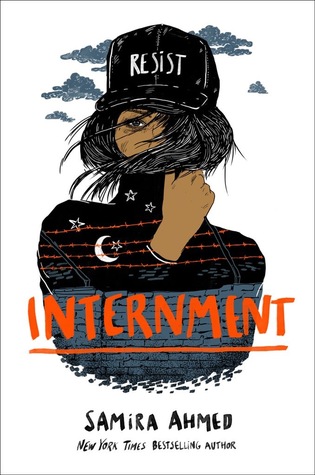
Description: Rebellions are built on hope.

Set in a horrifying near-future United States, seventeen-year-old Layla Amin and her parents are forced into an internment camp for Muslim American citizens.

With the help of newly made friends also trapped within the internment camp, her boyfriend on the outside, and an unexpected alliance, Layla begins a journey to fight for freedom, leading a revolution against the internment camp's Director and his guards.


Review: I was not a fan of Samira Ahmed's debut novel, Love, Hate, and Other Filters, which I read for last year's Ramadan Reading Challenge, but after seeing the many starred reviews for her sophomore novel I decided to give it a chance and lowered my expectations. Internment has a powerful and horrifyingly very possible premise in which in the near fifteen minutes of the future Muslim Americans have been registered and detained in internment camps because they have been labeled as a threat to the United State's security. They are sent to internment camps where their constitutional rights have been stripped and they are forced to comply.
  I had a very hard time getting into the novel as the themes of inequality, privilege, and activism among many others are very heavy handed. I had to remind myself that this novel is not written for readers who are well informed with our current politics, but those who are completely oblivious to it. With this in mind I was able to overcome my first hurdle.
   My second hurdle for this book is the weak execution of the novel that had so much potential to be better. There is  a lot of telling instead of showing in this novel. Ahmed misses the opportunity to explore several key items that could have brought the book to life such as the actual politics from both the policy makers and those protesting against the Muslim ban, tying the internment camps to the actual camps during World War II to emphasize that history is actually repeating itself, exploring the intersectionality of the Muslim community which she attempts to do but barely skims the surface, and finally, but most importantly creating an activism movement that slowly builds and brings the Muslim community together rather than having a couple of reactive teens do things haphazardly.
  I also wanted to dig in deeper to the characters. Layla is a sarcastic teen who doesn't know when to shut up and when to have an interior monologue. She constantly puts her family in danger because she throws a temper tantrum that she can't speak to her boyfriend David, which sets the novel in motion. I understand her rage and her desire to do something, but she is dangerously impulsive and naive to the point of stupidity to think that her actions do not have consequences. She does grow and show bravery towards the last half of the book, however, other characters especially the guards who oppose their commands are not explored. The teen led activism could have been stronger and inspirational like the #Neveragain movement, but it was handled sloppily. The Director is also a cartoonish villain and one dimensional. Despite my issues with this book, I do think Internment is an important read because of its premise, but I wish it read like a novel rather than an author's soapbox. 

Rating: 3 stars

Words of Caution: There is some strong language and scenes of strong physical abuse. Recommended for Grades 9 and up.

If you like this book try: When the Emperor Was Divine by Julie Otsuka
Rummanah Aasi
Description: One night in an isolated college town in the hills of Southern California, a first-year student stumbles into her dorm room, falls asleep--and doesn't wake up. She sleeps through the morning, into the evening. Her roommate, Mei, cannot rouse her. Neither can the paramedics, nor the perplexed doctors at the hospital. When a second girl falls asleep, and then a third, Mei finds herself thrust together with an eccentric classmate as panic takes hold of the college and spreads to the town. A young couple tries to protect their newborn baby as the once-quiet streets descend into chaos. Two sisters turn to each other for comfort as their survivalist father prepares for disaster. Those affected by the illness, doctors discover, are displaying unusual levels of brain activity, higher than has ever been recorded before. They are dreaming heightened dreams--but of what?

Review: I loved Walker's imaginative debut novel The Age of Miracles and was looking forward to reading more from her. Her latest, The Dreamers, has same atmospheric and philosophical musings like her debut novel. The Dreamers begins in a college dorm in an isolated town in the hills of Southern California, where a freshman thinks she is coming down with the flu. In fact, she has a mysterious disease that causes its victims to fall into a deep, dream-laden sleep from which they cannot be woken, and which sometimes leads to death. The disease spreads slowly at first, then more rapidly, and soon the whole town is under a quarantine.
  The story is told from multiple perspectives ranging from Mei, a lonely college freshman; 12-year-old Sara, who copes with an unhinged survivalist father; Sara's neighbors, a faculty couple with a newborn baby; and aging biology professor Nathaniel. Unfortunately we do not get a chance to spend time and learn more about these characters besides a touch and go as they deal with the disease. I would have much rather proffered if we had one character to explore, but the large number of characters does add to the sense of suspense and urgency to find a cure to this mysterious disease. Walker gives us a lot to think about when it comes to human nature, the state of dreaming and of consciousness, and the nature of epidemics. The text is sparse but beautifully written. It's not a book filled with action nor character-driven but I found it thoroughly fascinating.

Rating: 4 stars

Words of Caution: Sexual situations, child abandonment, and some minor language are in the book. Recommended for adults and older teens.

If you like this book try: Station Eleven by Emily St. John Mandel, Sleeping Beauties by Stephen King
Dry
Rummanah Aasi

Description: The drought—or the Tap-Out, as everyone calls it—has been going on for a while now. Everyone’s lives have become an endless list of don’ts: don’t water the lawn, don’t fill up your pool, don’t take long showers. Until the taps run dry.
  Suddenly, Alyssa’s quiet suburban street spirals into a war zone of desperation; neighbors and families turned against each other on the hunt for water. And when her parents don’t return and her life—and the life of her brother—is threatened, Alyssa has to make impossible choices if she’s going to survive.

Review: Shusterman's latest YA thriller is scarily realistic and plausible. In the near-future or alternate-present America, a prolonged drought called the Tap-Out results in the sudden depletion of Southern California's water supply. When their parents vanish while seeking desalinated water, Alyssa and her 10-year-old brother Garrett embark on a harrowing journey, searching for their parents and fending for themselves as society around them deteriorates. Along the way, the siblings pick up three teens: their survivalist neighbor Kelton, unpredictable lone wolf Jacqui, and calculating opportunist Henry.
  Dry alternates between the teens' distinct viewpoints and intersecting snapshots that supplement the backdrop of how others are dealing with the dire circumstances.The snap shots doesn't distract the reader and only enhances the hysteria, suspense, and time constraints on our characters until they die of dehydration. I liked Alyssa but she came across as your generic teen. I would have much rather preferred if the story was told by the spirited and impulsive Jacqui. I was intrigued by Kelton's family dynamic who were super prepared for any crisis and I wanted to learn more about them. Henry was well fleshed out despite the limited page time he appeared in the story.
  The story does have its share of bleak moments. I did have to suspend my disbelief in the lack of warning before the Tap-Out comes into full swing. I also had questions towards the ending that were not addressed and glossed over. While not my favorite Shusterman novel, Dry is a solid dystopian/survival thriller.

Rating: 4 stars


Words of Caution: There is some language and strong violence in the book. Recommended for Grades 9 and up.


If you like this book try: Not a Drop to Drink by Mindy McGinnis
Rummanah Aasi

Description: Suddenly - tomorrow or the day after - girls find that with a flick of their fingers, they can inflict agonizing pain and even death. With this single twist, the four lives at the heart of Naomi Alderman's extraordinary, visceral novel are utterly transformed, and we look at the world in an entirely new light. What if the power to hurt were in women's hands?

Review: I read The Power two weeks ago and I am still conflicted about it. There are a few things you should know about the book before deciding to read this book: Do not read this book for its world building and/or how the women get powers because it is very vague and unclear. Do not read this book for its characters. While there is a small cast of characters we follow throughout the book, they are not admirable, likable, or even have much character development. Do read The Power if you are interested in philosophy and gender politics. Reading this book is very much like watching a chess match, watching the players meticulously move their pieces after much thought.
  Sometime in the near future, young women discover they have within them the ability to unleash skeins of electrical current that can maim and kill. It is to believed that the power only affects people with the Y chromosome (mostly women but intersex individuals also have a very low form of power too) due to a substance dropped into the water during World War II. The power is triggered in flight or flight situations, but women quickly learn how to release it at will. Soon women begin to use this power to infiltrate and subvert all important institutions such as government and religion. Several women's revolts occur across the world. The first upheavals are in Saudi Arabia and Moldova, places where women have few rights. The woman who rules Bessapara, the first nation of the new world order, is unscrupulous and afraid, and she creates further instability by stripping men in her country of all rights and implicitly threatening world war. Men are now threatened and virtually have no rights. An underground terrorist group composed of men try to "revert back to the old times".
   The central question running throughout the book is: what would happen if women ruled the world? Alderman tests her female characters, from various backgrounds and classes, by giving them power and they all abuse it. The book does not have a linear narrative. It is actually told via a male historian with snippets from museums and other artifacts. There is a lot to unpack from this book from it's unique narrative structure to how we define power with male characteristics such as aggression. Along with power, the concept of freedom should also have been explored. I would have loved to learn more about the world building as we are not told when this story takes place, however social media such as Facebook and Reddit are constantly referenced. I would have also loved to see a wider, diverse cast of characters too. The author attempts to take her narrative globally but it only occurs on the book's periphery. What personally bothered me is the author's stereotypical assumptions of "oppressed" Muslim women who spontaneously go from cloaked individuals to being in a "Girls Gone Wild" video.
  The Power is a difficult book that will stick with you long after you read it. It is an intense read that I could only read in small snippets. It very much reminded me of The Handmaid's Tale with its shocking premise, but as it did with the other book, I was left cold and disconnected with its characters.

Rating: 3.5 stars

Words of Caution: There is strong language throughout the novel, scenes of violence such as sexual abuse and graphic depictions of sexual assault. Recommended for mature teens and adults only.

If you like this book try: The Handmaid's Tale by Margaret Atwood, Future Home of the Living God by Louise Erdrich
Rummanah Aasi

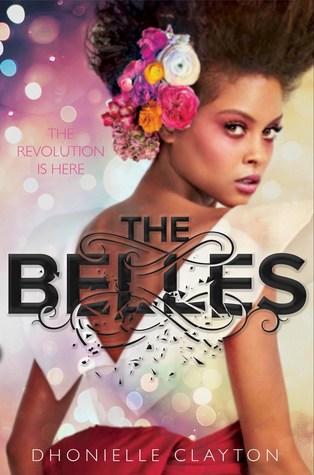
Description: Camellia Beauregard is a Belle. In the opulent world of Orleans, Belles are revered, for they control Beauty, and Beauty is a commodity coveted above all else. In Orleans, the people are born gray, they are born damned, and only with the help of a Belle and her talents can they transform and be made beautiful. But it's not enough for Camellia to be just a Belle. She wants to be the favorite, the Belle chosen by the Queen of Orleans to live in the royal palace, to tend to the royal family and their court, to be recognized as the most talented Belle in the land.
  Once Camellia and her Belle sisters arrive at court, it becomes clear that being the favorite is not everything she always dreamed it would be. Behind the gilded palace walls live dark secrets, and Camellia soon learns that the very essence of her existence is a lie, that her powers are far greater, and could be more dangerous, than she ever imagined. And when the queen asks Camellia to risk her own life and help the ailing princess by using Belle powers in unintended ways, Camellia now faces an impossible decision. With the future of Orleans and its people at stake, Camellia must decide: save herself and her sisters and the way of the Belles, or resuscitate the princess, risk her own life, and change the ways of her world forever.

Review: The description for Dhonielle Clayton’s latest series, The Belles, is deceptive and superficially appears to be quite similar to other books that offer a social commentary on our world's obsession with beauty and perfection. The Belles, however, manages to rise above those books by also tackling race issues, body diversity, socioeconomic inequalities, and slavery all without using these words to describe them. All of these important issues are timely, but powerfully lurk beneath the lush descriptions of beauty and fabrics that dominate the narrative. Clayton imagines a world in which the drive for perfection is also the greatest ruin. 
  In Camellia’s archipelago world of Orléans, the creation story begins when the God of the Sky fell in love with the Goddess of Beauty but soon grew jealous of the attention she gave to their children, the first humans. In punishment, he cursed them with ugliness: “Skin the color of a sunless sky, eyes the shade of blood, hair the texture of rotten straw, and a deep sadness that quickly turned to madness.” In retaliation, the Goddess of Beauty made the Belles, beautiful women who are born with non-gray skin and straw-like hair and who have the ability in their blood to temporarily transform the gray and ugly bodies of the citizens of Orléans into something beautiful.  
  Camellia and her five sisters are ready to debut in society as Belles and work for an exorbitant fee to work their magic upon the citizens of Orléans when the people’s beauty starts to fade. The favorite and most prized Belle will be selected to work for the royal family. Camellia yearns to chosen as the favorite, but her reluctance to follow directions may keep her from the ultimate prize. Once Camellia reaches her ultimate goal, she quickly realizes that world she was trained to live in and work for are nothing like she imagined. Beauty is a deception and a means of acquiring power. 
  Like the popular phrase, "Beauty is pain", the treatments are cringe-worthy and painful to imagine both for the customer whose bones and skin shuffle to the latest fads and also to the Belle who drains her own energy and have her blood purified by leeches. Along with these revelations, there is also many sinister things lurking around court such as unseen women heard crying at night in locked rooms, disfigured Belles, and sudden deaths that are swept under the carpet. The royal family is also facing terrible challenges: a crown princess who has been in a mysterious sleep for years and a second daughter whose ascension to the throne will be disastrous. Camellia is asked to use her Belle magic in ways it’s not intended. She quickly finds herself caught up in a political plot and faced with impossible choices. 
   Clayton is unafraid to tackle issues that are uncomfortable. She cleverly talks about beauty, especially when it comes to skin-tone, describing it with adjectives usually associated with food such as “the color of toasted walnuts,” “the rich color of honey bread,” “a sugared beignet fresh from the oil.” It’s a blatant response on how people of color are commonly described in literature and are in a way that fetishizes and commodifies them. Despite her status as a Belle who is revered in her society, she is often subjected to both. There are many other dualities that appear in the book too such as ugliness and shame. 
  While the book starts off slowly in the first few chapters are we get settled in the rich and rotting world of Orleans, the action and suspense gains traction. The horror which it cleverly veils slowly creeps up on you and once it clicks you can't unseen it. There is a cliff-hanger ending and some shocking reveals, but I'm okay with it because I know that means there is more to come in this eye-opening series. Don't be fooled or deterred from the pretty cover, The Belles is a thought provoking read that will foster great discussion.

Rating: 4 stars

Words of Caution: There is a scene of attempted sexual assault and disturbing images. Recommended for Grades 9 and up.

If you like this book try: Uglies series by Scott Westerfeld, North of Beautiful by Justina Ireland, The Fold by An Na, Such a Pretty Face edited by Ann Angel
Rummanah Aasi


Description: An England where people who are wicked in thought or deed are marked by the Smoke that pours forth from their bodies, a sign of their fallen state. The aristocracy do not smoke, proof of their virtue and right to rule, while the lower classes are drenched in sin and soot. An England utterly strange and utterly real. An elite boarding school where the sons of the wealthy are groomed to take power as their birthright. Teachers with mysterious ties to warring political factions at the highest levels of government.
  Three young people who learn everything they've been taught is a lie knowledge that could cost them their lives. A grand estate where secrets lurk in attic rooms and hidden laboratories. A love triangle. A desperate chase. Revolutionaries and secret police. Religious fanatics and cold-hearted scientists. Murder. A London filled with danger and wonder. A tortured relationship between a mother and a daughter, and a mother and a son. Unexpected villains and unexpected heroes. Cool reason versus passion. Rich versus poor. Right versus wrong, though which is which isn't clear.

Review: Smoke has a fantastic premise and a wonderful blend of historical fiction, fantasy, and dystopian elements. Set in an alternative Victorian England, sin is a physical substance and appears in the form of an ugly smoke that leaks directly from a person's body. Any immoral thought, however small, is easily detected. The concept of the smoke is what pulled me into this book. The moral questions surrounding sin are captivating and innumerable such as: are humans naturally inclined to sin or think "bad" thoughts and if so, does that make sinning a normal behavior? Do people behave morally for the sake of true goodness or is it to prove to others how much better they are?
  Smoke is mainly told in third person although there are short chapters told from the character's first person point of view which can be jarring at first. The plot is slow burning and at times drags as the author takes his time expounding on the atmospheric setting and establishing the three main characters in the story. Thomas Argyle and Charlie Copper are two young, upper-class best friends, who attend a boarding school where students are cleansed from the Smoke. Thomas, due to his upbringing and past, is naturally drawn to the Smoke whereas Charlie can mostly escape from it. Both boys build a natural friendship, mostly our their mutual dislike of one their classmates. Over Christmas holidays, Thomas and Charlie meet a girl named Livia, a prefect at another school, the attractive daughter of Baron and Lady Naylor. Naturally both boys are drawn to Livia for different reasons and a love triangle is formed. While the love triangle was annoying, it didn't overwhelm the plot and I was more engrossed in finding more about the Smoke.
  The story picks up pace and action when Thomas learns a shocking secret that sets up the characters for a quest to learn about the origins of Smoke and the maleficence behind it. This aspect of the book reminded me a lot of Philip Pullman's His Dark Materials series. Like many quests there are plenty of twists and turns in the story. The ending doesn't end in a cliffhanger but it is left open suggesting there is a sequel in the works. I really hope there is one because there is so much left to explore in the world that the author created and the questions about the Smoke go unanswered. I mostly enjoyed it and I would be willing to read more about this world should the author chose to write more. Overall, there are a lot of things in Smoke that will interest a wide range of readers, especially those who enjoy a cerebral fantasy.
  
Rating: 3.5 stars

Words of Caution: There are some disturbing images including a live execution scene and some minor language. Recommended for older teens and adults.

If you like this book try: His Dark Materials series by Philip Pullman, Bone Season series by Samantha Shannon
Rummanah Aasi
 I took a little break from reading manga last year. With the exception of reading the Fruits Basket manga series in bits and spurts, I didn't pick up any other series. I just wasn't excited about starting a new series so I turned my focus to graphic novels instead. This summer, however, I did want to return to manga and decided to take a break from the shoujo genre and go a different route so I picked up the No. 6 manga series. No. 6 is actually an adaptation based on the novel series of the same title and there is also an anime too that is available on Hulu. The series is complete with only nine volumes. If you enjoy action, science fiction/dystopia, and a little hint of romance, I would highly suggest picking up this series.


Description: For Shion, an elite student in the technologically sophisticated city No. 6, life is carefully choreographed. School, study, and the occasional visit with his friend and classmate Safu. One fateful day, however, he takes a misstep, sheltering an injured boy his age from a typhoon. Known only as Rat, this boy is a VC – a fugitive living outside the computerized tapestry of city control – and helping him will throw Shion’s life into chaos and start him down a path to discovering the appalling secrets behind the superficial perfection of No. 6.

Review: No. 6 follows the popular tropes of a dystopian novel. A society was devasted by a catastrophic disaster leaving nothing but rubble behind. With the vow and intention of preventing that disaster from happening again, a core group of people developed six societies to create six utopians. Eventually, over a period of time five societies were destroyed leaving No. 6 still standing. The world building is pretty standard in the manga series, but I did like that we are given small clues that something was amiss in No. 6 such as parasitic bugs start to appear and people infected by these bugs start to age rapidly and die. I also liked how the manga series kept you guessing as to what was the government's intention and why they would stealthily sneak up on its citizens when anyone began questioning No. 6.
  The main reason why you should pick up this manga series is because of its rich, complex characters and their relationships with one another. Our main character Shion has been born and raised in No. 6. He has the privilege of being well educated and affluent. He at first comes across as a day dreamer who is always wondering what lies beyond No. 6. It is not until Shion meets his complete opposite Rat, a poor boy,  and a criminal on the run who knows the dark truths about No. 6. Shion and Rat are drawn to one another yet have very different viewpoints. Shion is often called stupid, naive, and soft by Rat because he always manages to see the good in people and view things positively. In contrast, Rat is very rough around the edges, mistrusting, and manipulative all due to his upbringing and surviving on the streets. While Rat constantly belittles Shion, he secretly admires Shion's compassion and empathy. The relationship between Shion and Rat changes and morphs throughout the manga series. While there are subtle hints of romance between the two characters, I think their relationship can't really be labeled.
  In addition to Shion and Rat, there are other strong secondary characters that also have a prominent role in the story such as Dogkeeper, Shion's best friend Safu and his mother Karan, and the ex-journalist Rikiga. Each of these characters is influenced by Shion and Rat. It was fun to see how each of these characters viewed Shion and Rat throughout the series especially when they were tasked with helping to bring down No. 6. Since the manga is an adaptation of novels, the series did not go into more details as I would have liked. I wanted to know more about Shion's mother especially because she knew the founding members of No. 6. as well as taken a closer look at the juxtaposition between nature and technology which is a strong theme in the manga series. Overall, I would recommend reading No. 6 as there is a lot to discover and discuss. As of the moment, the No. 6 novels are not translated in English but I do hope they will be in the future as I would definitely pick it up.


Rating: 4 stars

Words of Caution: There is some strong language, crude humor, and strong violence (especially in the later volumes). Recommended for Grades 9 and up.

If you like this book try: Alive: The Final Evolution series by Tadashi Kawashima, Afterschool Charisma by Kumiko Suekane
Rummanah Aasi
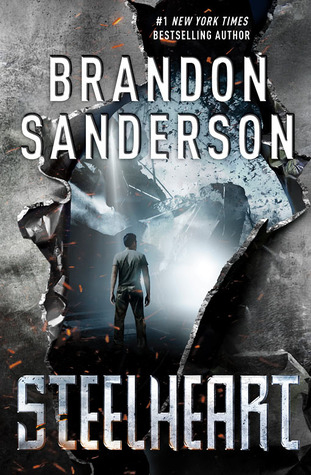
 I had my first book club discussion for this new school year. The students were very excited to read Steelheart by Brandon Sanderson. Many of them thoroughly enjoyed the book and are looking forward to hearing more movie news (the book is supposedly heading towards the big screen). While I liked the concept of the book and thought it was a fun read, it left me wanting more.


Description: Ten years ago, Calamity came. It was a burst in the sky that gave ordinary men and women extraordinary powers. The awed public started calling them Epics. But Epics are no friend of man. With incredible gifts came the desire to rule. And to rule man you must crush his wills.
  Nobody fights the Epics...nobody but the Reckoners. A shadowy group of ordinary humans, they spend their lives studying Epics, finding their weaknesses, and then assassinating them. And David wants in. He wants Steelheart - the Epic who is said to be invincible. The Epic who killed David's father. For years, like the Reckoners, David's been studying, and planning - and he has something they need. Not an object, but an experience. He's seen Steelheart bleed. And he wants revenge.


Review: Steelheart is a nice mash up of an X-men like comic and a traditional revenge story set in a dystopian Chicago setting. The formula though not new, Sanderson provides plenty of action and nonstop thrills with plenty of twists and turns until the very last page.
 Twelve years ago, a mysterious event called Calamity began turning random ordinary humans into evil Epics gifted with various combinations of superpowers, however, they are not invincible. The attention grabbing prologue sets the tone for the story as we learn of David Charleston's special vendetta against the Epics, particularly the ruler of Newago, a city cloaked in perpetual darkness and made entirely of solid steel thanks to its ruler, Steelheart, who killed his father 10 years ago. David has become obsessed with Steelheart in hopes he can track down the Epic's Achilles heel. He manages to make contact with a cell of Epic-killing Reckoners led by legendary mastermind Jon Phaedrus who is also known as simply "Prof". 
  We take the high octane ride with David as he tries to wrap his head around the mission of the Reckoners while going on car and motorcycle chases, secret missions, and avoiding huge explosions and hails of gunfire with high-tech weaponry. There is also a bit of a lull in the middle of the book as the Reckoners try to come up with a plan of how to attack Steelheart, but luckily it closes with a climactic battle with Epic Steelheart and a nice twist at the end. David shockingly realizes that not all Epics are evil. 
  While I liked the nice play of ordinary human trying to fight super villains and the fast paced plot, there is not much meat to the characters. I was hoping we would get layers to the characters, particularly that of Prof and Megan who play vital roles in the story, but that never happened. I also thought many of the names of the Epic and their powers were silly and stupid such as Deathpoint, Faultline, Pink Pinkess, and El Brass Bullish Dude to name a few. The book does not end in a cliffhanger, but it does raise several questions that will leave some readers clamoring for more. Definitely recommend this book to teens who love superhero movies, reluctant readers, and to those who are counting down the days until the next superhero movie to hit the big screens.

Rating: 3 stars

Words of Caution: There is strong violence and some gore in the book. Recommended for strong Grade 8 readers and up.

If you like this book try: Firefight by Brandon Sanderson (Reckoners #2), Young Elites by Marie Lu, Darkest Minds byAlexandra Bracken
Rummanah Aasi
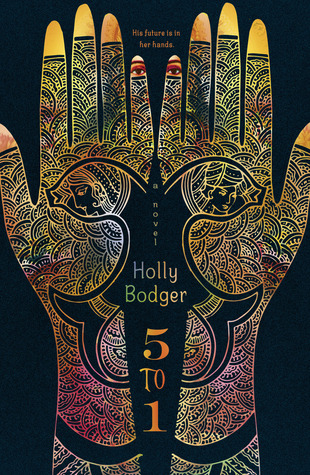
 I have dystopian burnout. It is not that I dislike this subgenre, but I have read a slew of dystopian books that in someway or in another is Hunger Games deja vu promising another blockbuster. As a result I have become bored and weary of the category of  dystopian. When I read about Holly Bodger's debut novel I didn't know what to expect and lowered my expectations. I'm relieved to find 5 to 1 to be an engaging dystopian novel set in India that poignantly explores gender politics. Please note that this review is based on the advanced reader's copy of the book provided by the publisher via Netgalley.

Description: In the year 2054, after decades of gender selection, India now has a ratio of five boys for every girl, making women an incredibly valuable commodity. Tired of marrying off their daughters to the highest bidder and determined to finally make marriage fair, the women who form the country of Koyanagar have instituted a series of tests so that every boy has the chance to win a wife.
  Sudasa doesn’t want to be a wife, and Kiran, a boy forced to compete in the test to become her husband, has other plans as well. Sudasa’s family wants nothing more than for their daughter to do the right thing and pick a husband who will keep her comfortable—and caged. Kiran’s family wants him to escape by failing the tests. As the tests advance, Sudasa and Kiran thwart each other at every turn until they slowly realize that they just might want the same thing.


Review: In order to enjoy 5 to 1 there are few things you have to keep in mind. First 5 to 1 is what I call a soft dystopian, there is not an emphasis on the world that Bodger created which ironically  works in the author's favor because the book's basis is steeped in reality of gender politics. Second, the book is not your average heart pounding action book, the book moves steadily yet slowly focusing more on character development. Third, there is no romance in the book which allows the author to show how the gender selection effects each gender without any rose tinted glasses placed upon the characters. Additionally this debut novel is told in alternating points of view, one in poetry and one in prose. Once you settle and acknowledge these differences from the usual dystopian tropes, you can enjoy the book for its uniqueness and see where it shines.
  Bodger explores a dystopian India in which gender selection has led to there being five boys for every girl. In generations past boys were the favored gender of infants and as a result female infant population dramatically decreased as they were aborted and disposed of, signaling debt and burden for families (sadly, this is really happening in several parts of Asia). A revolution took place and a matriarchal government is now in power. Now female babies are prized possessions and men's value are determined if they can help their wives produce girls. The subversion of the gender roles and expectations is exceptionally well done in 5 to 1 from the characters to the various Tests that the boys have to pass. 
  Throughout her novel Bodger doesn't support just one gender, but rather shows how the gender selection has negatively effected both genders equally. Neither men nor women benefited from their society. Nor is one more in control than the other.  Interestingly they are equally oppressed, which can be seen in the narrative style of the novel. Kiran, the male narrative, is written in captivating prose, which allows much wordier passages however he is limited in expressing his own desires outside of winning the Tests which he is forced to participate due to his gender and age. Similarly the beautiful poetry of Sudasa is appropriately jarring and nuanced, showing how on the outside she  may seem as if she is in control because she is a girl, but her voice is also reduced in how she expresses herself and her limited freedom. Bodger does well in infusing the Indian culture and lifestyle in her work, but I would have liked to have seen more particularly within Sudasa's family dynamics. A glossary of Hindi terms would also be a great addition particularly those who are unfamiliar with the language.
 While the lack of romance in 5 to 1 may disappoint readers, I think it is one of the strong aspects of the book. The Tests are suppose to be pointless and unromantic. The more appropriate importance is placed on personal freedom and choice. During the Tests both Sudasa and Kiran have an epiphany of their own desires and both shamelessly pursue their dreams, which I would have loved to see in a more flushed out epilogue. Despite these minor flaws, I thoroughly enjoyed 5 to 1 and I look forward to see what Bodger has in stored for us in future books.  

Rating: 4 stars

Words of Caution: There is some mild crude humor in the book and minor language. Recommended for strong Grade 7 readers and up.


If you like this book try: Matched series by Ally Condie
Rummanah Aasi
 With the school year coming to a close in a couple of days, I thought I would catch up on some reviews of books that I read earlier this year.


Description: Gwen has a destiny to fulfill, but no one will tell her what it is. She’s only recently learned that she is the Ruby, the final member of the time-traveling Circle of Twelve, and since then nothing has been going right. She suspects the founder of the Circle, Count Saint-German, is up to something nefarious, but nobody will believe her. And she’s just learned that her charming time-traveling partner, Gideon, has probably been using her all along.

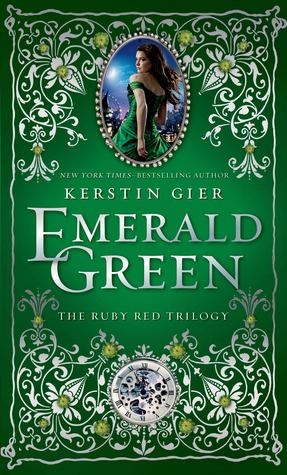
Review: I thought Emerald Green was a solid ending to a great time traveling series. We get a lot of our answers regarding Gwen's birth and a shocking revelation that the other characters have been dancing around but haven't officially addressed it. Gwen is still a delight, full of sass, wit, and handles her problems with ingenuity. It was lovely watching her grow throughout the series. The romance is still prevalent as Gideon sorts out his own issues and feelings for Gwen. I liked Gideon though I wanted to smack him upside the head for being an idiot for most of this book. Overall, I definitely felt satisfied with this ending though I'm sad the story is over and I have to say goodbye to these characters.

Rating: 4 stars

Words of Caution: There is some strong violence and minor language. Recommended for Grades 7 and up.

If you like this book try: Paranormalcy series by Kiersten White, Gemma Doyle series by Libba Bray,


Description: Each body has a story to tell, a life seen in pictures only Librarians can read. The dead are called Histories, and the vast realm in which they rest is the Archive.
  Da first brought Mackenzie Bishop here four years ago, when she was twelve years old, frightened but determined to prove herself. Now Da is dead, and Mac has grown into what he once was: a ruthless Keeper, tasked with stopping often violent Histories from waking up and getting out. Because of her job, she lies to the people she loves, and she knows fear for what it is: a useful tool for staying alive.
  Being a Keeper isn't just dangerous—it's a constant reminder of those Mac has lost, Da's death was hard enough, but now that her little brother is gone too, Mac starts to wonder about the boundary between living and dying, sleeping and waking. In the Archive, the dead must never be disturbed. And yet, someone is deliberately altering Histories, erasing essential chapters. Unless Mac can piece together what remains, the Archive itself may crumble and fall.


Review: I loved the premise of this book and intrigued me right away, however, much of the book felt unfinished. I had many questions that weren't addressed such as why does the Archive need the actual bodies and what happens when the Archive gets full? Though these unanswered questions didn't stop me from reading and enjoying the book, they did nag and bother me. While we are taken to the various layers of the Archive, but I didn't really have a firm grasp on the image in my head.
  Mackenzie is an interesting character, who is forced to lead a double life due to her role in serving the Archive. In order to make her approachable and human, we watch as she wrestles with how to grieve the death of her little brother, which was fine but I'm a bit surprised that she didn't mourn heavily for her grandfather as they had a very close relationship. Though I liked seeing the vulnerable side to Mackenzie, I thought it took too much page time and slowed down the book's pace for me. I wanted to get to the action, which finally happens when Mackenzie stumbles upon an old murder mystery and befriends a dead boy named Owen who shouldn't exist outside of the Archive. There is also plenty of humor provided by the a great secondary character named Wes that also works for the Archive and is Mackenzie's peer. I would have loved to get to know Wes better as his personality and stories intrigued me. Though the action moves the plot along, more questions keep popping up which makes me wonder if the author intended this to be a series. I know there is a companion book to The Archive which I'm interested in reading in hopes that some of my questions will be answered. Overall, I do recommend picking up The Archive if you are looking for an unique fantasy with a mystery that discusses the afterlife without any supernatural forces and beings.  

Rating: 3.5 stars

Words of Caution: There are some disturbing images and minor language. Recommended for Grades 7 and up.

If you like this book try: The Unbound by Victoria Schwab, In the Shadows by Kiersten White


Description: An electromagnetic pulse flashes across the sky, destroying every electronic device, wiping out every computerized system, and killing billions.
 Alex hiked into the woods to say good-bye to her dead parents and her personal demons. Now desperate to find out what happened after the pulse crushes her to the ground, Alex meets up with Tom—a young soldier—and Ellie, a girl whose grandfather was killed by the EMP. For this improvised family and the others who are spared, it’s now a question of who can be trusted and who is no longer human.


Review: Ashes is a book that I wanted to DNF after I made the 100 pages mark, but I continued because this was my student book club's pick for our dystopian read. While the book had an okay start with an adventure/survival story as an electromagnetic pulse that may have taken out the entire world and have solved Alex's brain tumor that was deemed incurable by her doctors. Alex soon meets new companions- an obstinate eight-year-old orphan named Ellie and a young soldier named Tom-as they try to make sense of things. While I was getting interested in watching how this group interacts with one another and find out what had caused the electromagnetic impulse, the book then takes a horror turn with the appearance of zombies that are soon called the Changed. I'm not a zombie fan so this part of the "action" and gore was not my cup of tea.This is why I wanted to DNF the book, fortunately this portion of the book didn't last long. Soon the book morphs yet again into a weird cult novel leaving the questions and plot threads in the first two sections of the book unanswered and/or completely ignored. Overall, this was my least favorite book club pick and I can definitely see why I was hesitant to pick it up. I honestly can't recommend this one nor am I interested in continuing this series. 

Rating: 2 stars

Words of Caution: There is some gruesome and gory scenes along with some strong language. Recommended for Grades 9 and up.

If you like this book try: Maze Runner series by James Dashner, Rot and Ruin by Jonathan Mayberry, The Knife of Never Letting Go by Patrick Ness
Rummanah Aasi
 I really liked Brian K. Vaughan's space opera graphic novel, Saga, but haven't been able to get the second volume of that series. Since I liked his writing and the illustrations of Saga, I thought I would check out his earlier series called Y The Last Man. 


Description: When a plague of unknown origin instantly kills every mammal with a Y chromosome, unemployed and unmotivated slacker Yorick Brown suddenly discovers that he is the only male left in a world inhabited solely by women. Accompanied by his mischievous monkey and the mysterious Agent 355, Yorick embarks on a transcontinental journey to find his girlfriend and discover why he is the last man on Earth. But with a gang of feminist extremists and the leader of the Israel Defense Forces hunting him, Yorick's future, as well as that of the human race, may be short-lived.

Review: Y: The Last Man: Unmanned is a dystopian graphic novel that has a really intriguing premise. A plague of unknown origin has spread and killed every mammal with a Y chromosome with the exception of one young man named Yorick and his male monkey pet. We don't find out the explanations for the plague or why Yorick and his monkey were saved, which is actually a good thing because there are several possibilities. 
  This graphic novel and I'm guessing the remainder of this series takes a satirical viewpoint of gender issues and the continual fight between progressive science versus the natural order of things. There is also a lot of humor and not so subtle social criticisms/satire as women commemorate the dead man at The Washington Monument (take a moment and think about it). We also have what society would dub as the crazy feminists who take on the role of the ancient Amazons and tear off one breast and take to believing Mother Earth meant to eradicate the males. Politicians are not left unscathed as Republican wives of dead senators show up with guns, arguing they should have a voice in the new government.
 Our main protagonist Yorrick is a likable slacker who is sometimes clueless. He is more concerned about reaching his girlfriend who he wants to marry and his sister. We are meant to believe that the survival of humanity rests in his head and let me tell you, it doesn't look good. 

  With its humorous dialogue, great illustrations, fun characters and a fast-paced story, I'm willing to take the journey with Yorrick to find out the answers to my questions.

Rating: 4 stars


Words of Caution: This graphic novel contains strong bloody violence, nudity, and language. Recommended for mature teens and adults only.

If you like this book try: Y: The Last Man: Cycles (Vol 2) by Brian K. Vaughan
Rummanah Aasi
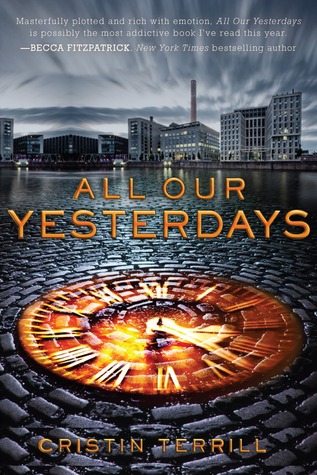
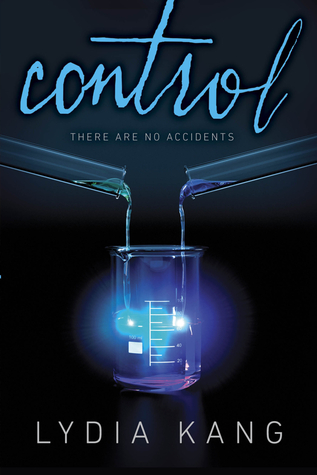
  I've heard lots of buzz about All Our Yesterdays by Cristin Terrill and when the hype got to be a bit much, I pushed the book further down in my reading pile in fears that it wouldn't live up to my high expectations. When I picked it up earlier this year, I had forgotten about the hype which in turned helped me to read it without any predetermined opinions. Unfortunately, I wasn't able to do the same with Lydia Kang's popular Control. Please note these reviews are based on the advanced reader's copy of the books provided by the publishers in exchange for an honest opinion. Both books have been released and can be found in either in your libraries or bookstores.


Description: "You have to kill him."
Imprisoned in the heart of a secret military base, Em has nothing except the voice of the boy in the cell next door and the list of instructions she finds taped inside the drain.
  Only Em can complete the final instruction. She's tried everything to prevent the creation of a time machine that will tear the world apart. She holds the proof: a list she has never seen before, written in her own hand. Each failed attempt in the past has led her to the same terrible present-imprisoned and tortured by a sadistic man called the doctor while war rages outside.
  Marina has loved her best friend James since they were children. A gorgeous, introverted science prodigy from one of America's most famous families, James finally seems to be seeing Marina in a new way, too. But on one disastrous night, James's life crumbles apart, and with it, Marina's hopes for their future. Marina will protect James, no matter what. Even if it means opening her eyes to a truth so terrible that she may not survive it. At least not as the girl she once was. Em and Marina are in a race against time that only one of them can win.

Review: All Our Yesterdays is one of the better time traveling books that I've read recently. The time-travel paradigms and a dual narrative combine in this fast-paced tale. The book is told by two voices are that of the same character: Marina, in the present, and Em, in the future. Thankfully, the present and future version of the girls are very different and distinguishable.
  Future Em and present Marina run parallel courses as Em tries desperately to change present circumstances enough to alter future horror. Marina's longtime crush James, a teen genius who discovers how to manipulate time travel, intends to use that discovery to save his assassinated congressman brother. Em and Finn (her future romantic interest and James's good friend) travel back to the present to change their own and the world's fate, but their multiple efforts result in imprisonment and torture by the mad scientist James becomes. Em/Marina's parallel stories converge in a violent confrontation where characters from the present meet their future selves. Serious readers of time traveling books may find lots of holes in Terrill's reasoning, but I'm not exactly sure how the time traveling in this book works but I was so invested with the characters and the action that I didn't really mind my confusion.
  The characters definitely made the story for me. I loved how completely different Em and Marina are and it actually took me a few pages to realize they were the same person. I loved how Em was a strong heroine who hasn't lost her sensibilities and the way to empathize with others. It took me a while to warm up to Marina, as her codependency tendencies got on my nerves but I do see a potential of growth in her. The love interests in this book were also appealing. James is a brilliant monster and Finn is consistently levelheaded and appealing. The romance dilemma in this one is definitely complex. The built-in tension provided by knowledge of the world that will result if they fail makes Finn and Em's efforts compelling and the escalating suspense kept me turning the pages into the shocking cliffhanger. I had to run to the author's website to make sure there was a book 2 and was relieved to find out there is one. The philosophical question is intriguing: What price is too high to change fate? I will definitely be reading the second book to see how things turn out for our characters.

Rating: 4 stars

Words of Caution: There is some language, a scene of underage drinking, and an allusion to sex. Recommended for strong Grade 8 readers and up.

If you like this book try: Pivot Point series by Kasie West, Tempest series by Julie Cross


Description: Set in 2150 -- in a world of automatic cars, nightclubs with auditory ecstasy drugs, and guys with four arms -- this is about the human genetic "mistakes" that society wants to forget, and the way that outcasts can turn out to be heroes.
   When their overprotective father is killed in a terrible accident, Zel and her younger sister, Dylia, are lost in grief. But it's not until strangers appear, using bizarre sensory weapons, that the life they had is truly eviscerated. Zel ends up in a safe house for teens that aren't like any she's ever seen -- teens who, by law, shouldn't even exist. One of them -- an angry tattooed boy haunted by tragedy -- can help Zel reunite with her sister. But only if she is willing to lose him.
Review: I picked up Control based on the tagline that fans of the Uglies series by Scott Westerfeld would enjoy it. I loved Westerfeld's imaginative take on physical beauty and consumerism in his series, but unfortunately I didn't find Control as intriguing. Control features a teenage scientist who struggles to rescue her abducted sister. After their father dies from injuries sustained in a freak accident, Zelia and her younger sister, Dylia, are left orphaned in a dystopian future America. They've scarcely begun to grieve when they are violently separated: Dylia is kidnapped by strangers who want to profit from her DNA, while Zelia ends up in Carus House, an underground organization that shelters people whose genetic mutations make their very existence illegal.
  My biggest problems with Control was its uneven pace and the lack of character development. The book moves too quickly when it should slow down so we can see the characters develop their relationships and their own personalities. We don't see Zelia spend much time with Dylia and we can't really feel the suspense nor the void when Dylia is abducted. Similarly, when Zelia becomes the new resident of Carus House she builds friendships a bit too quickly with others. The romantic tension with the bad boy Cyrad is nonexistent and when they do acknowledge how they feel towards one another it feels forced. Throughout the novel, Kang's scrupulous attention to scientific detail adds authenticity but also contributes to a lot of technologies that don't really make much sense. While I appreciated the fact that the protagonist is a girl who actually enjoys and is brilliant at science, I wished the author would spend some time in building the world she created. I had so many questions of why when I was reading this story such as why is gene manipulation outlawed in the first place? What caused it?
  The book works as a stand-alone, but the ending leaves the door open to a sequel. Control is another forgettable addition to an overcrowded field of dystopians, but for die-hard dystopian fans who wouldn't mind an Xmenish story line it might be worth picking up. I, however, will not be continuing this series.

Rating: 2 stars

Words of Caution: There is some language, allusion to sex, and underage drinking. Recommended for strong Grade 8 readers and up.

If you like this book try: The Madman's Daughter by Megan Shepard, Delirium series by Lauren Oliver, Uglies series by Scott Westerfeld, Divergent series by Veronica Roth
Rummanah Aasi
  Today I have the pleasure in introducing you to author H.L. Le Roy to the blog to reveal the cover of The Fountain of the Earth, which is the first book in his YA dystopian series of the same name as well as a chat with H.L. The Fountain of the Earth seems to be a promising series and it was published today by Tranquille Press!

Cover & Description

Terra Vonn is fighting to survive in a destroyed world,
surrounded by unspeakable horror . . .
and things are about to get much worse.


After witnessing the horrific murder of her mother, fifteen-year-old Terra Vonn has a singular focus—exacting revenge on the killers. But before she can complete her plan, savagery intervenes, and she is cast alone into a brutal post-apocalyptic world. As she trails the murderers south—through a land filled with cannibalistic criminals, slave traders, and lunatics—the hunter becomes the hunted. Terra quickly learns that she is not as tough or as brave as she thought she was. Worse, she may be the only one who stands between what little remains of civilization and destruction.


More Information at: Amazon / Goodreads


Author Interview with H.L.

Can you describe your book in ten words or less?

Only Terra Vonn can save what little remains of civilization.
How would you persuade readers who are a bit burnout on the dystopian genre to pick up your book?
 
It was important to me that this book be plausible. Everything in it could happen. In fact, many scientists warn that a Carrington class, or worse, solar storm could destroy civilization as we know it. You'll find no mysterious virus causing zombies, or vampires, just a frightening glimpse of a possible future.

Why did you decide to write from a female's point of view rather an a male's?
 
As I laid out the plot, I quickly discovered that the voice for The Fountain of the Earth needed to be a female who was easy to relate to, as well as easy to root for.  Ursula K. Le Guin once said, “that men and women can and do speak both to and for one another, if they have bothered to learn how.” So I find no dichotomy in writing from a female's point of view.
 
How would you describe Terra Vonn? What sets her apart from other heroines we might have seen before?
  
She is just fifteen but has seen terrible things in her brief life. And although she's subjected to casual cruelty in the beginning of the book, she quickly finds her strength. She knows she is likely to die if she doesn't find a way to adapt and survive.
 
What can we look forward to seeing in the second book of this series?

I've written nearly a third of book two, tentatively titled The Heralds of Juno. In it, war is coming, and Terra and all she loves with be deeply affected.
 
About H.L. Le Roy


H. L. (Holly) LeRoy is an American short story writer and novelist, author of the award winning Street Crimes anthology and the novel The Fountain of the Earth (Nov. 22, 2013), first in a series of young adult adventures. Born in San Jose, California, LeRoy currently resides in Pioneer, California with his family.

Learn more about H.L.: Blog, Twitter

Rummanah Aasi
  I had a very lukewarm reaction to Divergent. For me to enjoy a dystopian novel, I need a book with a strong world-building. I need to be convinced that there is something indeed wrong with the society in order to understand the main character's plights and motivations. The world building, in my opinion, gives the book not only structure but a foundation to a good story. For me the Divergent series has lacked this essential ingredient and it has tried unsuccessfully to incorporate it into the story. What had the potential to be a really good story turned to out to be mediocre at best.

Description: Every choice has consequences, and as unrest surges in the factions all around her, Tris Prior must continue trying to save those she loves, and herself, while grappling with haunting questions of grief and forgiveness, identity and loyalty, politics and love.

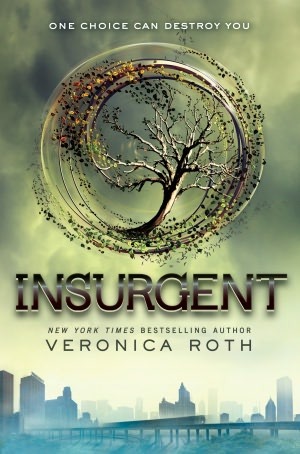
Review: Insurgent has a very strong case of middle book syndrome despite a great opening left by the cliffhanger of Divergent. Rocked by the recent simulation war, the five factions engage in increasingly dangerous power plays to pick up the pieces. Instead of filling in some back stories of the characters and the world as I had hoped, Roth fills her 500 pages book with plot that is filled with lots of twists and turns that is suppose to make your heart pump. Unfortunately the plot doesn't move very much nor very quickly as we try to make some sense of who is really pulling the strings in this faction world. I found a lot of the plot twists to be too predictable and I couldn't keep track of all the characters that are virtually exactly alike come and go in this volume. I still can't muster up any emotions for any of these characters including the central characters and couple, Tris and Tobias.
  The relationship between Tris and Tobias was fun to watch as they began to trust one another and grow as a couple in Divergent. In Insurgent the couple has mutated into a bizarre parent-child relationship where one patronizes the other by giving them rules to follow while the other stamps their feet as a petulant child in resistance. Tris's reckless behavior and cry-wolf type of self sacrifice takes out the importance of her role in whatever she is suppose to do in this 'mysterious' world Roth has created. There is a decent commentary about grief and forgiveness, but that quickly veered into preachy mode and eventually tumbled into whine mode a la "I don't want to do this anymore. Wah!" The only thing that kept me from chucking this book across the room was a slither of hope that explanations will come in the final installment as we learn little clues about the outside, but then again I could have just skipped the entire 450 pages of this book and went straight to the ending in order to save time and avoid my frustration.

Rating: 2 stars

Words of Caution: The violence in Insurgent is much stronger and there is a large body count and there are some heavy make-out scenes featuring Tris and Tobias. Recommended for Grades 8 and up.


Description: The faction-based society that Tris Prior once believed in is shattered—fractured by violence and power struggles and scarred by loss and betrayal. So when offered a chance to explore the world past the limits she’s known, Tris is ready. Perhaps beyond the fence, she and Tobias will find a simple new life together, free from complicated lies, tangled loyalties, and painful memories.
  But Tris’s new reality is even more alarming than the one she left behind. Old discoveries are quickly rendered meaningless. Explosive new truths change the hearts of those she loves. And once again, Tris must battle to comprehend the complexities of human nature—and of herself—while facing impossible choices about courage, allegiance, sacrifice, and love.

Review: I really hoped Allegiant would redeem itself after a flimsy middle book, but alas it continues the downward spiral of Insurgent. Though we do finally get answers to why Tris's world is separated into factions, the reasons behind Roth's post-apocalyptic world is a half baked concept of racism that is based on a highly oversimplified examination of human personality and genes. Instead of spending time to explain what it means to have 'pure' genes versus 'defected' genes, we are once again plunged into a boring and rehash plot of Insurgent where Tris and the gang run from one megalomaniac trying to rule the world to another. The grand revealing of the outside was completely anti-climatic and the fact that the setting was post-apocalyptic Chicago was completely irrelevant.
  Once again we are introduced to a new large cast of transient characters that had virtually no impact on the story besides moving a limping plot along, which is completely unlike the pace of Roth's earlier installments that move almost lightening fast. In fact there were many times I had to put the book down because I got so bored and I gave up hope in trying to come to terms with the huge plot holes and the scientific nonsense.
  Tris becomes a bit more tolerable in this one after she let all her angst out in Insurgent, but her recklessness is what mars her reputation as a strong heroine for me. Must she always be right and the only one undergoing dangerous situations? Tobias, in contrast, is stuck on "woe is me" island and though I understand he has been scarred by his rough life, but can we get past that when the end of the world is here? Tris and Tobias have rocky moments in Allegiant, more of the patronizing type though there are a few sweet moments.
  I know there has been many heated discussions about the ending of Allegiant, but for me I saw it coming a long time ago. It was the neon-flashing-in cap letters obvious especially with a lot of the red herrings featured both in Divergent and Insurgent. I can see what type of book that Allegiant was suppose to be-one full of emotion and intensity, but regrettably it completely missed the mark. If this series was not popular with the teens that I work with, I would have definitely taken a pass on this series, but I wanted to make sure that that I knew about the series in order to help them with reader advisory questions.

Rating: 2 stars

Words of Caution: There is strong violence, an ambiguous scene of sensuality, and some language. Recommended for Grades 8 and up.

If you like these book try: Candor by Pam Bachorz, Maze Runner series by James Dashner
Related Posts with Thumbnails