I am not a big fan of nonfiction, but I did find The Other Wes Moore to be a fascinating memoir. I think this would be a great book for a book club. Unlike many popular memoirs written, The Other Wes Moore is relevant and asks important questions about our society, youths.
 Description: The chilling truth is that his story could have been mine. The tragedy is that my story could have been his.
Two kids named Wes Moore were born blocks apart within a year of each other. Both grew up fatherless in similar Baltimore neighborhoods and had difficult childhoods; both hung out on street corners with their crews; both ran into trouble with the police. How, then, did one grow up to be a Rhodes Scholar, decorated veteran, White House Fellow, and business leader, while the other ended up a convicted murderer serving a life sentence? Wes Moore, the author of this fascinating book, sets out to answer this profound question. In alternating narratives that take readers from heart-wrenching losses to moments of surprising redemption, The Other Wes Moore tells the story of a generation of boys trying to find their way in a hostile world.
Review: The Other Wes Moore is a story about two young African-American men who share the same name and grew up on the same inner-city streets, but wound up in vastly different places. Author Wes Moore is a Rhodes Scholar, former Army officer and White House Fellow. He works in investment banking. The other Wes Moore, a drug dealer, is imprisoned for life. Both are in their early 30s and grew up in a fatherless home. While reading this memoir you can't help but think how could two young men who had so much in common could take such different paths.
Drawing on conversations with the other Wes and interviews, the author creates an absorbing narrative that makes clear the critical roles that choices, family support and luck play in young people's lives. The author Wes Moore was fortunate to have family support and people who were determined to make a future for him, pushed for discipline when the author found himself drawn to the street life of Baltimore and his grades dropped significantly. He was very fortunate that his family was able to pool their limited financial funds and send him to military school where he learned responsibility and gained a sense of purpose. Unlike the author, the other Wes had a drug-pusher older brother and began dealing at an early age. His mother's efforts to help were ineffectual. Often arrested--car theft, attempted murder, etc.--the other Wes dropped out of school, fathered four children with different women and tried unsuccessfully to go straight. Then he took part in the store hold-up, which led him to spend the rest of his life in prison.
The Other Wes Moore is not didactic. While it is quite obvious that the author was very lucky and had several priviledges that were not available for his counterpart, the availablity of a mentor could have been there for the other Wes. The message of this book isn't just to compare two lives, one a success story and the other a tragedy but rather it is a wake-up call for all of us to understand the importance of a good and positive role models which can dramatically affect the lives of young adults. I would definitely recommend this book for readers who are interested in sociology and like narrative nonfiction.
Rating: 4 stars
Words of caution: There is some language and drug use. Recommended for teens and adults.
If you like this book try: The New Kids by Brooke Hauser, In the Place of Justice by Wilbert Rideau
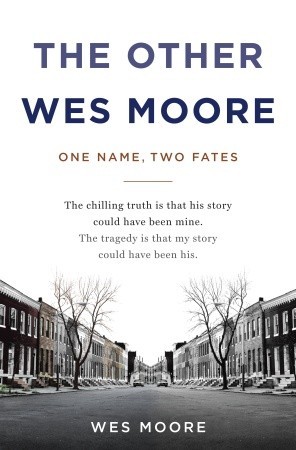
Two kids named Wes Moore were born blocks apart within a year of each other. Both grew up fatherless in similar Baltimore neighborhoods and had difficult childhoods; both hung out on street corners with their crews; both ran into trouble with the police. How, then, did one grow up to be a Rhodes Scholar, decorated veteran, White House Fellow, and business leader, while the other ended up a convicted murderer serving a life sentence? Wes Moore, the author of this fascinating book, sets out to answer this profound question. In alternating narratives that take readers from heart-wrenching losses to moments of surprising redemption, The Other Wes Moore tells the story of a generation of boys trying to find their way in a hostile world.
Review: The Other Wes Moore is a story about two young African-American men who share the same name and grew up on the same inner-city streets, but wound up in vastly different places. Author Wes Moore is a Rhodes Scholar, former Army officer and White House Fellow. He works in investment banking. The other Wes Moore, a drug dealer, is imprisoned for life. Both are in their early 30s and grew up in a fatherless home. While reading this memoir you can't help but think how could two young men who had so much in common could take such different paths.
Drawing on conversations with the other Wes and interviews, the author creates an absorbing narrative that makes clear the critical roles that choices, family support and luck play in young people's lives. The author Wes Moore was fortunate to have family support and people who were determined to make a future for him, pushed for discipline when the author found himself drawn to the street life of Baltimore and his grades dropped significantly. He was very fortunate that his family was able to pool their limited financial funds and send him to military school where he learned responsibility and gained a sense of purpose. Unlike the author, the other Wes had a drug-pusher older brother and began dealing at an early age. His mother's efforts to help were ineffectual. Often arrested--car theft, attempted murder, etc.--the other Wes dropped out of school, fathered four children with different women and tried unsuccessfully to go straight. Then he took part in the store hold-up, which led him to spend the rest of his life in prison.
The Other Wes Moore is not didactic. While it is quite obvious that the author was very lucky and had several priviledges that were not available for his counterpart, the availablity of a mentor could have been there for the other Wes. The message of this book isn't just to compare two lives, one a success story and the other a tragedy but rather it is a wake-up call for all of us to understand the importance of a good and positive role models which can dramatically affect the lives of young adults. I would definitely recommend this book for readers who are interested in sociology and like narrative nonfiction.
Rating: 4 stars
Words of caution: There is some language and drug use. Recommended for teens and adults.
If you like this book try: The New Kids by Brooke Hauser, In the Place of Justice by Wilbert Rideau


.jpg)


.jpg)


 Posts
Posts